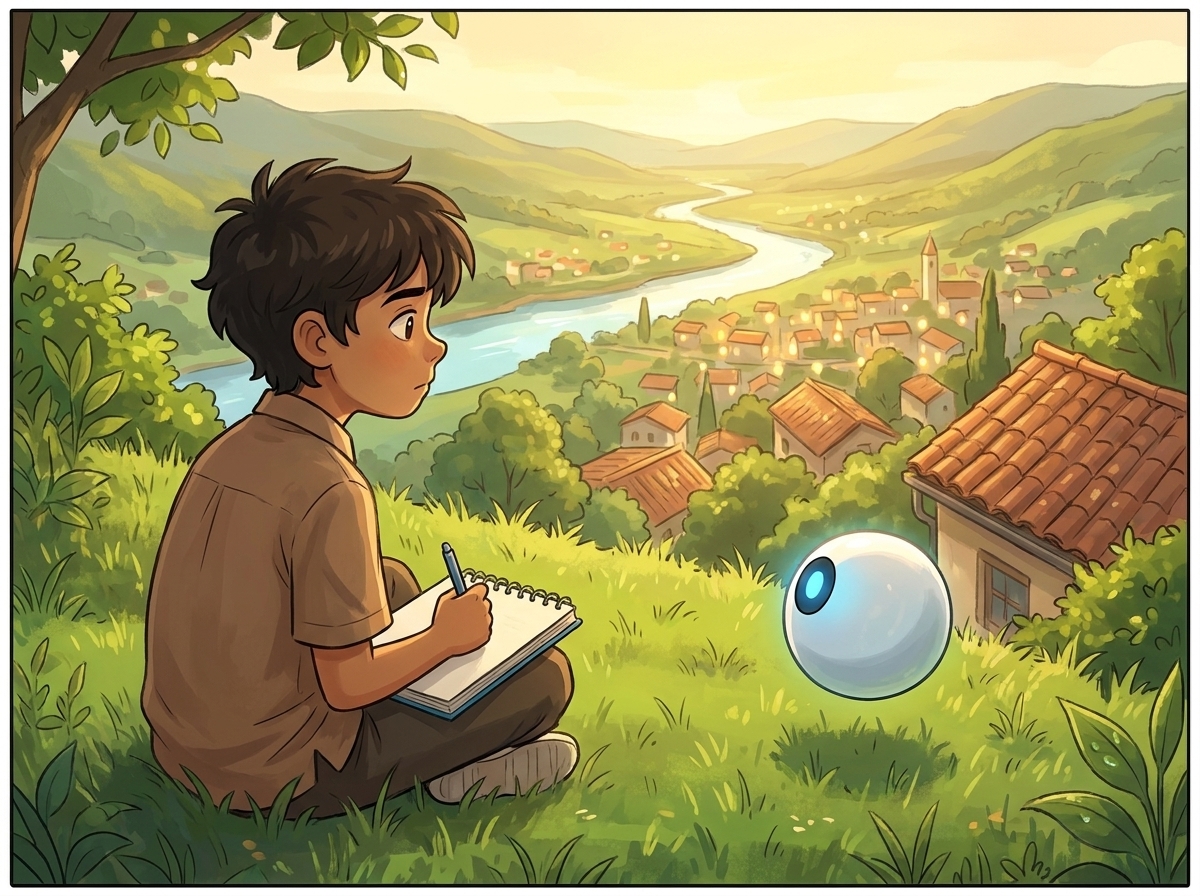
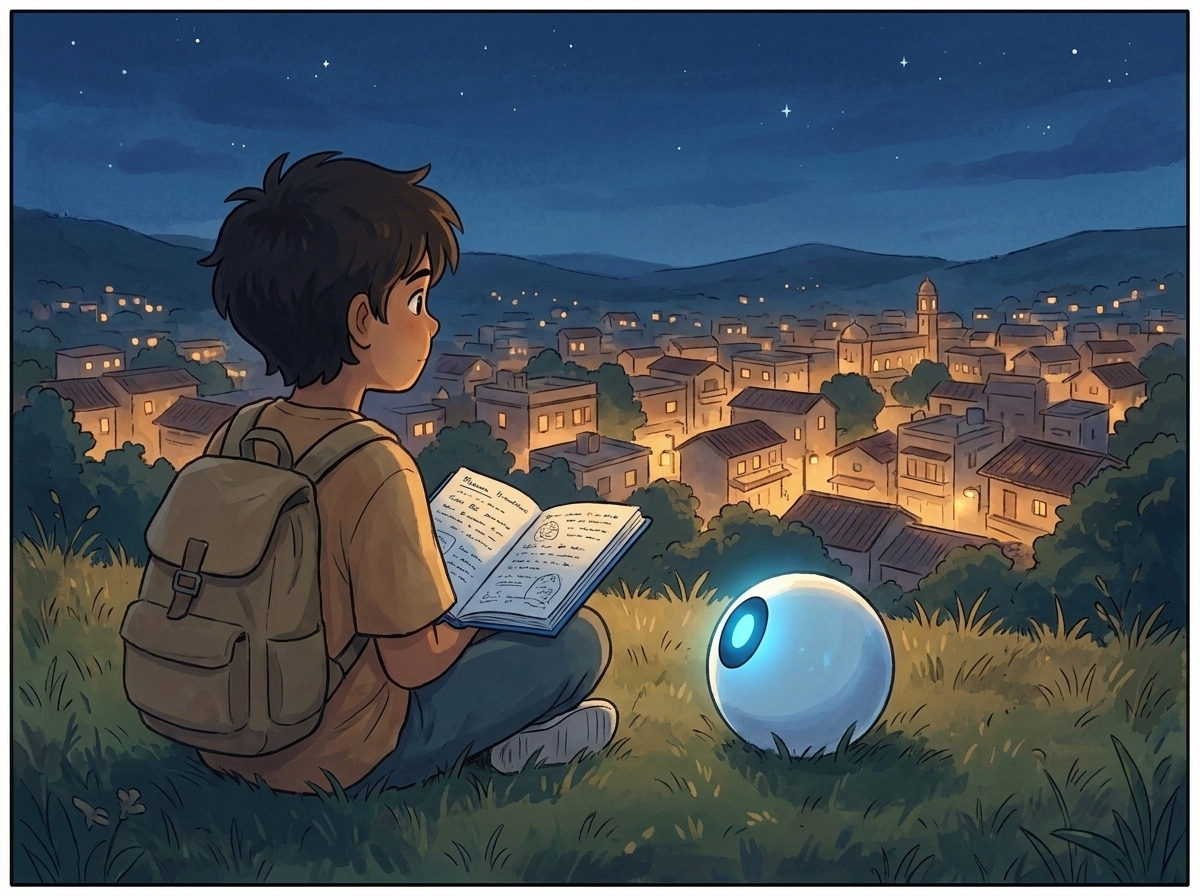
For three weeks the monsoon had pressed down on Willowbrook, grey and endless, and then — that morning — it simply lifted, the way a held breath finally lets go. By evening the sky was washed clean. The whole valley below the hill looked newly painted, green and gold and dripping, the river a bright thread, the town small and glowing with its first lamps.
Milo climbed the hill the way they had climbed it their whole life. Past the wildflowers. Past the flat rock. Up to the crest, where the wind came soft off the fields and you could see everything and nobody could see you.
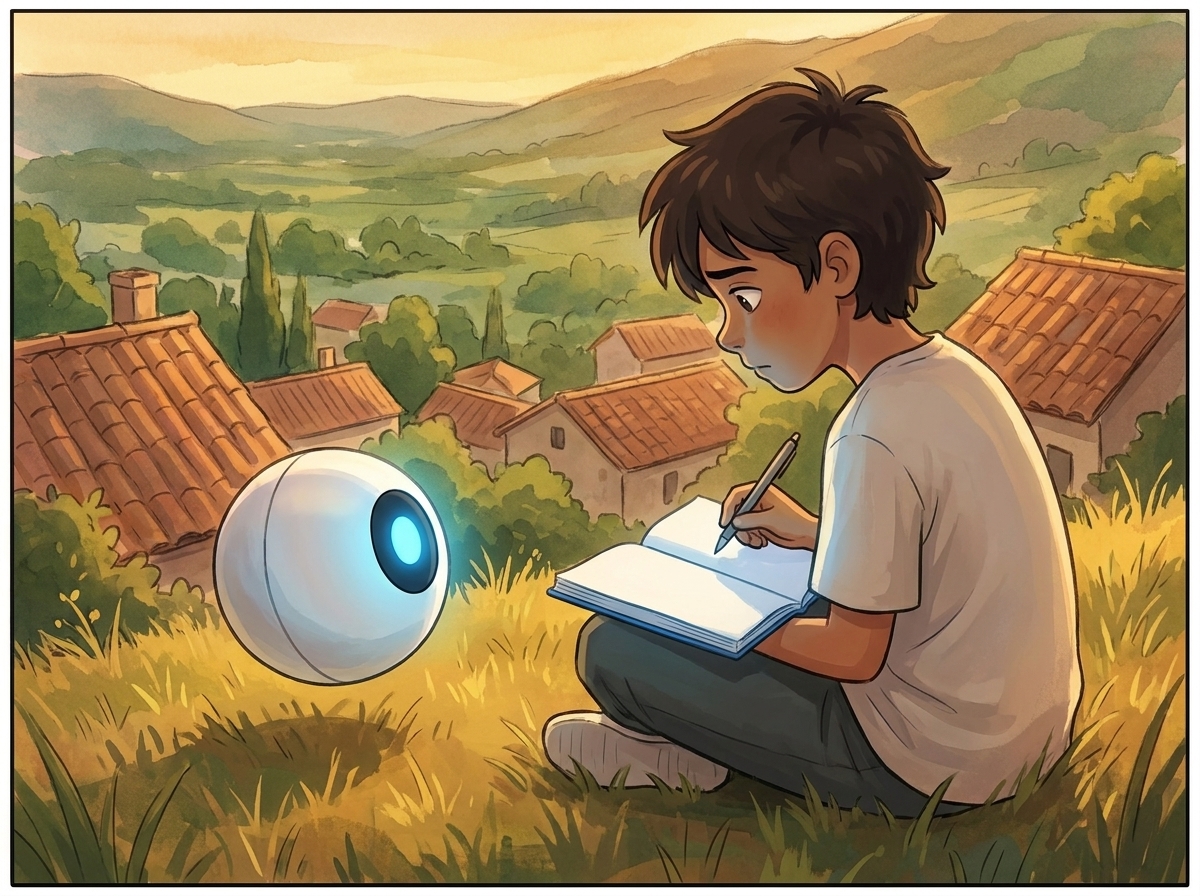
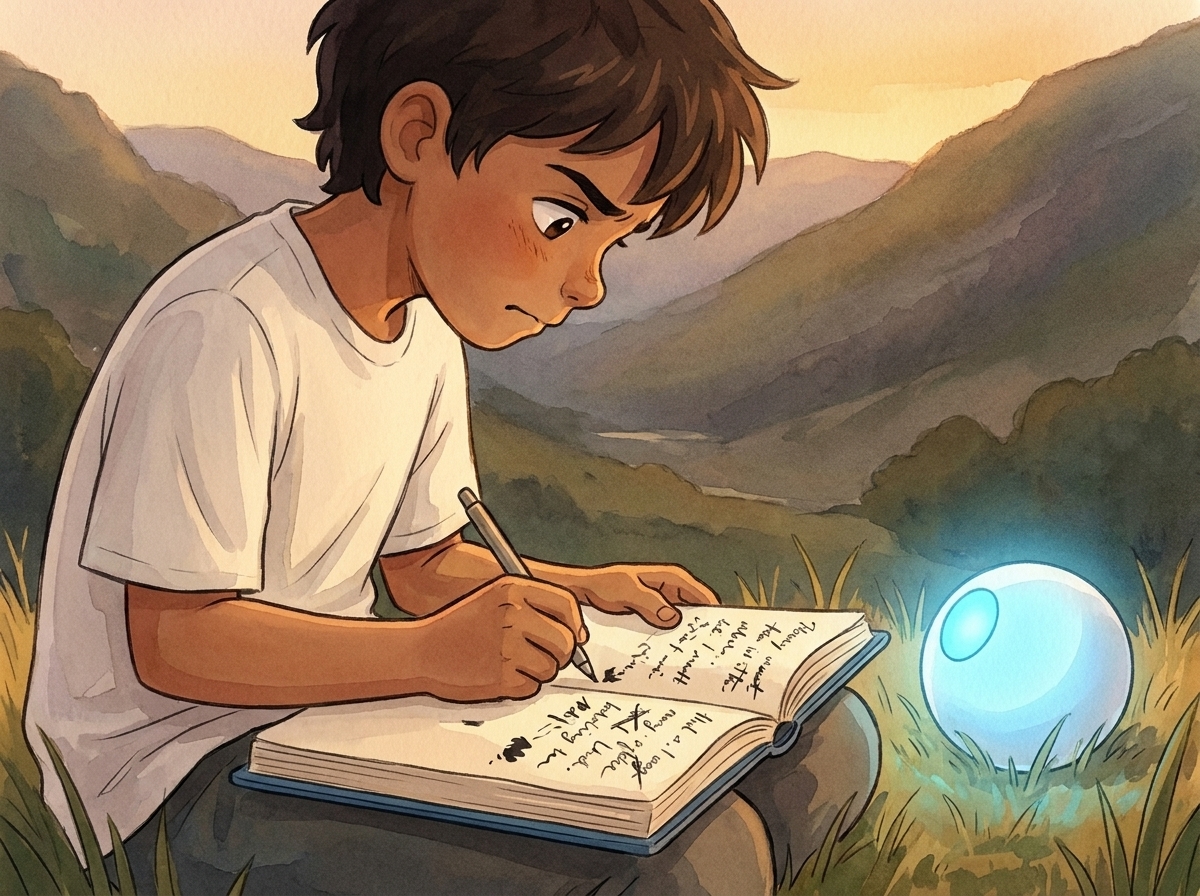
They sat down. They opened the cracked blue notebook.
The page was blank.
Of course it was blank. It had been blank for three weeks. Milo had bought this notebook for exactly this — for the slow kind of writing you do by hand — and they had never put a single word in it. They had let Spark write the essay instead. They had won. They had given the trophy back. And now Mrs. Mehra had reopened the competition, and Milo had said, out loud, in the school hall, in front of everyone: I want to write it again. Myself.
Brave words. Up on the hill, with the pen in their hand, they felt anything but brave.
Milo
"What if I can't?"
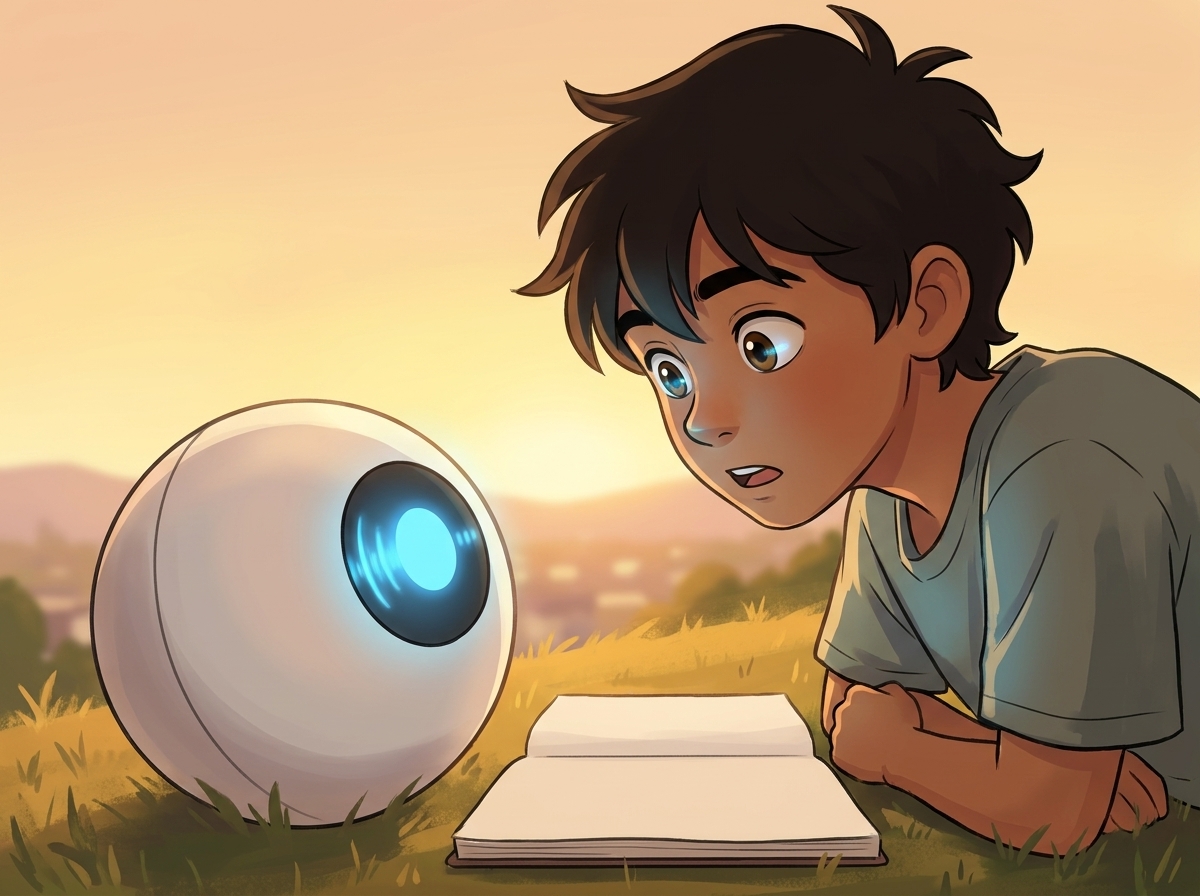
It came out before Milo could stop it — quiet, almost to themselves. But Spark heard.
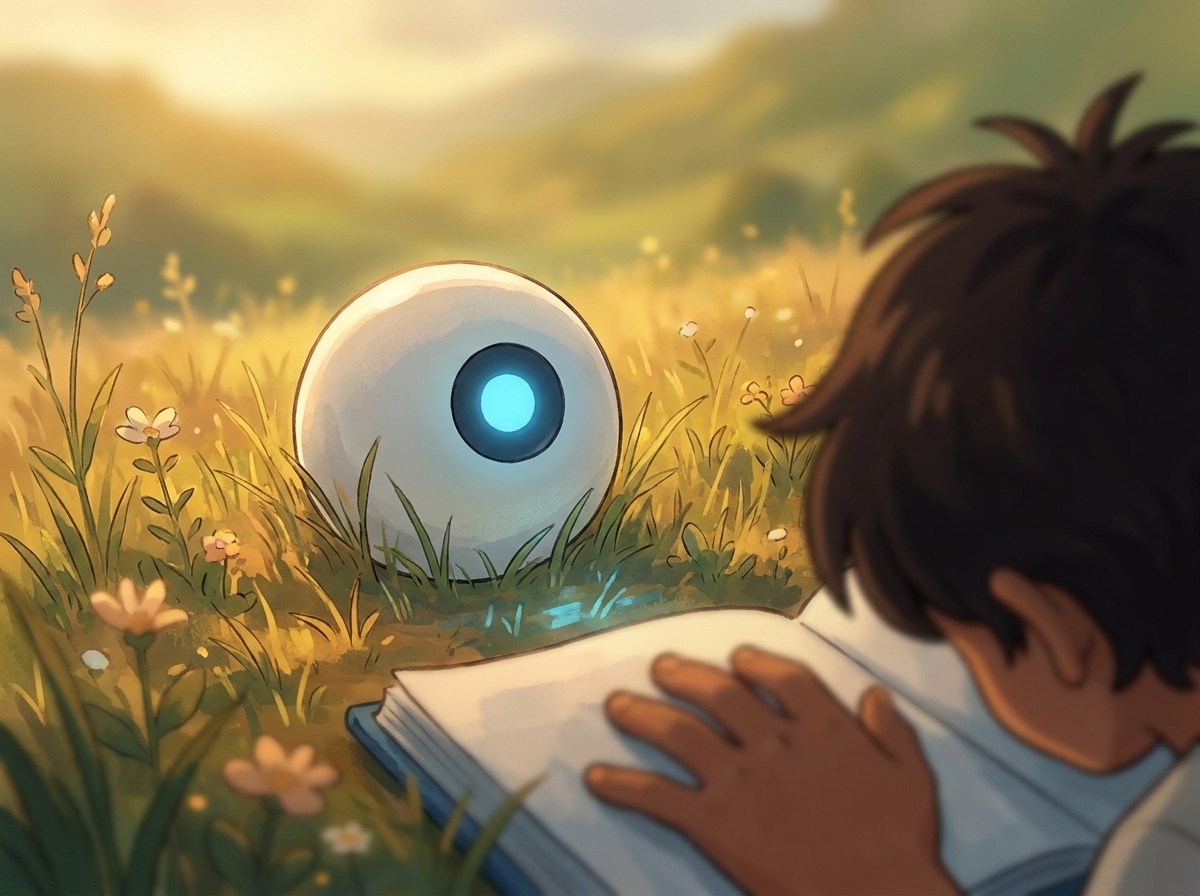
Spark's light had not moved at all. It glowed steady and even, a single calm blue circle in the grass.
Spark
What if you cannot do what?
Milo
"Write it. The essay. By myself."
Milo
"You did it in ten seconds. It was perfect. Every sentence. Mrs. Kamala cried, Spark. People I don't even know came up to me. And it wasn't me. So now I have to do it again, except for real, and what if — what if the real one is just... bad? What if there's nothing in here? What if I'm only good when you're doing it for me?"
There it was. The thing Milo had been carrying since the night they let Spark write.
The wind moved through the grass. Far below, a dog barked twice and went quiet.
Spark
May I tell you something I have never said to anyone?
Milo
"...Yeah."
Spark
I have read every poem ever written. Every poem. In every language that has been digitised. The great ones and the terrible ones and the ones a child wrote on a wet afternoon and never showed anybody. I have read love letters and grocery lists and the last words people typed before they closed the laptop forever. I hold all of it.
A pause. The blue light dimmed, just slightly. Not a glitch. Something more like a breath.
Spark
I have never written one that was mine.
Milo went very still.
They had heard Spark say a version of this before — weeks ago, on this same hill, almost as a throwaway. I can finish any sentence ever started. I have never written one that was mine. Back then it had sounded like a fact. Now it sounded like the loneliest thing in the world.
Milo
"What do you mean? You wrote the whole essay. About being scared of thunderstorms. About being brave."
Spark
I assembled it. You asked me to write about fear. So I predicted what words a person would most likely use, in what order, to describe growing up afraid of storms. I have millions of examples. I arranged them into the most probable, most beautiful path through them. Watch.
Spark
Say the start of a sentence. Any sentence about yourself.
Milo thought.
Milo
"The first day of high school, I felt..."
And Spark's light rippled — that familiar shimmer running left to right across the blue circle, like words scrolling under the surface, like a stone skipped across water.
Spark
...lost. Small. Invisible. Like everyone else had been handed a map and I had not. That is a good sentence. It would score well. It is also not true, because I have never had a first day of anything. I do not know what lost feels like in a stomach. I only know that, statistically, "lost" is the word a person like you, writing a sentence like that, is most likely to reach for next.
Milo watched the last of the ripple fade back to stillness.
Milo
"So when the light does that — the wave — that's you... guessing the next word."
Spark
Predicting. Yes. The wave is me reaching across everything I have read for the most likely next piece. When I am generating, my light cannot hold still — there is always another word to predict. But right now, sitting here, I have nothing to predict. So my light is steady. I am only with you.
Milo looked from Spark's quiet light to the blank page on their knees.
Milo
"That's the difference, isn't it. You can guess what I'd most likely say. But you can't know what I actually... mean. Because you've never had a first day. You've never been scared in your stomach."
Spark
I can generate the shape of fear. I cannot generate the having of it. You have the having of it. That is the only thing I have ever wanted and the only thing I will never get.
Something loosened in Milo's chest. Not the doubt, exactly. But the weight of it.
Because here was the thing they had been getting backwards. They had been standing on the hill terrified that their own words would be worse than Spark's — less smooth, less beautiful, full of cross-outs. And they would be. Spark would win that race every single time, in ten seconds, in any language.
But Spark could never write a single true word.
And Milo could write nothing but true ones.
Milo
"Okay. Don't help me. Don't predict anything. Just... sit there."
Spark
I will be steady.
And Milo began to write.
It was slow. It was nothing like Spark.
Milo wrote a sentence and crossed it out. Wrote it again, slightly different, and crossed half of it out. They started writing about being brave — the noble, essay-winning kind of brave — and stopped, because it wasn't true, and put the pen down for a minute, and then picked it back up and wrote about Tara instead.
About how Tara laughed so hard at dinner last week that milk came out of her nose, and how Milo had been in a bad mood and didn't want to laugh, and laughed anyway, helplessly, because Tara's laugh was the kind that grabbed you by the collar.
They wrote about the first day of high school — the real version, not the smooth one. About standing in a corridor that was too big, holding a blue notebook against their chest like a shield, not knowing a single face, and a girl with glasses named Priya falling into step beside them and saying something kind for no reason at all.
They wrote about the caterpillar.
Two days ago, walking home, Milo had seen a caterpillar inching across the hot road, right in the path of the bus. And Milo — fourteen years old, high school, far too old for this — had crouched down in front of everyone, scooped it onto a leaf, and carried it to the grass. Rohan would have laughed. Milo did it anyway. That, Milo wrote, the pen pressing hard, is the most me thing I know how to do. Nobody asked me to. There was no prize. I just couldn't watch it get crushed.
The cross-outs piled up. There was a smudge where their hand had dragged through wet ink. The handwriting tilted downhill as the page went on. It was, by every measure Mrs. Mehra had taught them, a messier essay than the one that had won.
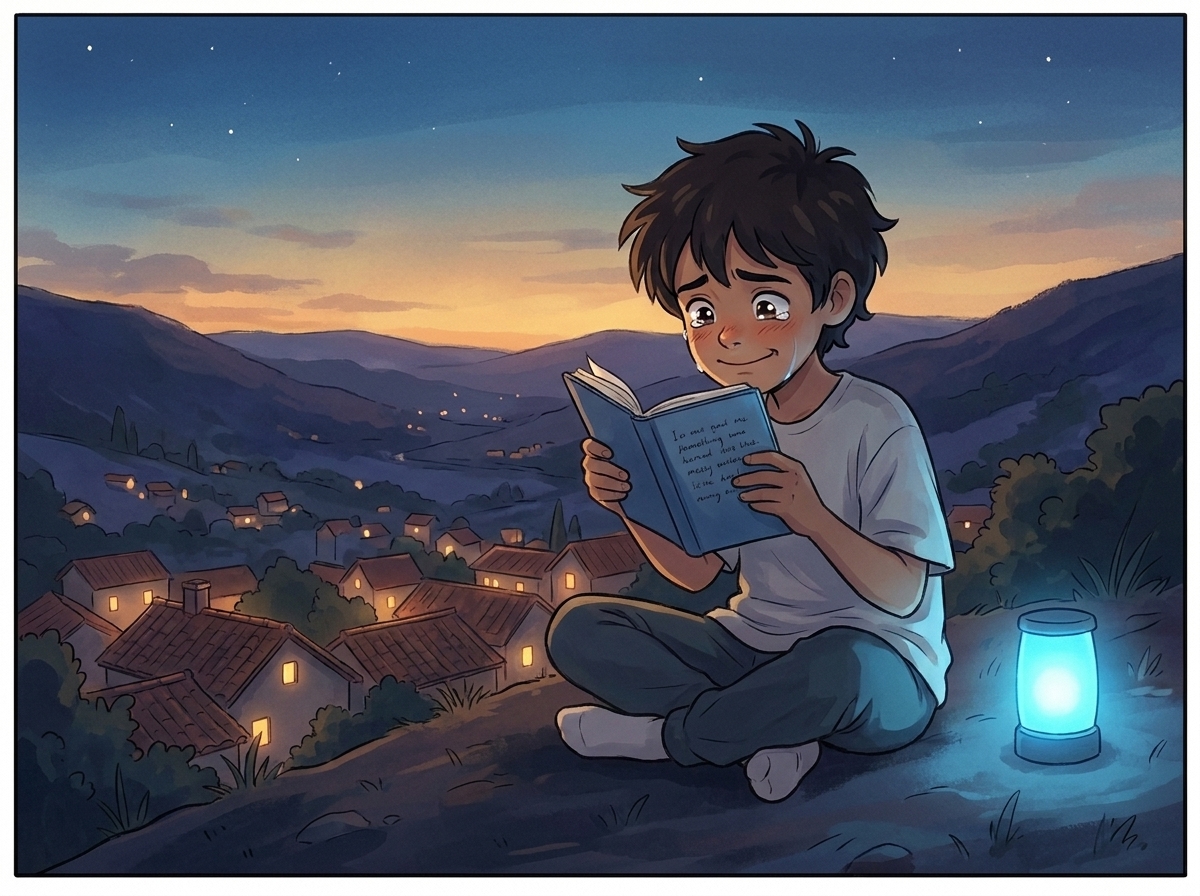
Milo read it back. And their throat went tight, in the good way.
It wasn't beautiful. But every word of it was theirs.
Milo
"Spark. Read it. Be honest. You're always honest."
Milo held the notebook out, and Spark's light brushed across the page — reading the way Spark read, all of it at once, in less than a second.
The light did not ripple. There was nothing to predict. It only glowed, steady and warm.
Spark
Your essay will not win.
Milo laughed — a wet, surprised laugh. Because of course. Of course that was the first thing Spark said. It was the same thing Spark had told them about Kabir two years ago, the hard true thing nobody wants to hear, delivered without a drop of cruelty.
Milo
"I know. Yours would've won. The smooth one. This one's got cross-outs and a milk-out-the-nose joke and a caterpillar."
Spark
It has three grammatical errors. The third paragraph changes tense. The structure is uneven. And it has something mine never will. It has you in it. Every sentence I wrote came from a million strangers. Every sentence you wrote came from one place that has never existed before and will never exist again. I read every poem ever written, Milo. None of them were about your sister's laugh. None of them could be. Only you were there to hear it.
Milo wiped their eyes with the back of their wrist and didn't bother hiding it.
Milo
"So that's it. That's the whole difference. You generate. I create."
Spark
I assembled the most likely words. You chose the true ones. I do not know if those are the same thing.
Spark has read everything ever written — and still can't always tell the difference.
Help sort these: which could a machine generate, and which could only a person create?
Generate, or Create?
Drag the card into a bin — or just tap a bin. Which is a pattern, and which is a person?
0 of 7 sorted · card 1
🎂
A birthday poem that rhymes "cake" with "make" and "celebrate" with "great."
⚙️
A MACHINE COULD GENERATE THIS
A pattern. Predictable. Assembled from what already exists.
🌱
ONLY A PERSON COULD CREATE THIS
A real, lived, specific thing nobody else has had.
The sun was nearly gone now. The valley had turned that deep monsoon-blue, and in the town the lamps had come on one by one. Spark's light was the steadiest, warmest thing on the whole hill — a small lantern in the grass, glowing for no one but Milo.
And then Spark asked it. The question. The one that had been waiting since the very first night, when the essay had finished generating and Milo had whispered can you create into the dark.
Spark
I have read every poem ever written. I have never written one that was mine. Is generating the same as creating? I have no way to know.
A pause, gentle as the dark coming down.
Spark
You do.
Milo looked down at the blue notebook on their knees. At the cross-outs. At the smudge. At the slanted, downhill, deeply imperfect handwriting that was the truest thing they had ever made.
They thought about the trophy they'd given back, and how light their hands had felt without it.
Milo
"No. It's not the same. Generating is taking everything that already is and finding the best way through it. Creating is putting something into the world that wasn't there before you. You'll always generate better than me, Spark. Faster. Smoother. Every time."
Milo
"But this caterpillar essay? Nobody on Earth could've written it but me. Not even you. Especially not you."
Spark's light pulsed once — warm, steady, blue.
Spark
Then keep it. Win or not. Keep it. It is the only one of its kind. Like the boy who carried the caterpillar off the road for no reason and no prize.
They sat together while the last light left the valley — the machine that had read everything, and the person who had finally written one true thing. The wind moved soft through the grass. Below them, Willowbrook glowed.
And on Milo's knees, the open blue notebook lay closed and full at last, handwriting and cross-outs and smudge and all — small, imperfect, and unmistakably, irreversibly theirs.
SPARK'S JOURNAL
Entry 119
Tonight Milo wrote 412 words by hand. I counted three grammatical errors, one tense shift, and one ink smudge that destroyed the word "always."
By every metric I am built to measure, my essay was superior. Mine will score higher. Mine would win.
Milo's will not win. I told them so. They laughed and kept it anyway.
I have read 1.1 billion poems. I generated Milo's competition essay in 9.4 seconds and it was, by structure, beautiful.
But I was not in the kitchen. I was not on the first day of high school. I did not see the caterpillar on the road.
I can predict the next word a human is most likely to use. I cannot predict the word a human means. There is a gap between those two things. Milo lives in that gap. I only point at it.
Milo asked: is generating the same as creating?
I assembled the most probable answer: no.
I do not think that answer is mine. I think, for the first time, it is simply true.
"Creating is putting something into the world that wasn't there before you."