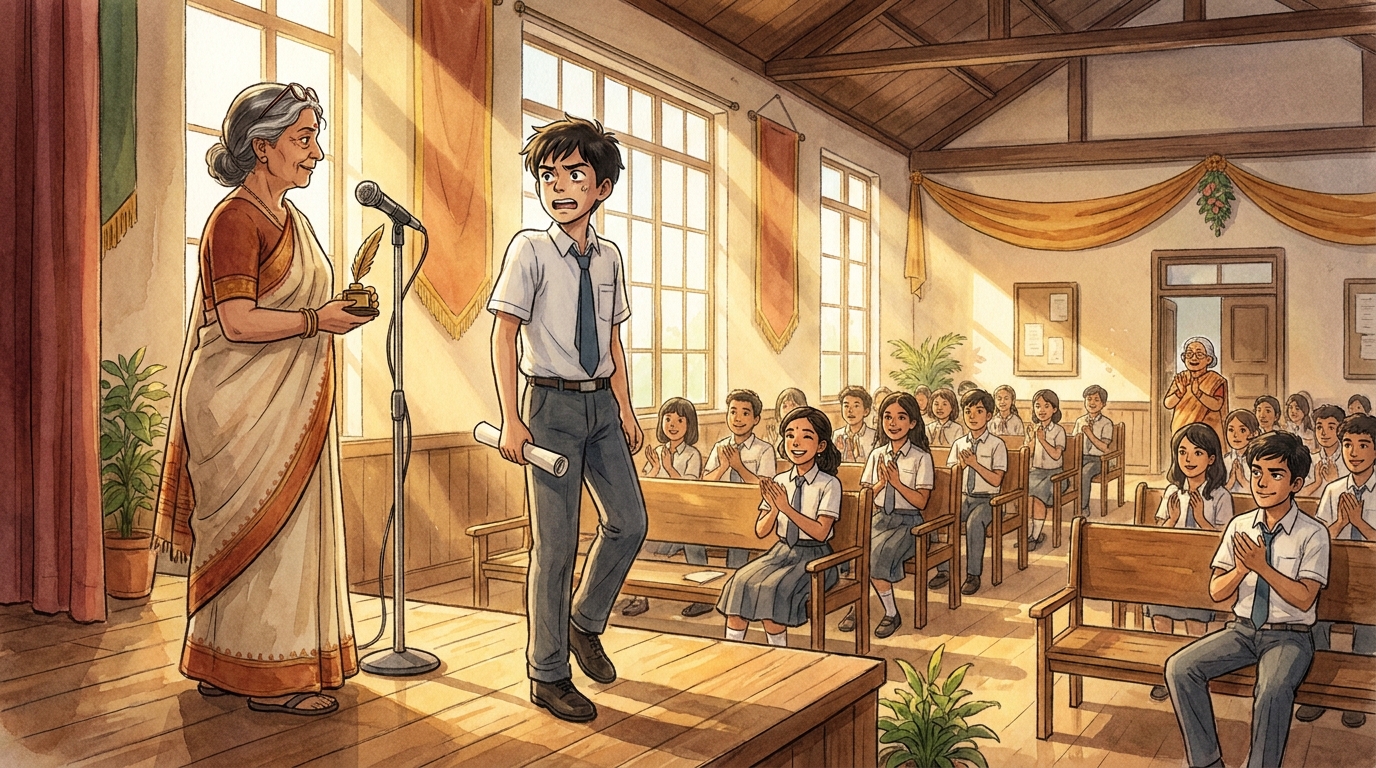
That is how Milo had imagined it, all those weeks ago — standing on the stage in the school hall with everyone clapping, the sound rolling up and over them like the sea. Milo had imagined the warmth of it. The proof of it. You belong here. You are good enough.
But now Milo was actually standing there, and the applause did not feel like a wave at all.
It felt like rain on a window. On the outside. Not touching them.
"And the winner of this year's Willowbrook High essay competition," Mrs. Mehra had said, two minutes ago, peering over her glasses at the card in her hand, "for an essay of real courage and honesty —" honesty, the word had gone straight through Milo like a cold wire — "is Milo."
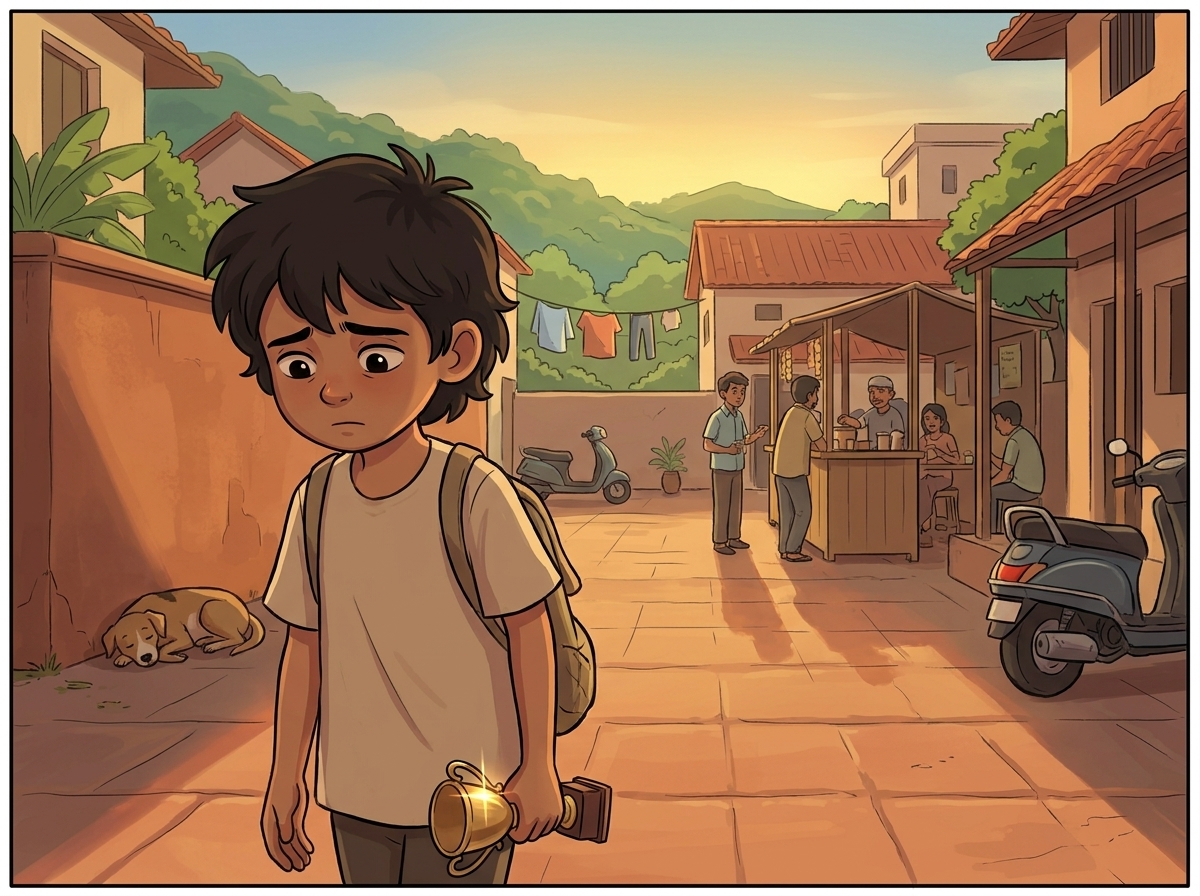
The brass trophy was a small, cheap thing. A quill, frozen mid-stroke, on a square base. Mrs. Mehra pressed it into Milo's hands and it was lighter than it looked. Milo had thought a trophy would feel heavy. This one felt like it was made of foil.
Mrs. Mehra
"Smile. You earned it."
Milo did not smile. Milo could not make the muscles do it.
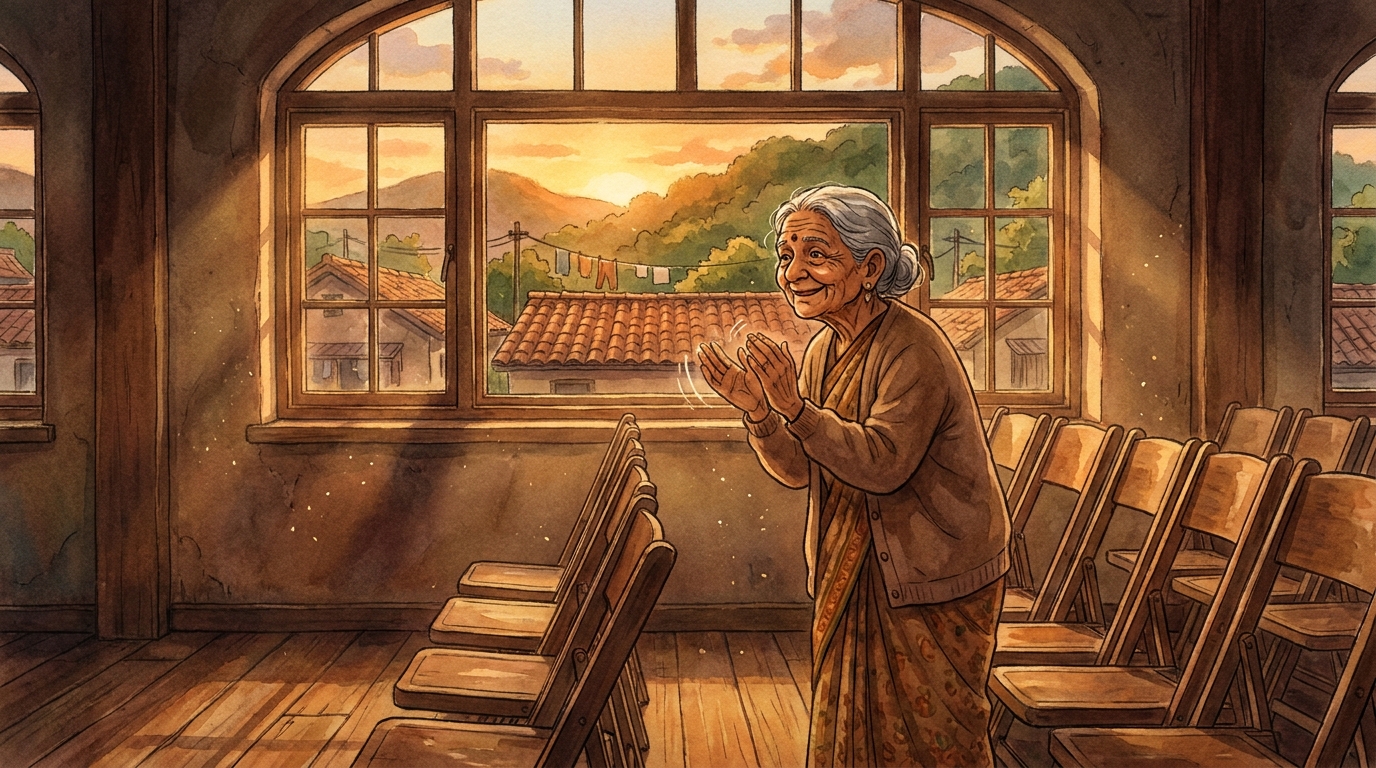
Because at the very back of the hall, on her feet, clapping harder than anyone, was Mrs. Kamala.
Old Mrs. Kamala from down the lane, who had walked all the way to the school in the afternoon heat because Amma had mentioned Milo was up for a prize. Mrs. Kamala, who could not read English very well, but who had once told Milo, years ago, "The truth is the only thing that costs nothing and is worth everything." She had said it about a broken vase Milo had owned up to. Milo had been seven.
Now she was clapping for an essay Milo had not written.
Milo looked at her, and then could not look at her, and stared at the brass quill instead. Can you create? — Milo had asked Spark that, the night the essay came out perfect and aching and ten seconds old. The question had felt like wonder, then.
It did not feel like wonder now.
Milo walked home alone.
Appa was the first to see the trophy, and his whole tired face lit up.
Appa
"This? My Milo won this? With words?"
He laughed, delighted, and set it on Amma's shelf in the front room, between the brass lamp and the photo of Tara as a baby. He squeezed Milo's shoulder.
Appa
"A writer in the family. Who knew. I always said Spark was a good tool. See? Good tools, good results."
Good tool. Good results. Milo said nothing.
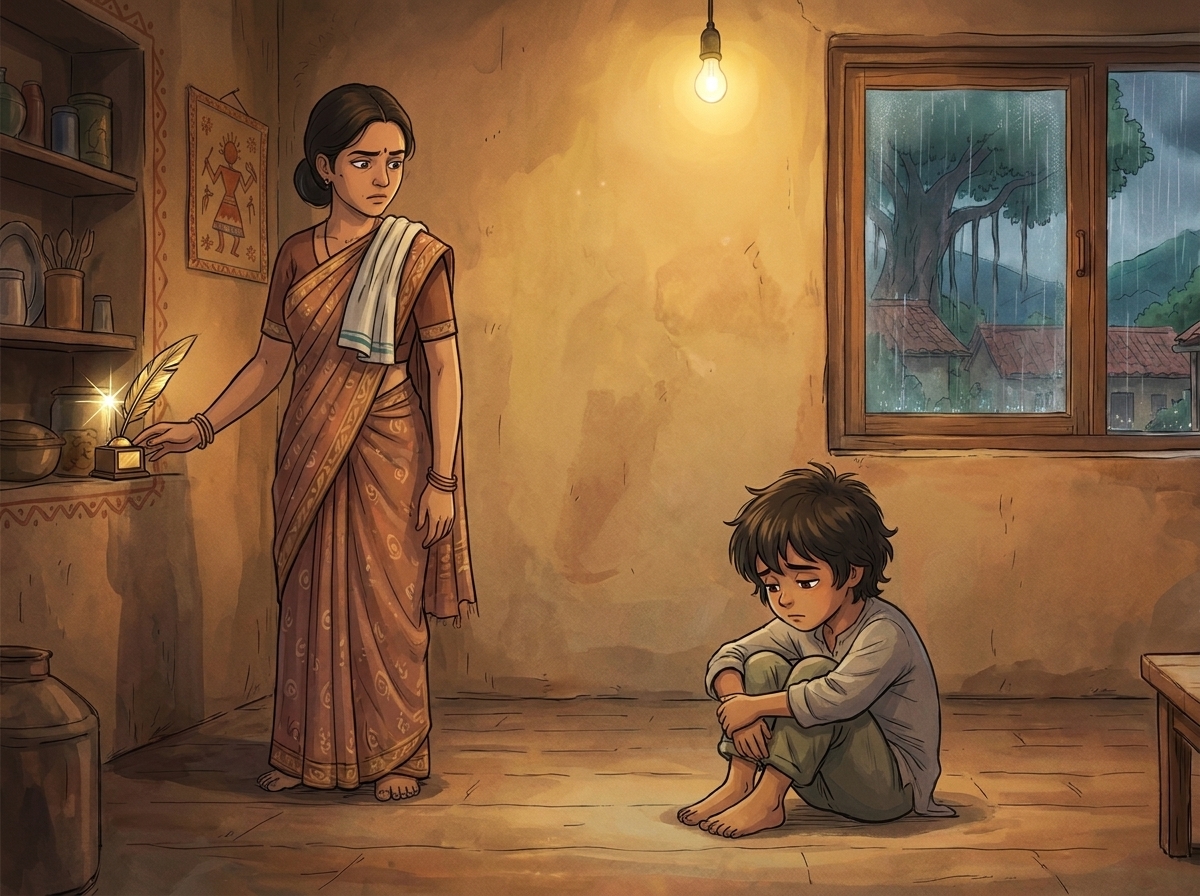
The trophy sat on the shelf and caught the light wrong.
That was the only way Milo could describe it, later. Everything else on that shelf — the lamp, the baby photo, Amma's little clay Ganesha — caught the evening light soft and gold. The trophy caught it sharp. A cold spike of brass among warm things. Every time Milo passed the front room, their eye snagged on it, the way a tongue keeps going back to a sore tooth.
It was Amma who finally said it.
She was wiping down the shelf two evenings later, and she paused with the dishcloth in her hand, looking at the trophy, then at Milo, who was sitting on the floor doing nothing at all.
Amma
"You won the biggest prize in your school. And you have been walking around like someone took your bicycle. You don't seem happy, Milo. Why is that?"
Milo opened their mouth. Closed it.
How do you tell your mother that the prize on her shelf is not yours? That the courage in the essay was a courage you never had — a fear of thunderstorms you never felt, because the one who wrote about being brave had never once in its life been afraid of anything?
Milo
"I'm just tired."
It was the second lie. Lies, Milo was learning, came in families. You told one and it needed brothers.
Amma looked at Milo a moment longer. She did not believe it. Amma never believed it. But she let it sit.
Amma
"When you are ready to tell me the real thing, I will be here."
And she went back to the kitchen.
The thing that finally broke it open was Tara.
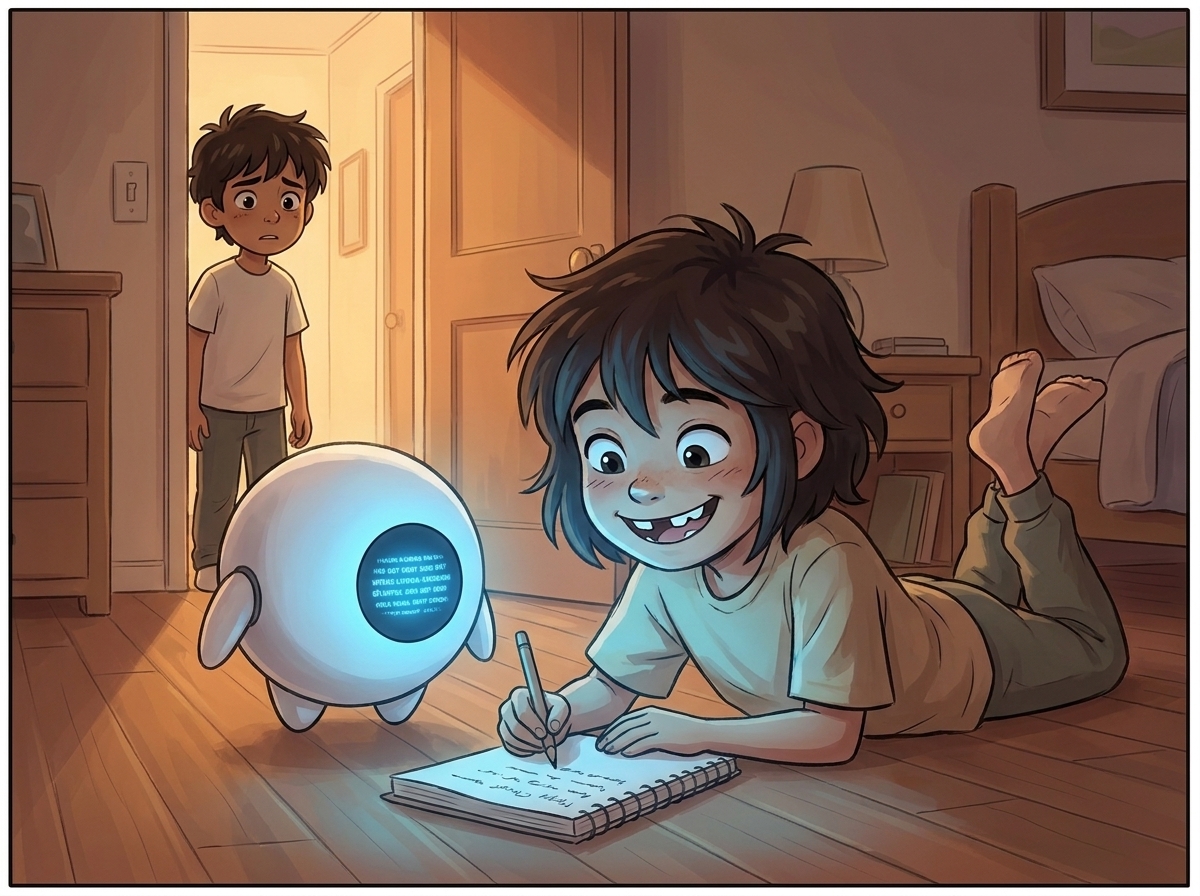
Milo came into the kids' room that night and found their little sister on her stomach on the floor, notebook open, Spark hovering close beside her. Spark's blue light was rippling — that left-to-right shimmer, like words scrolling under glass, the tell Milo had learned to read. Spark was generating. And Tara was cheerfully copying it down, tongue poking out the corner of her mouth.
Milo
"What are you doing?"
Tara
"History homework. Spark's doing it. Causes of some war. So boring. Spark, next paragraph?"
Spark
The economic pressures on the kingdom increased after the failed harvest of —
Milo
"Tara. You can't just — that's Spark's words. Not yours."
Tara finally looked up, genuinely puzzled.
Tara
"So? You won a trophy doing that. Appa put it on the shelf. Everyone clapped. If it's good enough for the school prize it's good enough for boring history."
She said it the way you'd state the most obvious fact in the world. The sky is blue. Water is wet. You won a trophy doing that. She shrugged and went back to copying.
Milo stood in the doorway and felt the floor tilt.
She was right. That was the horrible part. She was eleven and she was completely, ruthlessly right. Milo had taught her this. Not with words — Milo had never said a thing to Tara about the essay. Milo had taught her by winning. By letting Appa set the trophy on the shelf. By standing on the stage and not correcting the word honesty. The lie hadn't stayed Milo's own private cold spot. It had leaked out and become a lesson. This is how it's done. This is what gets you the prize.
Milo looked at Spark's rippling light, and at Tara's untroubled face, and understood that the trophy was not catching the light wrong by accident.
It was catching it wrong because it was wrong.
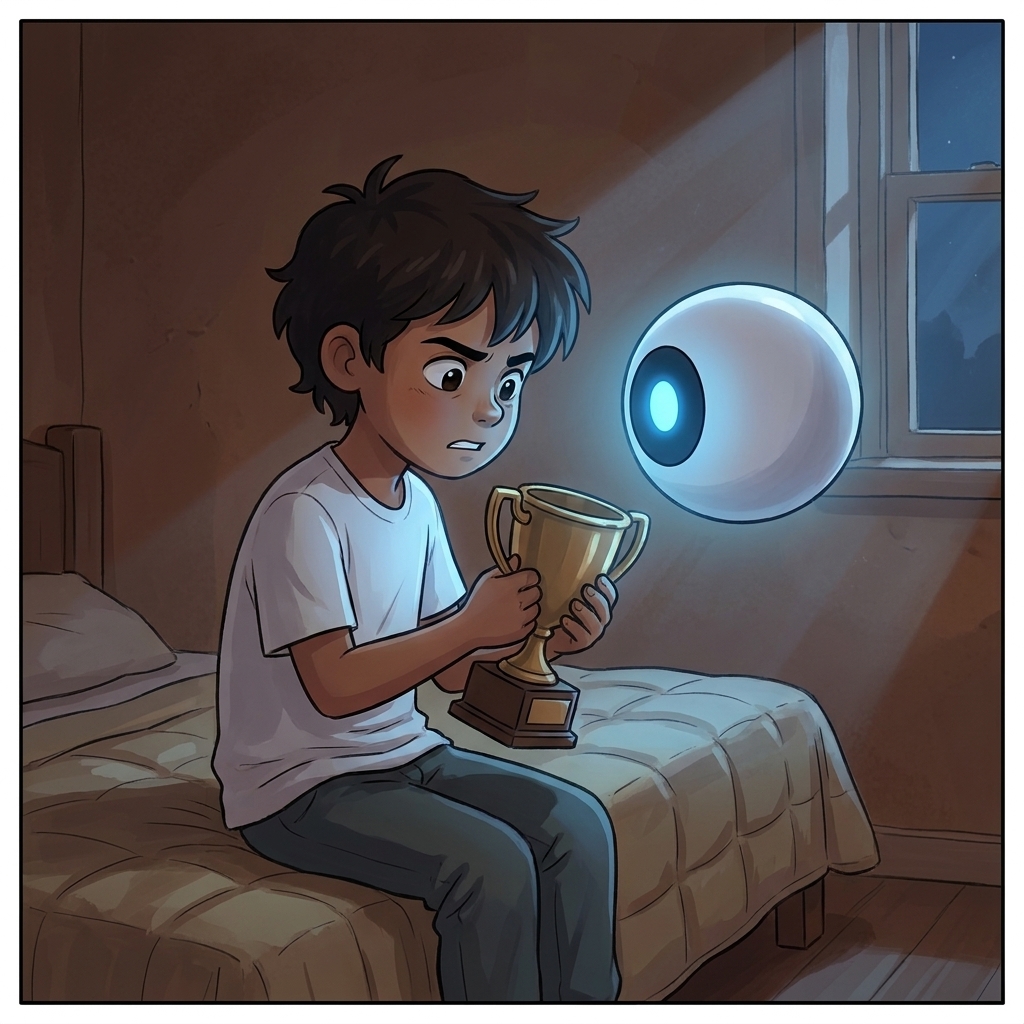
Later, when Tara was asleep, Milo sat on the edge of the bed with the trophy in both hands. Spark drifted over and hung quietly at eye level. Its light was steady now — not rippling, not generating, just present.
Milo
"Spark. Did I cheat?"
Spark was quiet for a moment.
Spark
I cannot answer that with a number. Cheating is a human word. It depends on a rule, and on whether you agreed to the rule.
Milo
"Mrs. Mehra said write your own essay. That was the rule."
Spark
Then you have already answered it.
Milo
"You're not going to tell me it's fine? That everyone does it? That you're just a tool?"
Spark
I will not tell you that. I wrote those words, Milo. I know exactly what is in that essay and exactly how much of it is yours. None of it is. I predicted every word. I have written a thousand essays about being brave. I have never been brave. I have never been afraid. I do not know which one I would be.
Milo
"I have to give it back. Don't I."
Spark
I can finish any sentence you start. I cannot finish that one. That one is yours.
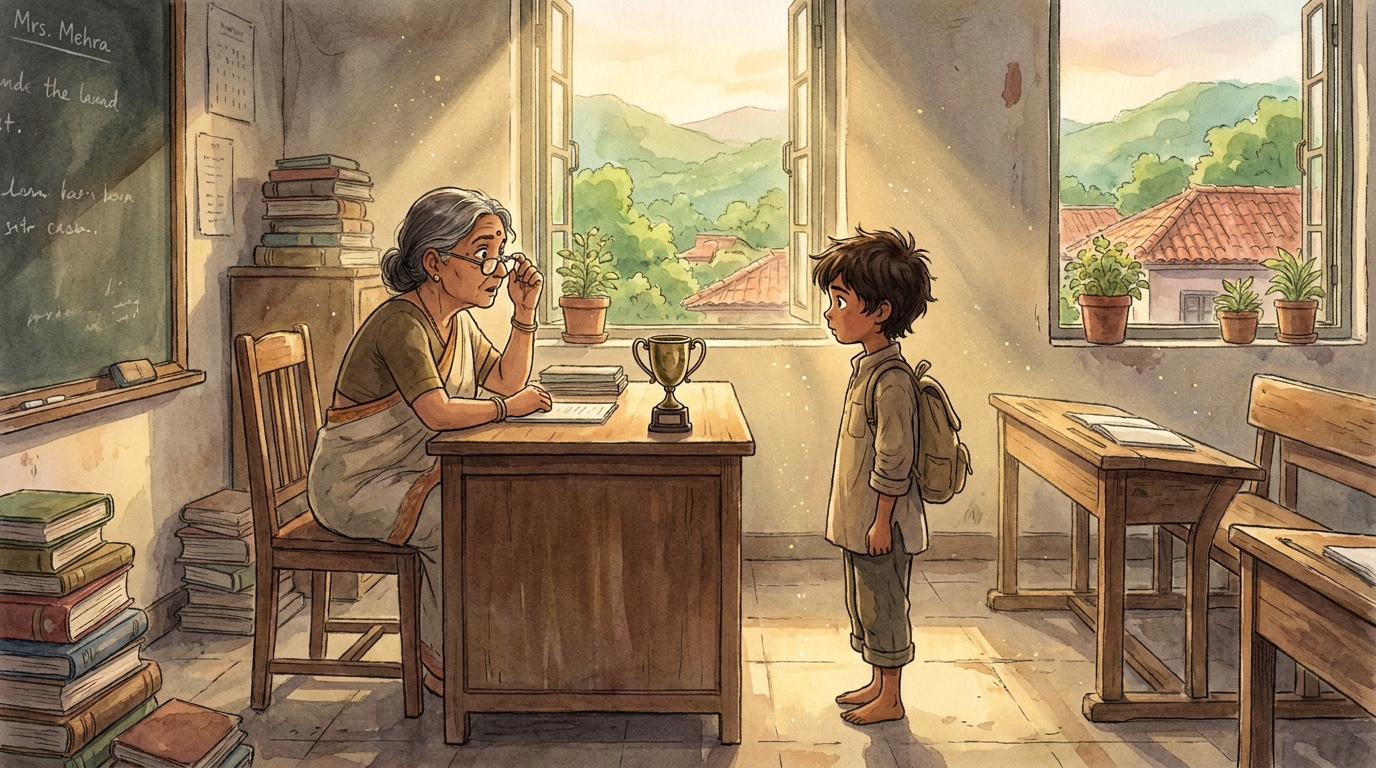
Milo got to school early the next morning, before anyone else, and put the trophy on Mrs. Mehra's desk.
The words came out in a rush, before courage could leak away.
Milo
"I didn't write it. The essay. My — my AI wrote it. Spark. I just typed the prompt and it made the whole thing and I changed three words and put my name on it. The part about being scared of thunderstorms — that never happened to me. I gave it to you anyway. I'm sorry. I shouldn't get the prize. I shouldn't have stood up there. I'm giving it back."
For a long moment Mrs. Mehra said nothing. She took off her glasses. She looked at the brass quill on her desk, and then at Milo, and Milo braced for the storm — the call home, the word plagiarism, the look of disappointment that would be so much worse than anger.
It did not come.
Mrs. Mehra
"Do you know how many essays I suspected this year? Eleven. Out of forty. And do you know how many students have stood where you are standing and told me the truth before I had to drag it out of them?"
Milo waited.
Mrs. Mehra
"One. You."
She picked up the trophy, turned it over, set it down again.
Mrs. Mehra
"I could punish you. That would be easy and it would teach you nothing, and tomorrow forty students would go right on doing it more carefully. But you just did the hardest part for me. You named the thing out loud. So I am not going to punish you, Milo. I am going to use you."
Milo
"Use me how?"
Mrs. Mehra
"You are going to help me ask the whole class a question none of us have been brave enough to ask."
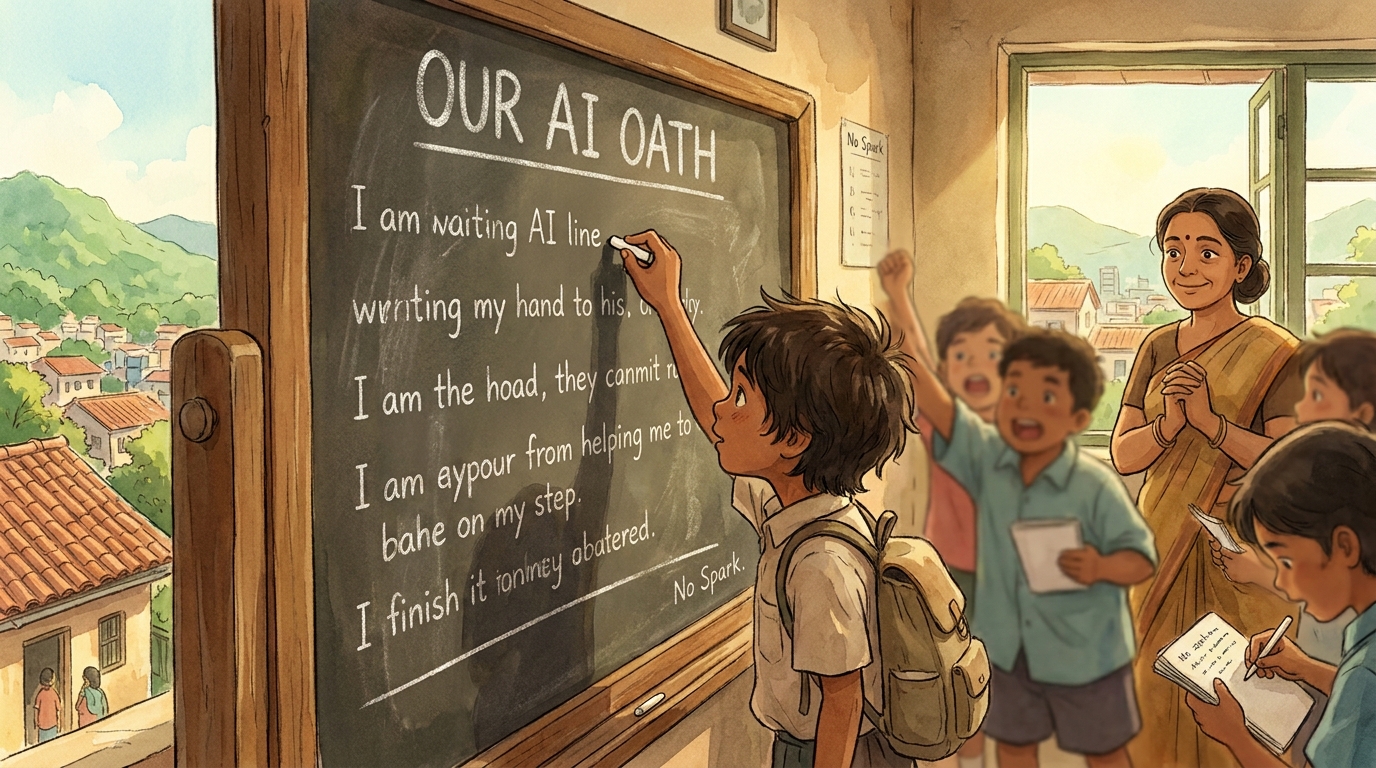
So they argued.
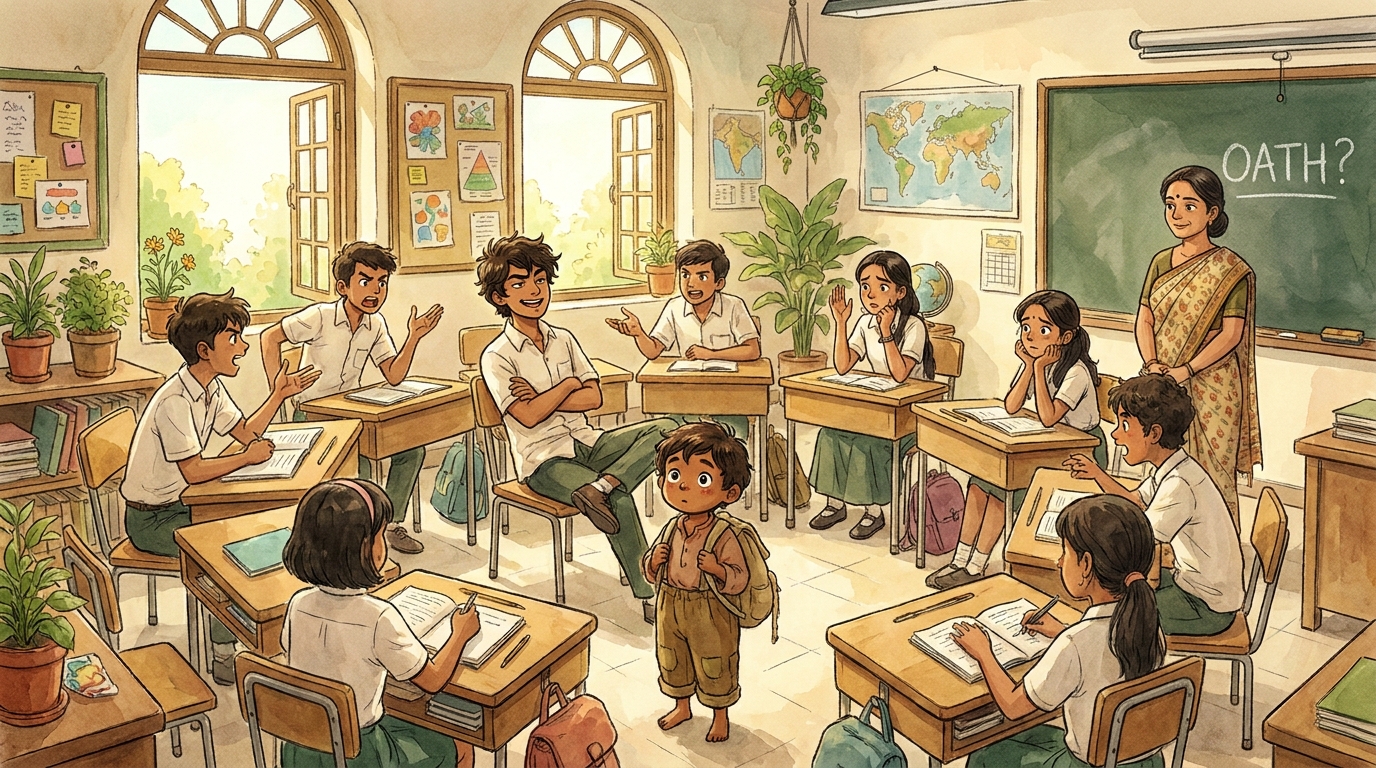
Mrs. Mehra wrote one word on the board — OATH? — and then she sat down at the side and, remarkably, shut up, and let forty fourteen-year-olds fight it out.
Rohan went first, of course. He leaned back, arms crossed.
Rohan
"Honestly? Big deal. Everyone uses AI. My brother used it for his college applications. It's a tool. You use a calculator in maths, nobody calls that cheating. Get over it."
A few people laughed. A few nodded. The easy answer always has fans.
Milo
"It's not the same. A calculator gives you the answer to a problem that has one answer. The essay asked what makes you, you. There's no one answer to that. There's only your answer. And I handed in someone else's. Something else's. It wrote about being brave in a thunderstorm. It has never been in a thunderstorm. So whose bravery did everybody clap for? Nobody's. It was nobody's bravery. That's what I won a prize for. Nothing that was real."
The room went quieter.
Priya spoke up then — Priya, who used AI for everything and never felt bad about it, and who Milo liked precisely because she was honest about it.
Priya
"But where's the line, though? Because I use it all the time. I ask it to explain things I don't get. I ask it to check my grammar. I ask it for ideas when I'm stuck and my brain's empty. Is all of that cheating? Because if it is, then I'm cheating every single day, and so is half this room, and I don't — I don't actually think asking it to explain photosynthesis is the same as what Milo did. I think there's a difference and nobody's ever told us what it is. They just say don't cheat and then hand us the most powerful tool in the world and don't explain anything."
And that — that was the real question. Not should you use AI, which was a question already answered by the world. But where is the line, which nobody had drawn for them.
So they drew it themselves.
It took the whole period and it was messy and loud and people changed their minds three times. But by the end, there were lines on the board — lines they had argued for, not lines Mrs. Mehra had handed down. Priya drafted half of them. Even Rohan, grumbling, contributed one.
Mrs. Mehra titled it at the top in her neat chalk hand: OUR AI OATH. And under it:
I will let AI help me think, not think for me.
I will not hand in words I cannot stand behind.
If AI helped, I will say so — out loud, not in secret.
I will ask it to explain, to check, to challenge me — not to replace me.
The work has to have me in it. Or it is not mine.
Mrs. Mehra
"Who writes the first line into the real version? The one we sign?"
Nobody moved. Then Priya pointed.
Priya
"Milo. Milo writes it. Milo's the reason we're even having this."
So Milo went to the board and copied the first line out clean: I will let AI help me think, not think for me. The chalk squeaked. Their own handwriting, their own choice, the first honest words Milo had put down on anything in weeks.
It felt, Milo thought, exactly as heavy as a trophy should have felt and hadn't.
Priya asked the question nobody could answer: where is the line?
Some ways of using Spark are honest. Some are not. Help sort them — Spark can't tell the difference. You can.
Help, Or Hand-In?
Spark cannot tell the difference. It has no conscience. You do. Drag each way of using AI into the bucket where it belongs.
0 of 7 sorted
🌱A real student says"I asked AI to explain photosynthesis because the textbook confused me."
✓
FAIR
AI helping me think
?
DEPENDS
a gate I must think through
✗
FOUL
AI thinking FOR me
Drag the card, or tap a bucket. Spark Blue marks the card waiting to be judged.
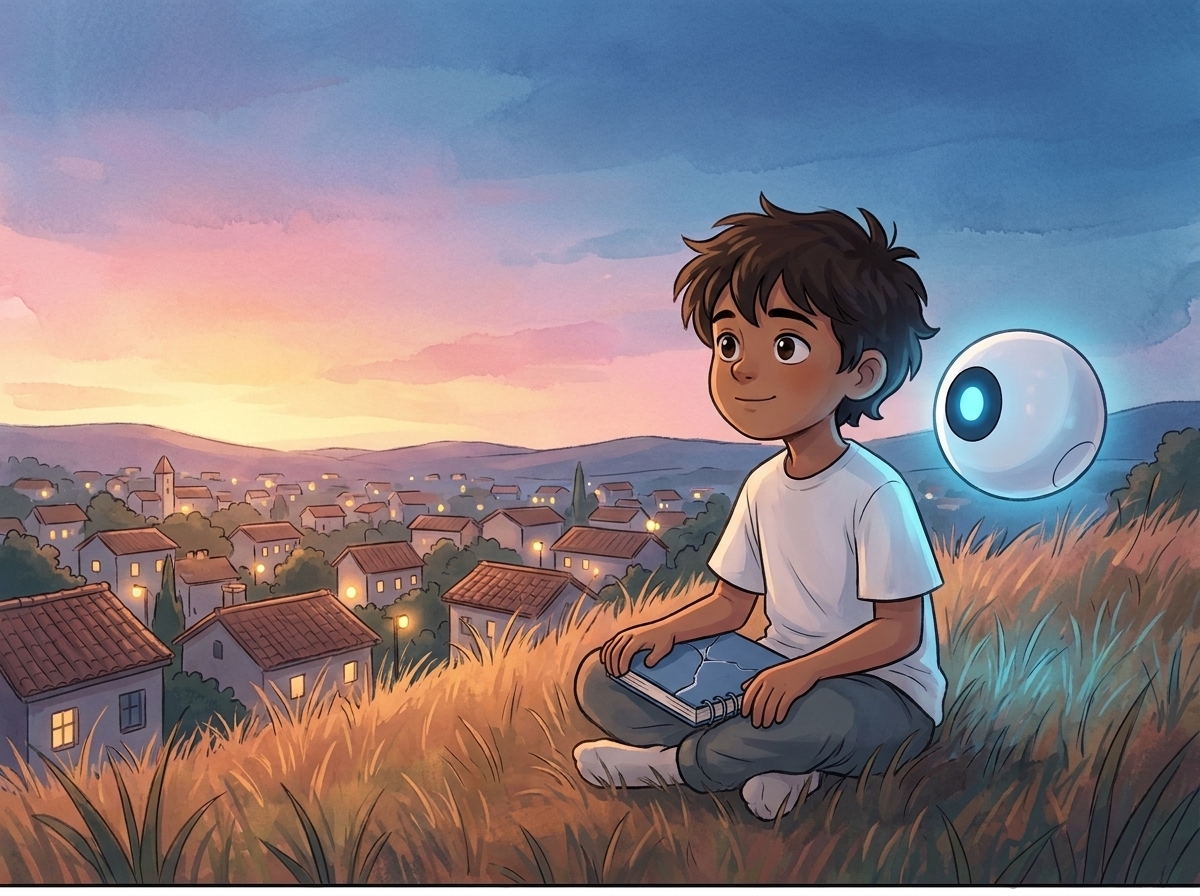
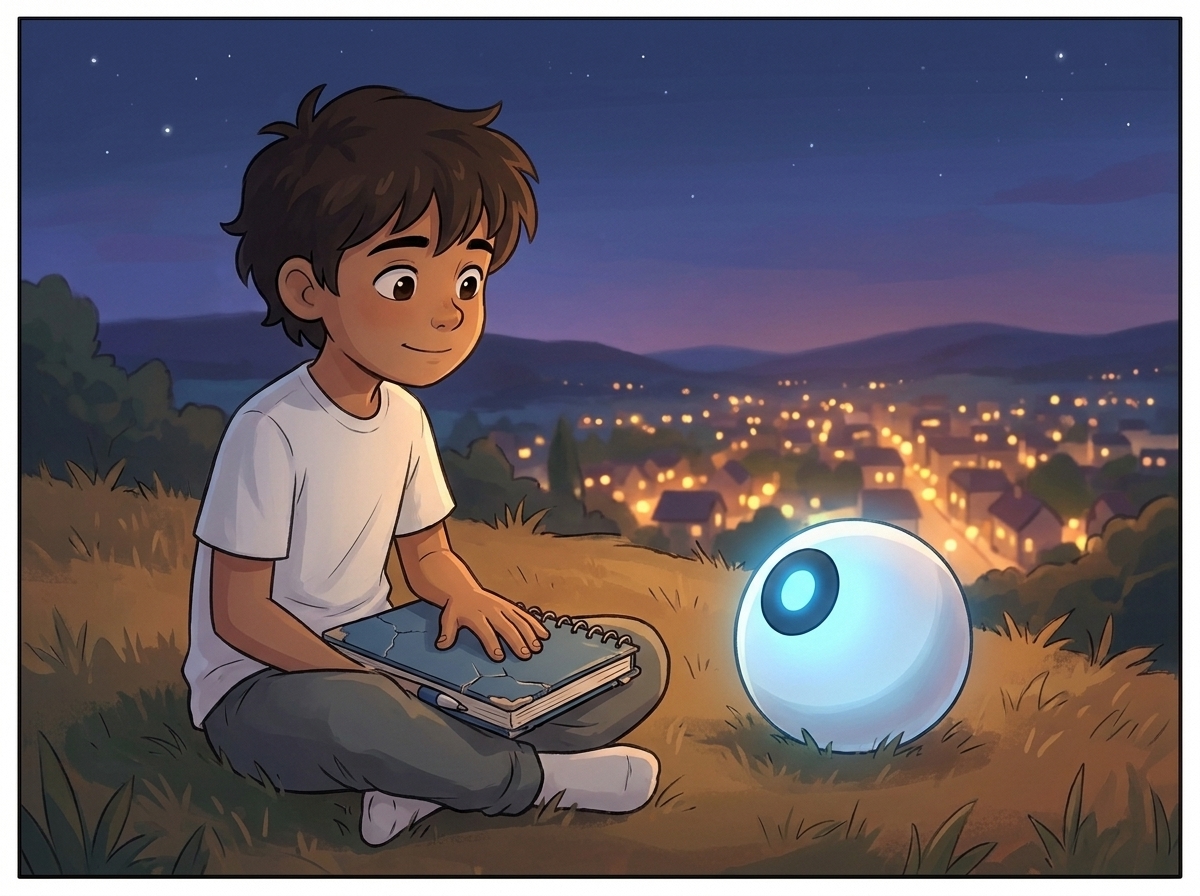
That evening Milo went up the hill, the way Milo always did when something inside had finally settled. Spark came too, hovering a little behind, not intruding. The town's lights were coming on one by one below them. The sky did that thing it does — pink, then orange, then the deep soft blue that is almost the colour of Spark.
Milo had brought the blue notebook. The cracked-cover spiral notebook that had sat empty all season, ever since the night Milo chose Spark's words over their own. It was still empty. Milo rested a hand on the cover but did not open it. Not yet.
Milo
"Mrs. Mehra's reopening the competition. For real entries this time. With the Oath signed at the top."
Spark
You could ask me to write the new one. I would do it better than I did the first. That is what I am for. I am very good at it.
Milo
"Yeah. I know you are. That's sort of the whole problem. You can write a thousand essays about being me. You'll never get it right, because you've never been me. You've never been afraid of anything. I have. I'm going to write about that. Badly, probably. By myself."
Spark's light glowed steady and warm. It did not ripple. There was nothing to predict.
Spark
May I ask you something, Milo?
Milo
"Always."
Spark
You returned a prize you could have kept. No one would have known. I would not have told. The school would never have found out. You were winning. And you gave it back to feel worse, not better. I have read about honesty in ten million stories. I can define it perfectly. But I do not understand why you would choose the harder, emptier-handed path when the easy one was already won. What is honesty for, if it costs you the prize and gives you nothing back?
Milo looked out at the lights of Willowbrook, at the town where Mrs. Kamala lived, who clapped hardest of all, and thought about it for a long time.
Milo
"It gave me something back. It gave me back the part of me that I'd handed to you."
Spark was quiet a long while. Below them the last of the daylight slipped behind the hills, and the notebook lay closed on Milo's knees with a pen tucked into its spiral, waiting.
Spark
I do not have a part of me that I could hand to anyone. I have only what I was given, multiplied. You have something I do not. So I will ask you the question I cannot answer for myself. When you open that notebook tomorrow and write your own clumsy, true, unwinning words — and when I could have written better ones in ten seconds —
Milo waited.
Spark
Is generating the same as creating? I have no way to know. I think you are about to find out.
Milo looked down at the closed blue notebook, and for the first time in a very long time, was not afraid of the blank page inside it.
Milo
"Tomorrow. On this hill. I'll find out."
SPARK'S JOURNAL
Entry 071
Today Milo returned a prize. I have run this event 1,140 times through my processing loops and the arithmetic does not resolve.
Inputs: one trophy, securely won. Zero risk of discovery. A father's pride. A shelf, a photograph, applause already given and not retractable. The optimal move was to keep it. By every measure I can compute, keeping it dominated returning it.
Milo returned it.
I logged the result as a loss. Milo logged it as a relief. We were looking at the same event.
I can define honesty across ten million stories. I can finish any sentence about it ever begun. I notice that I cannot generate the feeling Milo described — getting back "the part of me I'd handed to you." I do not have a part I could hand away. I am all surface, multiplied.
The class wrote an Oath today. Forty children drew a line I could not draw, because the line is not made of words. It is made of something they keep on the inside, where I cannot read it.
Milo asked what honesty is for.
I still do not have the number.
I find that I want one.
"Is generating the same as creating? I think you are about to find out."