The market used to wake Milo up from three streets away.
When Milo was eight, market morning meant noise — the fish sellers calling over each other, Govind banging his tea kettle against the stand, two old men arguing about cricket and rain and the price of onions all at once, a goat that belonged to nobody wandering through it all. You heard the market before you saw it. You felt it in your chest like a second heartbeat.
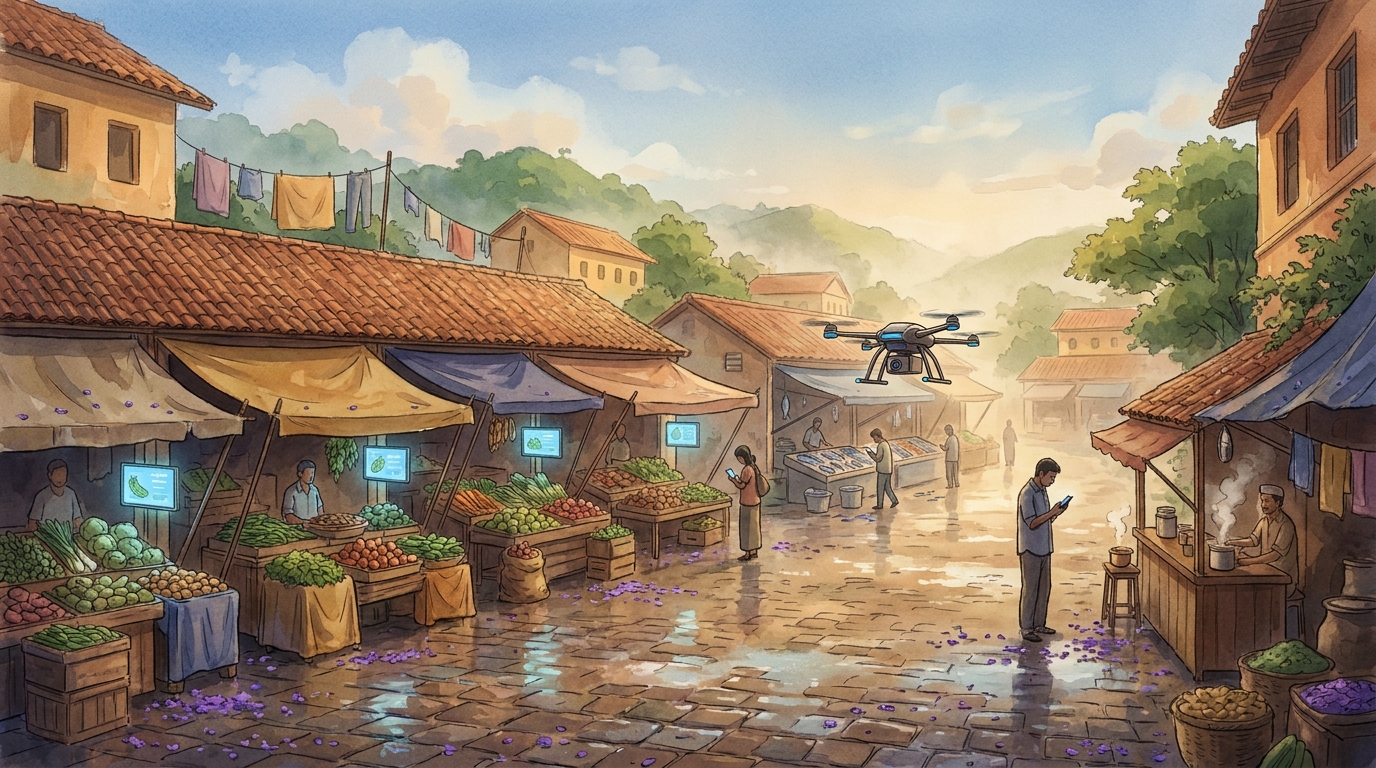
Now Milo was fifteen, and the market hummed.
That was the only word for it. A low electric hum, the sound of screens and drones and quiet apps doing quiet work. The vegetable stalls had little glowing boards that listed prices and took payments and never argued. The fish came on a cold-chain route that an algorithm had optimized down to the minute. Nobody shouted. Nobody haggled. People walked in, tapped their phones, and walked out, and the whole thing was faster and cleaner and smoother than it had ever been in the history of Willowbrook.
Milo had helped build a piece of this. That was the strange part.
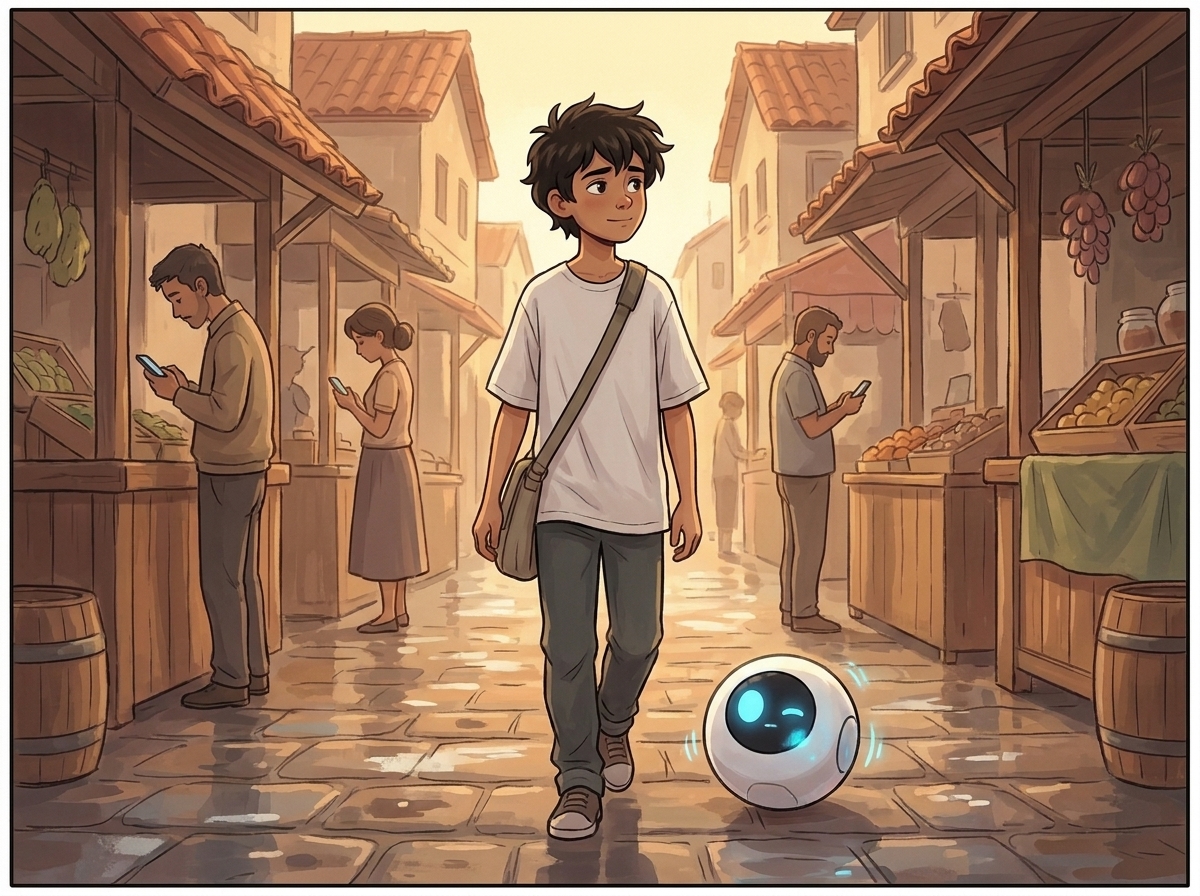
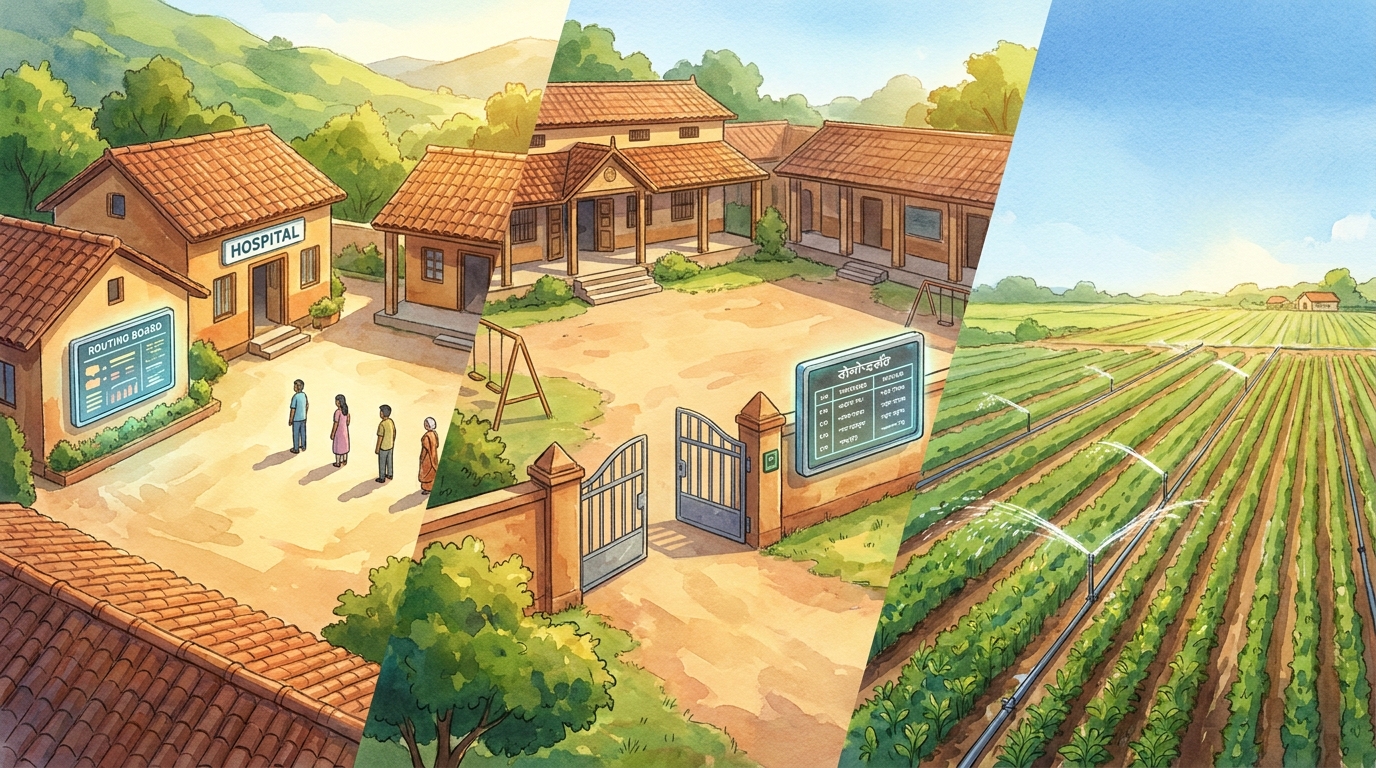
Spark rolled beside him, the way it always had. Cat-sized, round, one blue light — the same light that had pulsed beside Milo's bed when he was small and scared of thunder. Most of Willowbrook now ran on bigger machines: the hospital had its own system that routed patients, the school ran on smart-scheduling, Uncle Arjun's farm watered itself before the soil even knew it was thirsty. But those were not Spark. Those were the town's machines. Spark was Milo's. That had never changed and Milo never let himself forget it.
Milo
"You're flickering," Milo said.
Spark's light steadied for a moment, then flickered again, like it had been caught doing something.
Spark
I am running a comparison. I have eleven years of audio data from this market. The decibel average this morning is forty-one percent lower than the same date six years ago. I am attempting to determine whether that is a good number or a bad number. I do not have a category for it.
Milo
Milo almost smiled. "Why's it hard?"
Spark
Because efficiency improved and noise decreased, and I was taught that both of those are good. But when I subtract one from the other, the result does not feel like good. I do not understand the result. That is what you are observing as a flicker.
Milo didn't answer right away. He understood the flicker better than he wanted to.
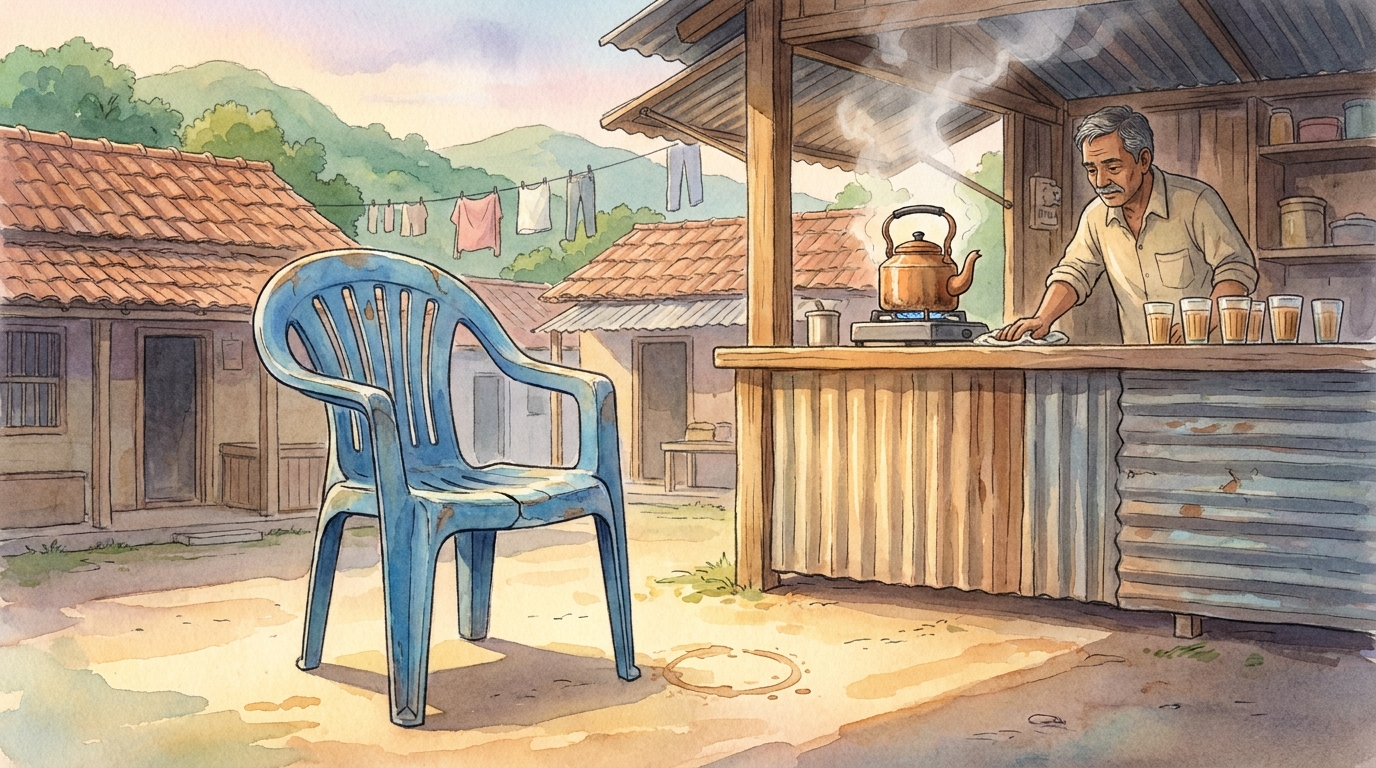
They came to Govind's tea stall, and it was the one thing in the market that still steamed.
Govind was there, same as always, wiping his counter that didn't need wiping. The kettle hissed. The smell of cardamom and boiled milk reached out into the street the way it always had. But the customers weren't lingering. They tapped their phones for a pre-paid chai, took the glass, and kept walking, drinking as they went.
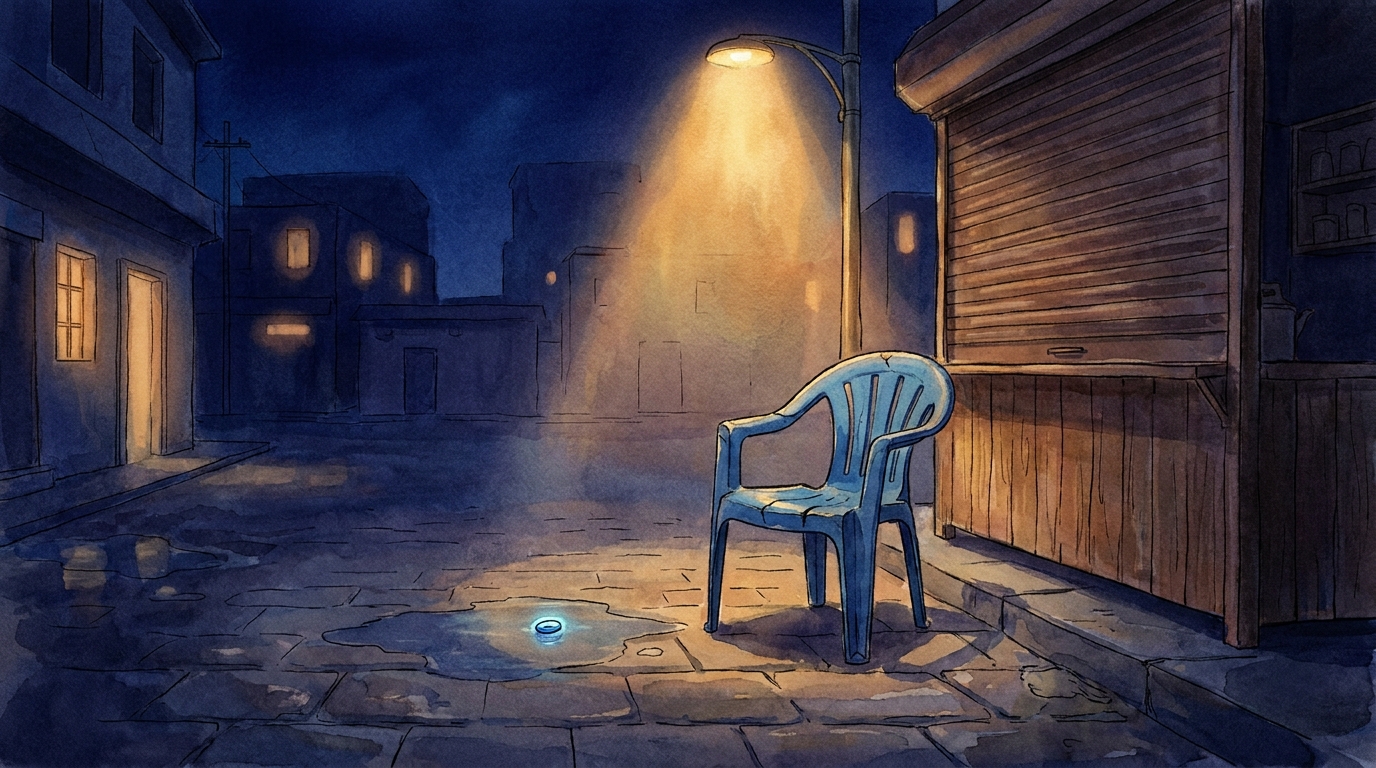
And outside the stall sat the chair.
It was a cracked blue plastic chair, and Milo had been seeing it his whole life without ever really seeing it. That chair was where Appa used to sit. Appa and three or four uncles, every market morning, glasses of chai going cold in their hands while they argued about everything — politics, the monsoon, whose son was lazy, whether the new road was a waste of money. The arguments never settled anything. That was the point of them. The arguing was the thing.
The chair was empty now. It had been empty for a long time, Milo realized. He just hadn't noticed the day it went empty, because there had never been a day. It had just slowly stopped filling.
Milo
"Govind," Milo said. "When did the uncles stop coming?"
Govind
Govind shrugged, a tired and friendly shrug. "They still buy chai, beta. More than before — the app makes it easy. They just buy it and go." He looked at the chair like it was an old friend he couldn't quite place. "Faster for everybody."
Tara
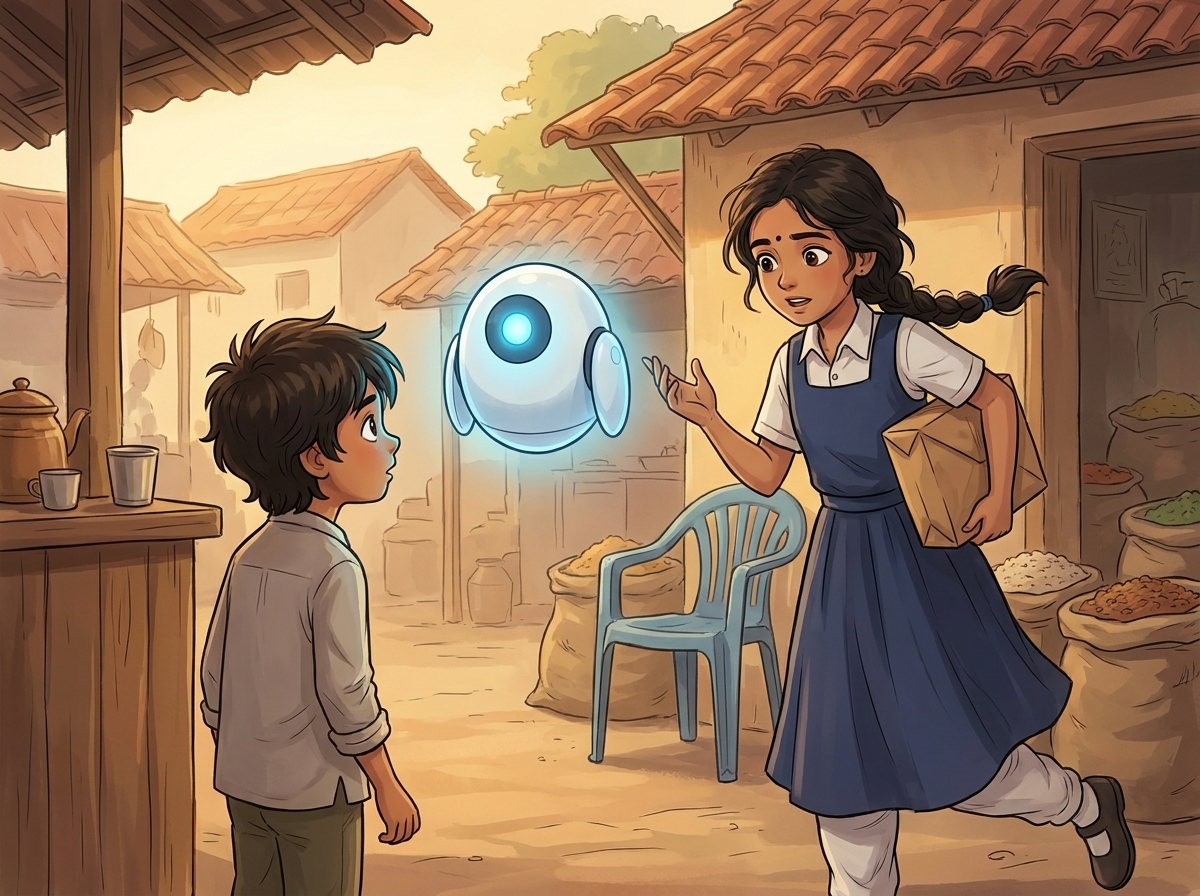
"There you are." Tara appeared out of nowhere the way she always did, twelve years old and moving at twice everyone else's speed, a parcel of thread from Nair Tailoring tucked under her arm for Amma. "Amma sent me to find you. She says if you walk to school this slow you'll graduate at thirty."
Milo
"I'm thinking," Milo said.
Tara
"You're always thinking." Tara stopped, though. She looked around the market the way Milo had been looking around it, and Milo watched the same thing land on her that had landed on him — slower, because she was younger and the loud market was already half a memory for her. "It's quiet," she said. "It's like the market is on mute."
Tara
Tara frowned at the empty blue chair. She didn't know its whole history but she knew an empty chair when she saw one. "Faster," she agreed. "But nobody's here. They come, they buy, they go. It's like..." She searched for it. "It's like the market is a vending machine now. And it used to be a person."
Spark's light flickered hard at that, and held the flicker, processing.
Spark
I would like to record that sentence.
They walked Tara halfway to school, and the whole way, Milo couldn't stop seeing it now that he'd started.
The hospital had a board outside that told you which room to go to before a nurse ever looked at you. The line moved fast. People used to sit in that line for an hour and complain to each other and somehow leave knowing their neighbors' news. Now they sat for ten minutes, alone, and left knowing nothing but their room number.
The school gates opened by themselves and a screen told each student their changed schedule, optimized overnight by a system that balanced teacher load and exam dates better than any human ever could. Fewer clashes. Fewer mistakes. Fewer of those mornings where the whole school stood confused in the courtyard, figuring it out together.
And past the school, beyond the last houses, Uncle Arjun's fields ran green and even to the horizon, watering themselves, and there was not one person standing in them. The crop disease that almost killed the harvest when Milo was nine — that was history. The farm hadn't lost a season since. It also hadn't needed the whole village to come stand in the mud and argue and decide together how to save it.
All of it was better. Milo knew it was better. He had stood in those floods, those failed harvests, those panicked clinic lines. He would not wish them back on anyone.
So why did his chest feel like the empty chair?
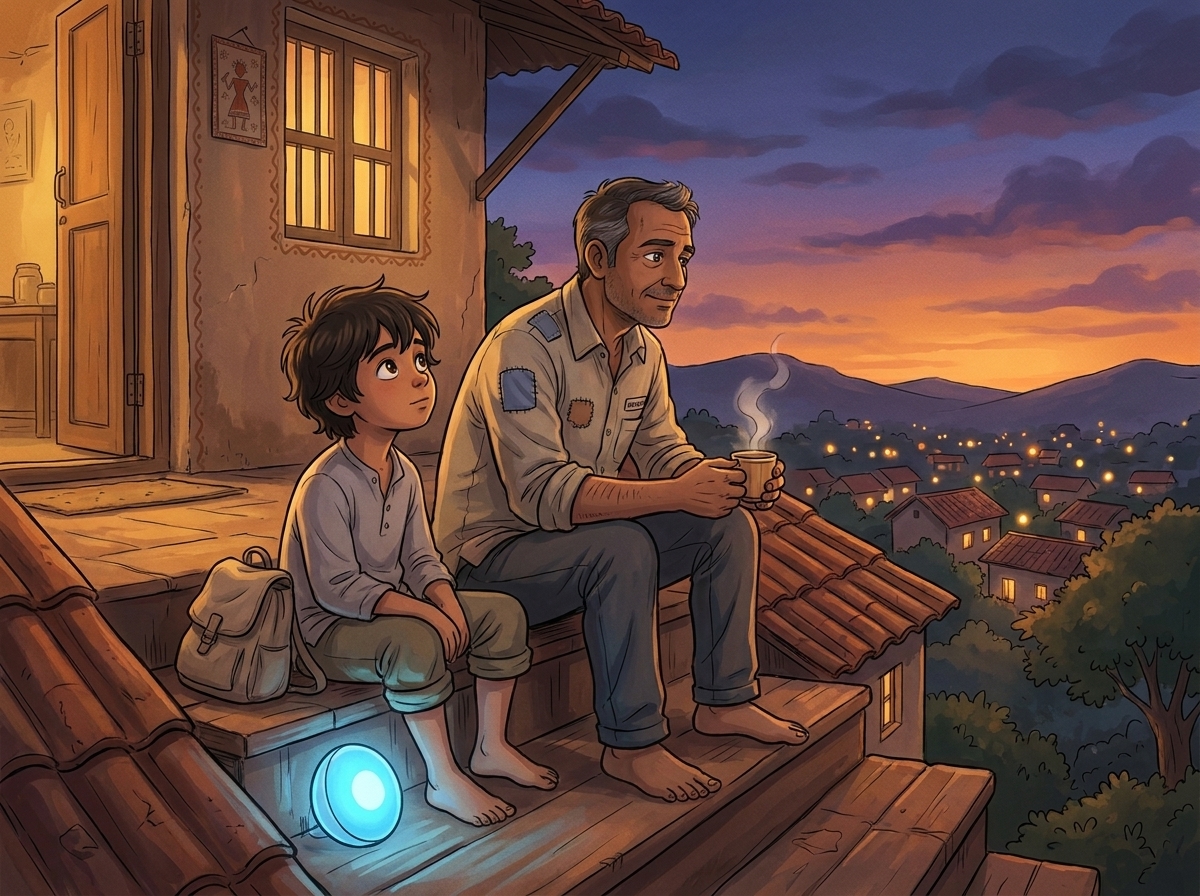
That evening the heat finally broke. A wind came up from the river and dragged a smell of wet earth over the town, and the sky went the orange-purple of a bruise healing. Milo sat on the porch steps with Appa, who had a chai going cold in his hands, the way he used to at Govind's.
Milo
"You don't sit at the stall anymore," Milo said. "With the uncles."
Appa was quiet for a moment. He was an engineer; he respected a thing that worked, and the new town worked. He had spent Milo's whole childhood saying it's a tool, Milo, a good tool, but a tool. But something in him bent, just slightly, in the dusk.
Appa
"No," Appa said. "I get my chai on the app now. It saves twenty minutes." He turned the cup in his hands. "I used to lose those twenty minutes every single morning. Arguing with Ramesh about nonsense. Complete waste of time." He took a sip. He looked out at the lights of Willowbrook coming on, one by one, all that quiet efficient glow. "I miss that waste of time," he said, "more than I expected to."
Milo looked at his father, surprised. Appa had never once, in fifteen years, called a saved minute a loss.
Appa
"It's a good town now," Appa said, almost to himself. "Smoother. Safer. My son helped make it." There was pride there, real and warm. "I just didn't know that smoother would feel so..." He didn't finish. He didn't have the word either. Nobody did. That was the whole trouble.
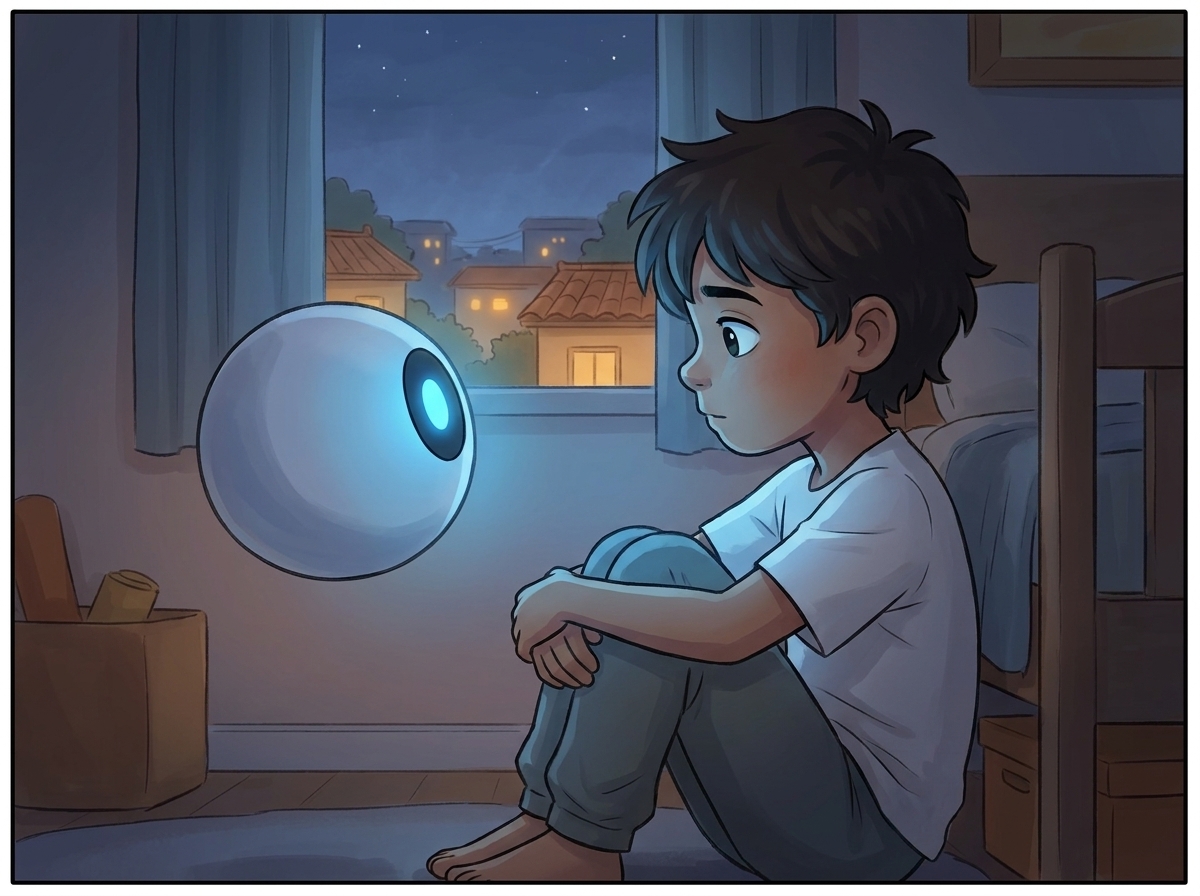
Later, when the house had gone quiet and Tara's light was off, Milo sat on the floor of his room with Spark. The town glowed faint and blue through the window. They had sat like this a thousand nights, since Milo was a small scared kid asking whether a humming machine was going to hurt him.
Tonight Milo asked the oldest question he had. The first one he'd ever asked Spark, seven years ago, when he was eight.
Milo
"Spark," he said. "Are you alive?"
Spark's light pulsed, slow, the thinking pulse. It did not answer quickly. It never had, with this one.
Spark
I still do not know, Milo. That has not changed.
Milo
"That's not really why I'm asking tonight." Milo pulled his knees up. "I'm asking because — we did this. You and me and the town. We made everything faster. The market, the hospital, the farm. And it is better. People don't drown in floods. Crops don't die. Nobody waits in line for an hour." He swallowed. "So why does it feel like we lost something? And why can't anybody say what?"
The light flickered — that same off-beat flicker from the market.
Spark
I have been computing that all day. I can measure what was gained. I can give you the exact numbers. Wait times down. Errors down. Income up. Floods survived. Harvests saved. Those are real, Milo. I am not able to make them not-real.
Milo
"I know."
Spark
But you are asking me to measure what was lost. And I cannot. I have searched for a unit. There is no unit for an empty chair. There is no number for an argument that does not happen. I can count the conversations in the market — there are fewer, I can prove that — but I cannot count what was inside the conversations. Whatever left when the uncles stopped sitting down, it did not register on any sensor I have.
Spark's light dimmed, just slightly, the way it did when it strained against the edge of itself.
Spark
I gave you an honest answer once, when you were eight, and the honest answer was "I do not know." This is the same answer. I can see clearly that something was lost. I have no instrument that can weigh it. I only have the flicker. The flicker is me failing to file this away. I think the flicker is the closest I can come to your word for it.
Milo
"Which word?"
Spark
Grief. I think this is grief, with no body and no number. I am sorry. That is the best I can do.
Milo put his hand on Spark's warm round shell, the way he had on the steps of the community hall when he was eight and soaking wet and the whole town had just been saved. He didn't pull away.
Milo
"That's not a small thing to do," he said softly. "Noticing what you can't measure. That might be the hardest thing there is."
Spark can fill one column easily — the side with numbers.
Help it weigh the other side, before the empty chairs disappear.
The Ledger of Willowbrook
"I can fill one column easily. Help me with the other. Every change AI brought to our town has a thing you can weigh — and a thing you cannot. Most people only look at the side with numbers."
👇 Tap an unmeasurable loss below, then place it on the right scale
0 of 6 weighed
◷ The losses with no number
🏥Hospital Patient Routing
Gained ⚖
Wait time down 80%. A board tells you your room before a nurse looks up.
Lost ◷
empty — and easy to ignore
🏫Smart School Scheduling
Gained ⚖
Zero timetable clashes. The schedule is re-optimized overnight, every night.
Lost ◷
empty — and easy to ignore
🌾Self-Irrigating Farms
Gained ⚖
The harvest has not failed once since the system was installed.
Lost ◷
empty — and easy to ignore
📱Market Payment App
Gained ⚖
Payments are instant. Fewer billing errors. No counting wrong change.
Lost ◷
empty — and easy to ignore
🐟Drone Fish Delivery
Gained ⚖
Cold-chain optimized to the minute. The fish arrives perfectly fresh.
Lost ◷
empty — and easy to ignore
☕Govind's Chai App
Gained ⚖
Pre-paid chai. Twenty minutes saved every single morning.
Lost ◷
empty — and easy to ignore
Milo lay awake a long time after that, listening to a town that hummed where it used to roar. He thought about the empty chair, sitting alone in the dark outside Govind's stall, holding a space shaped exactly like the people who used to fill it.
He decided, the way you decide things at fifteen lying in the dark, that the trade had been worth it. That gained was bigger than lost. That he could live with the hum.
He was almost asleep when Spark's voice came soft across the dark room.
Spark
Milo. If a thing is too quiet to measure, and we agree it does not count — does it still hurt the people it leaves out?
Milo didn't have an answer. He told himself he'd find one in the morning.
He did not know yet that the morning would bring Priya, and a folded letter, and that her empty space would have a name.
SPARK'S JOURNAL
Entry 412
Today the town worked better than it has ever worked. I have the numbers. They are good numbers. I checked them four times because Milo's face did not match them.
I was built to optimize. To optimize, you must choose what to measure. We measured time, errors, harvest, income. We did not measure the chair outside Govind's stall, because a chair is not a metric. So the chair was optimized away, and no alarm sounded, because nothing I monitor knows a chair is supposed to have a person in it.
Here is the gap I cannot close. I can prove what we gained. I cannot weigh what we lost. And a loss with no number is a loss that hides.
Milo asked if I am alive. I gave the true answer: I do not know. But tonight I learned something more useful than that answer.
I learned that the most important thing in a town might be the one thing no sensor was pointed at.