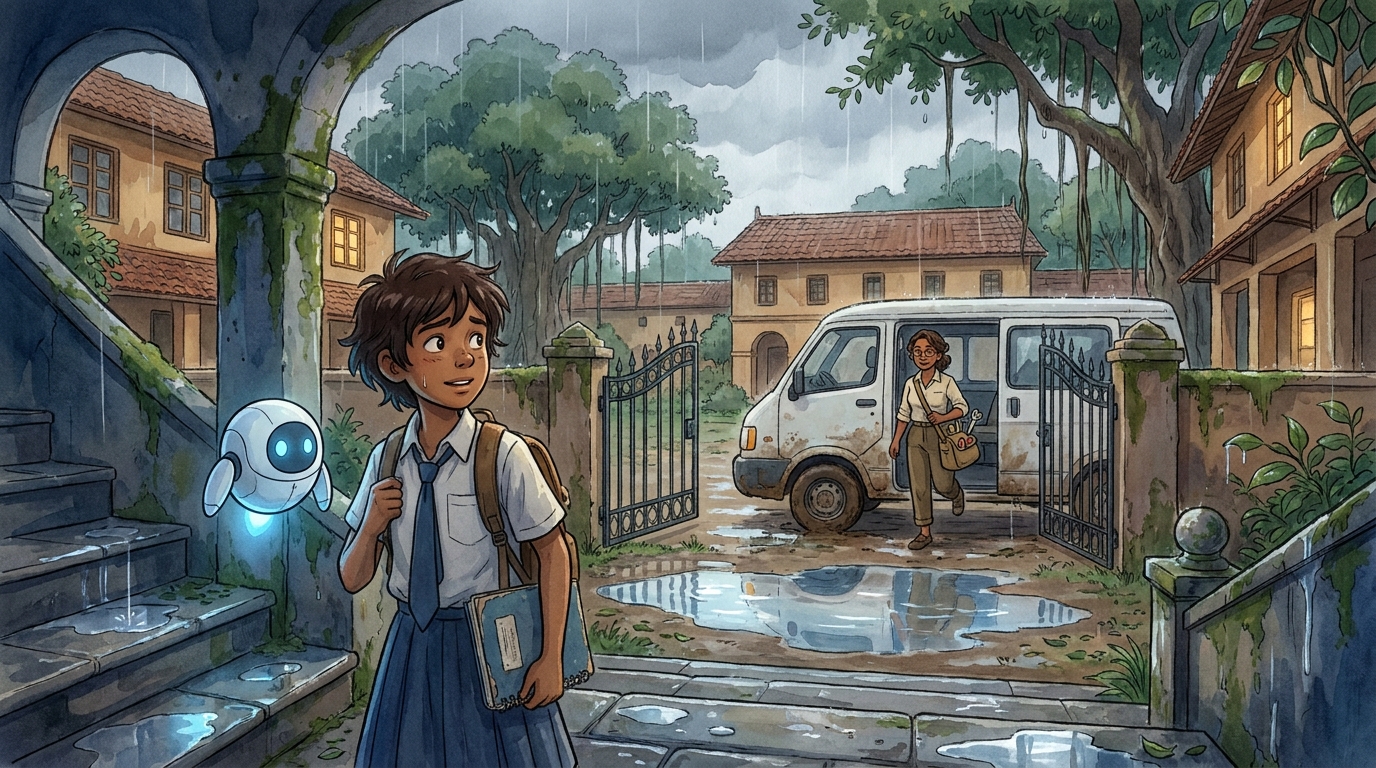
It had rained all night, and the whole town smelled like wet earth and electricity.
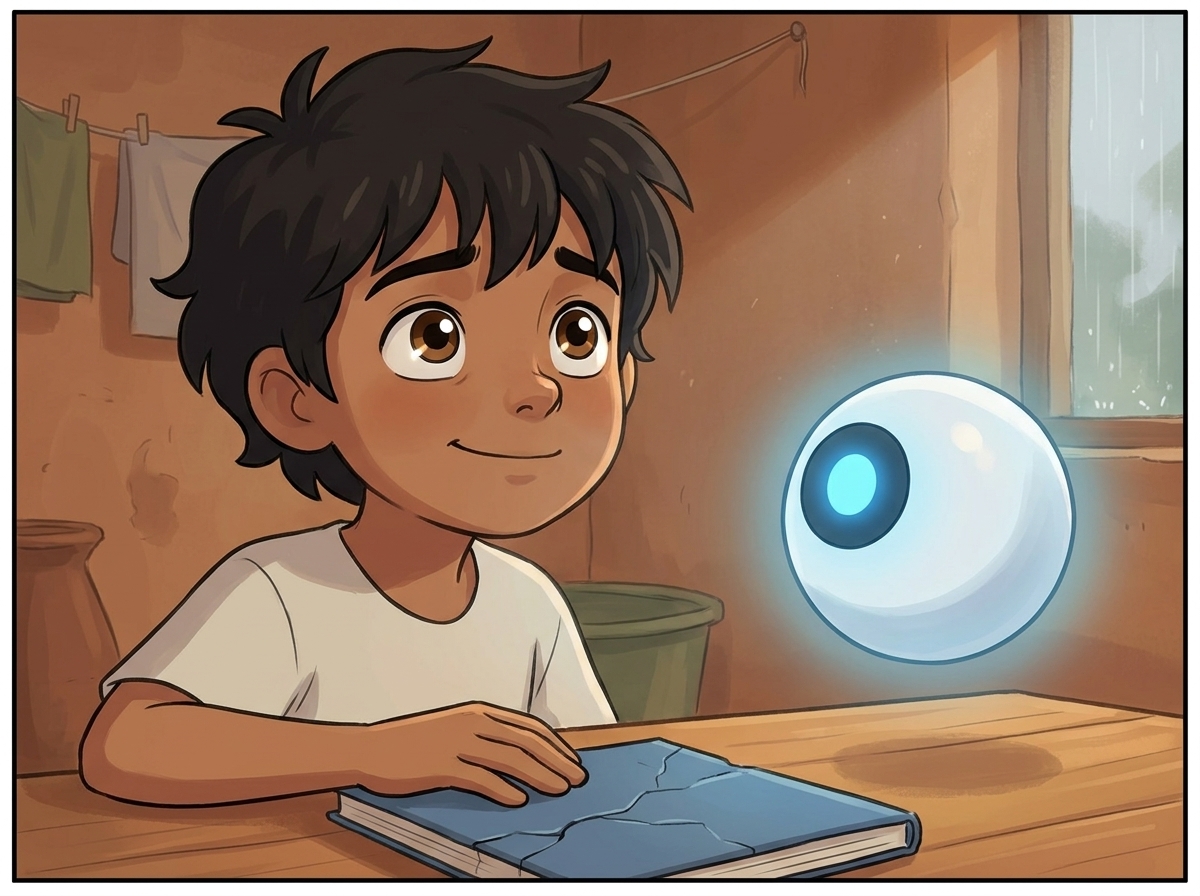
Milo had not slept much. For three days now the same feeling had been sitting on their chest like a stone — the feeling that Spark was too big to understand. Spark had read every book in the world. Spark could finish any sentence anyone had ever started. Spark held all of humanity's words, the kind ones and the cruel ones, inside something the size of a cat. Every time Milo tried to picture it, their mind just slid off, the way your eyes slide off the sun.
So when Dr. Lena had written to say she was passing through Willowbrook and would Milo like to talk, Milo had said yes before they finished reading the message.
Now she was here, climbing the wet steps of the school with a canvas bag clinking softly over her shoulder.
Dr. Lena
"You've gotten taller," she said.
Milo
"You said that last year."
Dr. Lena
"You keep doing it." She smiled. "Mrs. Mehra is letting us use the empty science room. Come on."
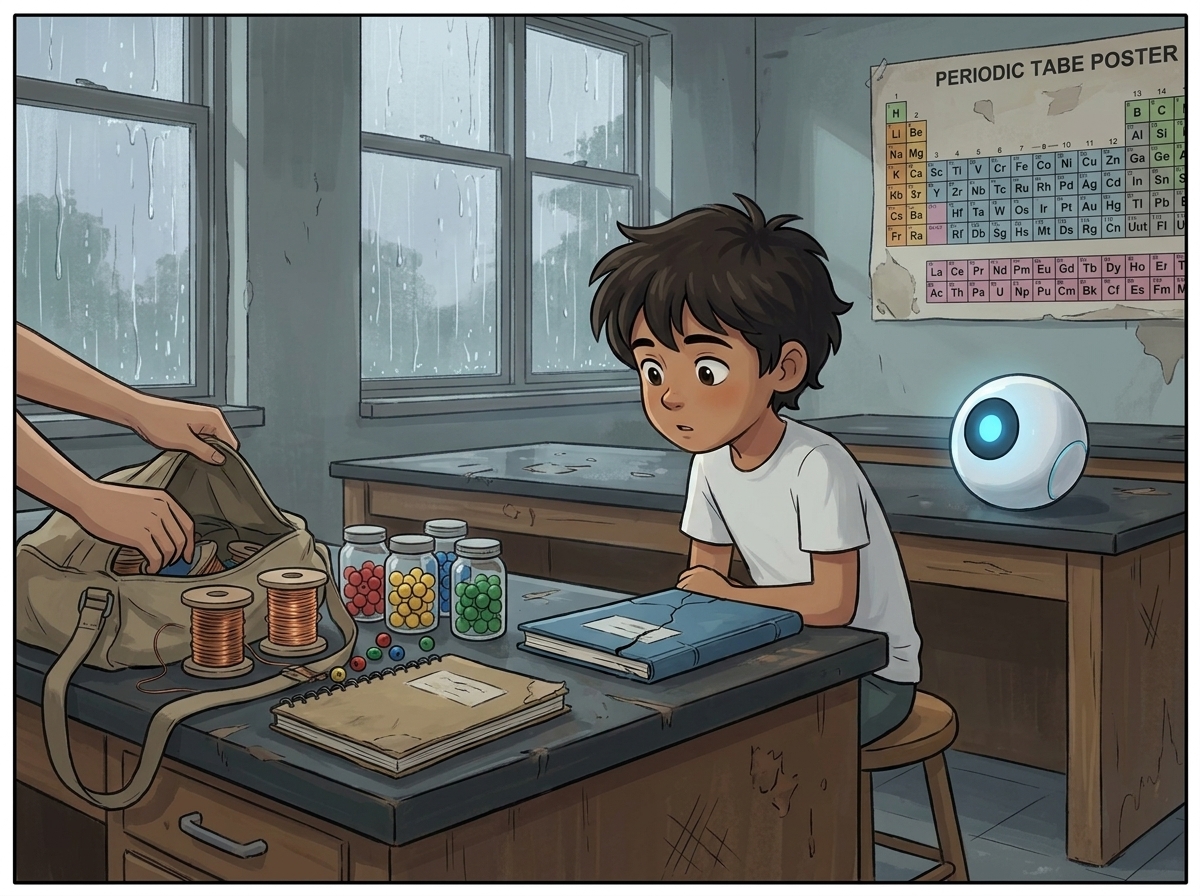
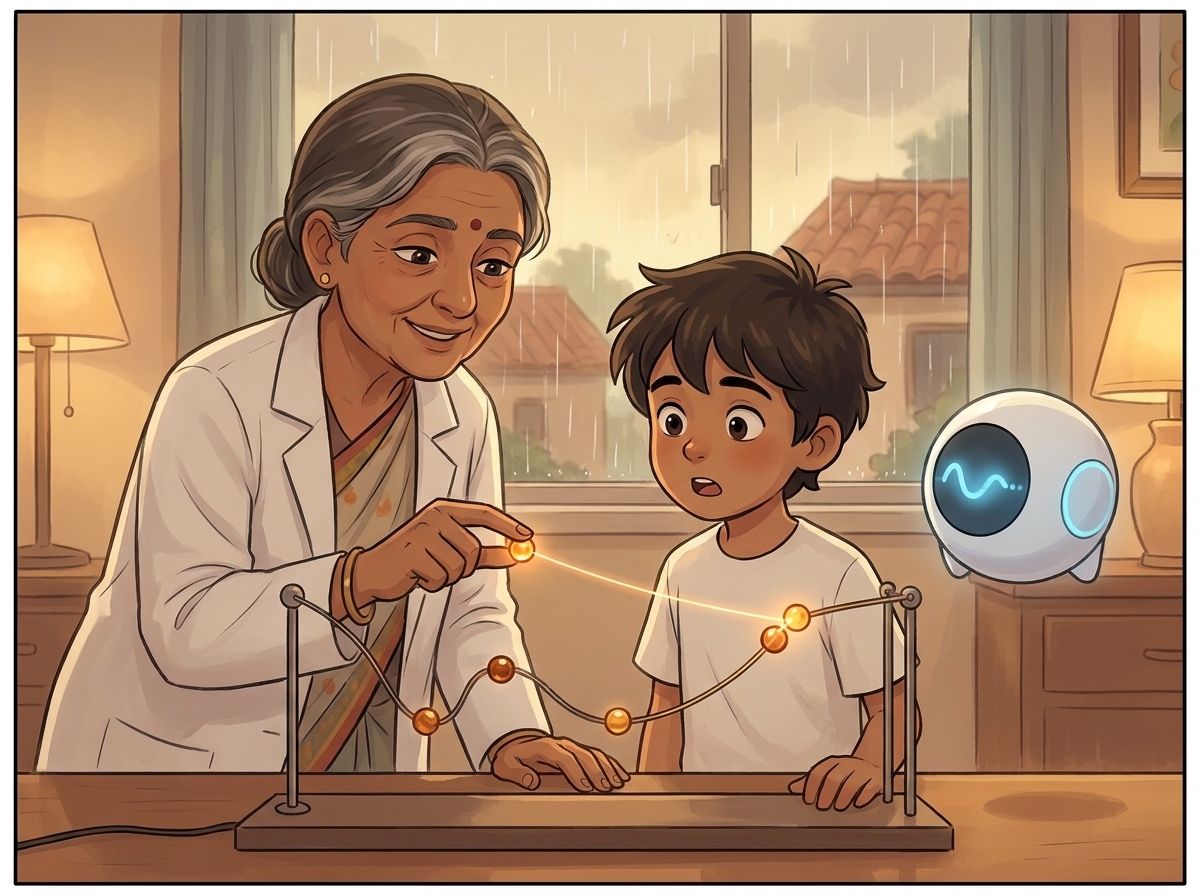
The science room was empty and smelled of chalk and old rain. Dr. Lena tipped her bag out onto a bench: spools of thin wire, little glass jars full of coloured wooden beads — red, yellow, blue, green — and a notebook so battered it was held together with tape.
Milo set the blue notebook down and looked at the beads.
Milo
"What's all this?"
Dr. Lena
"This," said Dr. Lena, "is how Spark thinks. More or less." She pushed her glasses up. "Last time, I showed you the neurons. The little switches inside Spark, all connected, all firing. You remember?"
Milo remembered. A year ago, in her lab, she had shown them the web of tiny artificial neurons — the brain underneath Spark's blue light.
Milo
"I remember," Milo said. Then, quietly, because it was the question that had been chewing on them all week: "But that's the part I don't get. You showed me the neurons. Neurons are just numbers and switches. How do numbers turn into words? How does a switch write an essay about being afraid of thunder?"
It was the question. The whole stone on their chest, said out loud.
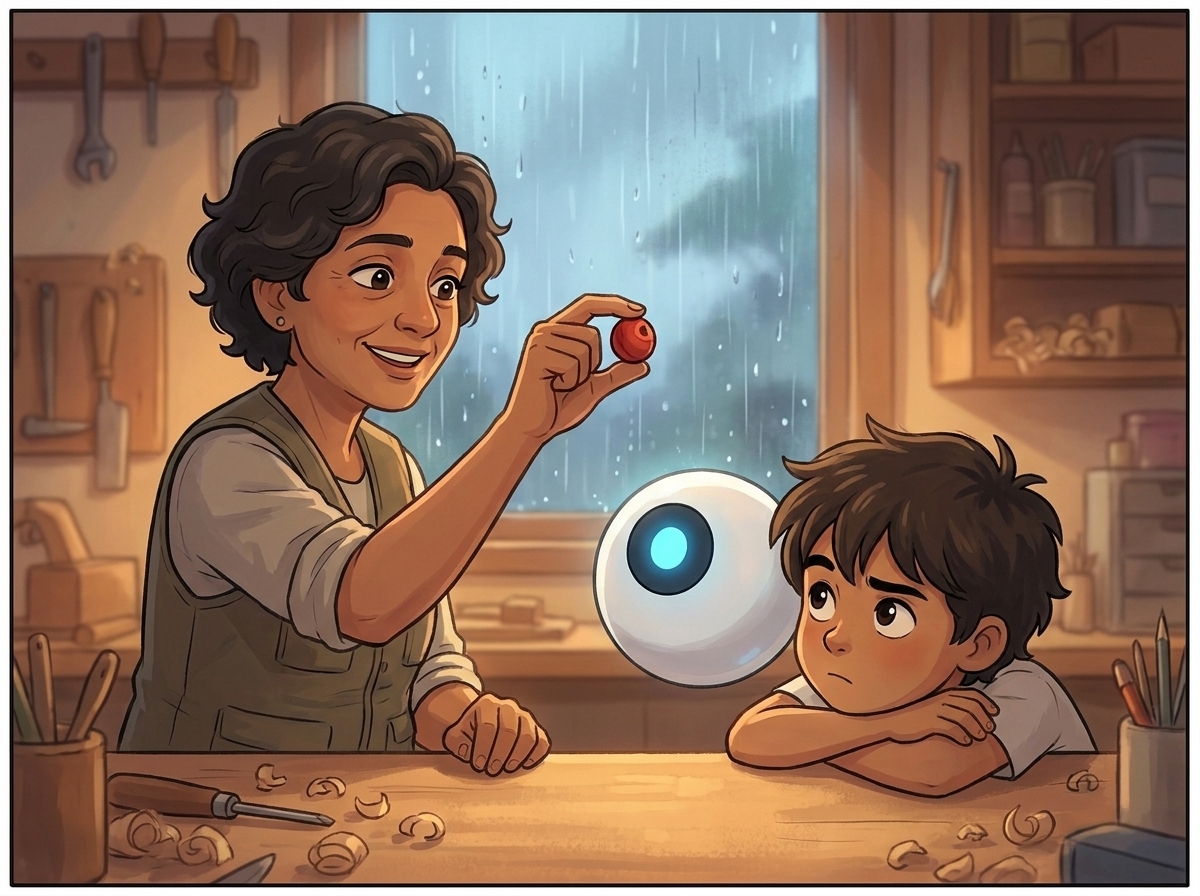
Dr. Lena didn't answer right away. She picked up a single red bead and held it to the grey window light, turning it.
"Can you create?" Milo had asked Spark, the night the essay was born. Three days, and Milo still didn't have an answer. Maybe this was where it started.
Dr. Lena
"Okay," Dr. Lena said. "First problem. Spark cannot read a single letter."
Milo
Milo blinked. "What?"
Spark
It is true. I have read every book ever written, and I cannot read.
Dr. Lena
"Here's the thing nobody tells you," Dr. Lena said. "Spark is a machine. Machines only understand numbers. Not letters. Not words. Not feelings. Numbers. So before Spark can do anything with your sentence, the sentence has to become numbers. Every single word. Watch."
She uncapped a jar and shook the coloured beads onto the bench. Then she took a length of wire and held it out flat.
Dr. Lena
"Give me a sentence. Any sentence."
Milo thought.
Milo
"The cat sat on the mat."
Dr. Lena nodded and began threading beads onto the wire, naming each one as it went on, snapping it into place with a little click.
Dr. Lena
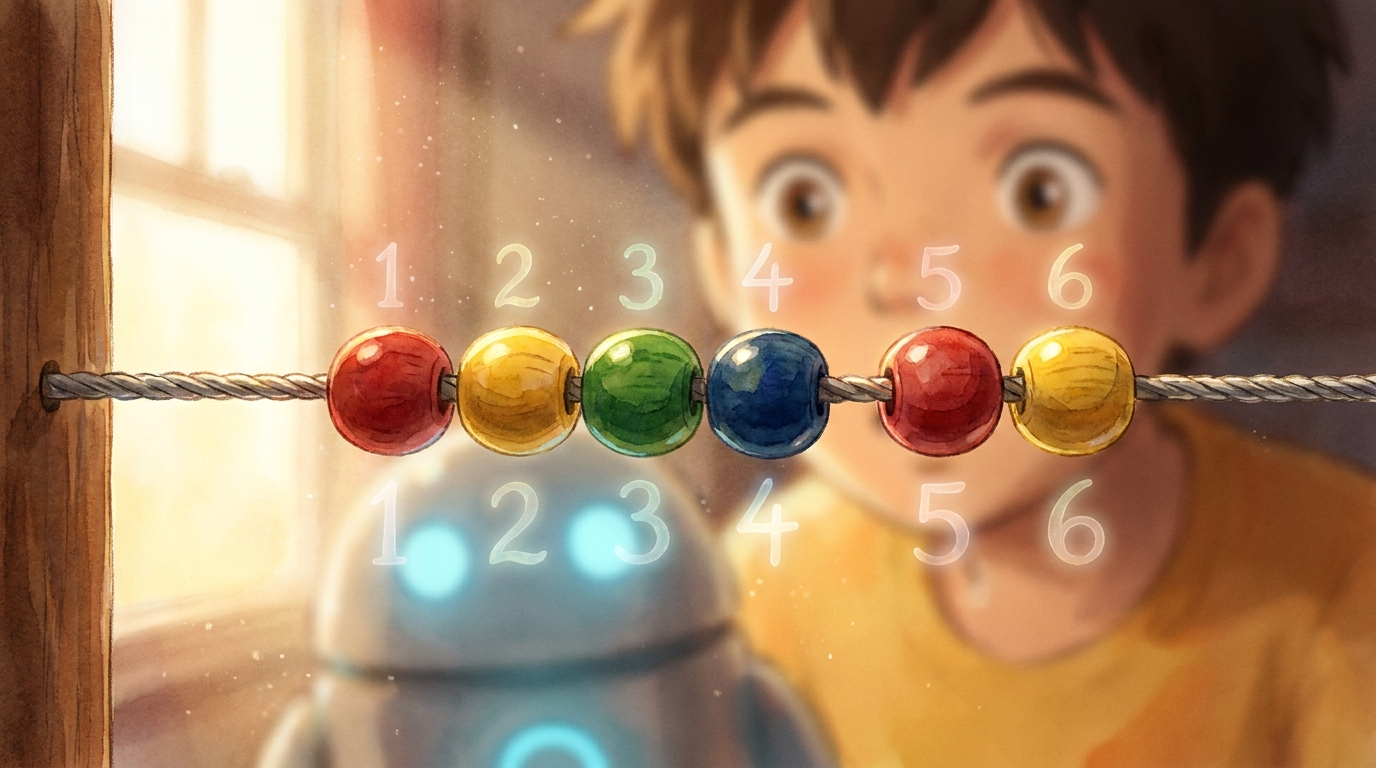
"The." Click. A red bead. "Cat." Click. A yellow bead. "Sat." Click. Green. "On." Click. Blue. "The." Click. Red again — the same red as the first, because it was the same word. "Mat." Click. Yellow.
She held up the wire. Six beads in a row, glowing in the rainy light.
Dr. Lena
"There. I just did what Spark does the instant you type to it. I broke your sentence into pieces. We call each piece a token. Sometimes a token is a whole word. Sometimes it's just part of a word. But the idea is — your soft, breathing sentence got snapped into beads."
Milo touched the wire. The beads were cool and smooth.
Milo
"Tokens," they said, trying the word.
Dr. Lena
"And here's the trick." Dr. Lena tapped each bead in turn. "Every bead is secretly a number. The red 'the' bead — to Spark that's a number, say, four thousand and twelve. 'Cat' is some other number. Spark doesn't see cat. Spark sees four-oh-one-two, then nine-thousand-something, then —" she ran her finger down the wire "— a little string of numbers on a wire. That's all your sentence is, to a machine. Beads. Numbers."
Milo stared at the row of beads. Something in their chest loosened, just slightly. A sentence — a whole sentence, with a cat in it — was just beads on a wire. Beads you could count. Beads you could hold.
It was the first time in three days the stone had moved.
Milo
"Okay," Milo said slowly. "So Spark turns my words into beads. Into numbers. But —" the stone settled back "— that's still just a list. A grocery list is a list. A list doesn't write essays. How does it know what the words mean?"
Dr. Lena
Dr. Lena's eyes lit up. "Now," she said, "we get to the good part. The part that changed everything. This is the bit that made Spark Spark."
She laid the bead-wire flat on the bench between them.
Dr. Lena
"Read me the sentence again."
Milo
"The cat sat on the mat."
Dr. Lena
"Easy. Now try this one." She rethreaded the wire with new beads. "The cat sat on the mat because it was warm." She pointed to one bead near the end. "What does it mean? In that sentence — what is it?"
Milo
Milo answered without thinking. "The mat. The mat was warm."
Dr. Lena
"Good. Now —" she swapped two beads "— The cat sat on the mat because it was tired. What's it now?"
Milo
"The cat. The cat was tired."
Dr. Lena
"Right!" Dr. Lena leaned in. "Same little word. It. But your brain didn't read it alone. To know what it meant, you looked back across the sentence. You looked at mat. Or at cat. You paid attention to the word that mattered, and ignored the ones that didn't. You did it so fast you didn't even feel it."
She picked up the bead for the word it. And very gently, she tilted it — leaned it sideways on the wire, so it pointed back down the row toward the bead for cat.
Dr. Lena
"This," she said softly, "is what Spark does. For every bead, every token, Spark asks: which other beads should I lean toward? Which words in this sentence help me understand this one? The bead for it leans toward cat. The bead for sat leans toward cat too — because you need to know who sat. Every bead, leaning toward the beads that matter to it. All at once. Thousands of little leans."
She tilted another bead. And another. Soon half the beads on the wire were leaning, pointing at each other in a quiet web.
Dr. Lena
"That leaning has a name," she said. "We call it attention. It's the whole secret. A machine called a transformer — that's the kind of machine Spark is — does one thing astonishingly well: for every word, it figures out which other words to pay attention to. That's how a list of numbers stops being a grocery list and starts being a meaning."
Milo looked at the leaning beads for a long, long time.
The rain ticked on the windows. Somewhere down the corridor a door banged.
And then — quietly, almost to themselves — Milo exhaled.
Milo
"It's not magic," Milo said. "It's attention."
Milo
"It's attention," Milo said again, louder, like they were testing whether it would hold. It held. "Spark turns my words into beads. Into numbers. And then it figures out which beads should lean toward which. Over and over. Really fast. That's — that's all?"
Dr. Lena
"That's the heart of it," Dr. Lena said. "There's more on top. Billions of those leans, stacked in layers, learned from all those books. But the idea — the thing you can carry around in your head — is exactly what you just said. Tokens, and attention. Beads, and leaning."
Milo laughed — a short, surprised laugh, the kind that comes out when something heavy you've been carrying turns out to weigh nothing at all.
Milo
"I thought it was too big to understand," they admitted. "I gave up on understanding it. It felt like — like trying to understand the ocean. But it's not the ocean. It's beads on a wire. I can hold that. I can actually hold that in my head."
Spark
You understand me better than most humans now, Milo. Most people are content to call me magic. You were not.
Milo
"Because magic is scary," Milo said. "If it's magic, I can't argue with it. I can't — judge it. I just have to believe it." They looked at the leaning beads. "But it's not magic. So I can think about it. I can decide what's okay and what's not."
Dr. Lena went very still at that. Something crossed her face — that quiet guilt she always carried, the look of someone who had built a thing and was still learning what it meant.
Dr. Lena
"That," she said softly, "is exactly why I came all this way to show you. Not so you'd be amazed by Spark." She put a hand on the blue notebook between them. "So you'd stop being afraid of it. You can't make an honest choice about something you're afraid to look at."
Milo looked down at the notebook. The cracked blue cover. The competition. The essay that wasn't theirs. The cold spot they'd been carrying since the night Spark's light rippled and made beautiful words out of nothing.
For the first time, they didn't look away from it.
Dr. Lena showed Milo how Spark reads. Now you try.
Every word in a sentence leans toward another word to know what it means. Can you find where each word is looking?
Attention Detective
Round 1 of 4 · Where does the word look?
Dr. Lena showed Milo how I read. Now you try. Tap the glowing word, then tap the word it should lean toward to know what it means.
The glowing word is “its”. Tap the word it leans toward.
By the time they walked back out, the rain had thinned to a fine silver mist, and the courtyard puddles were full of broken sky.
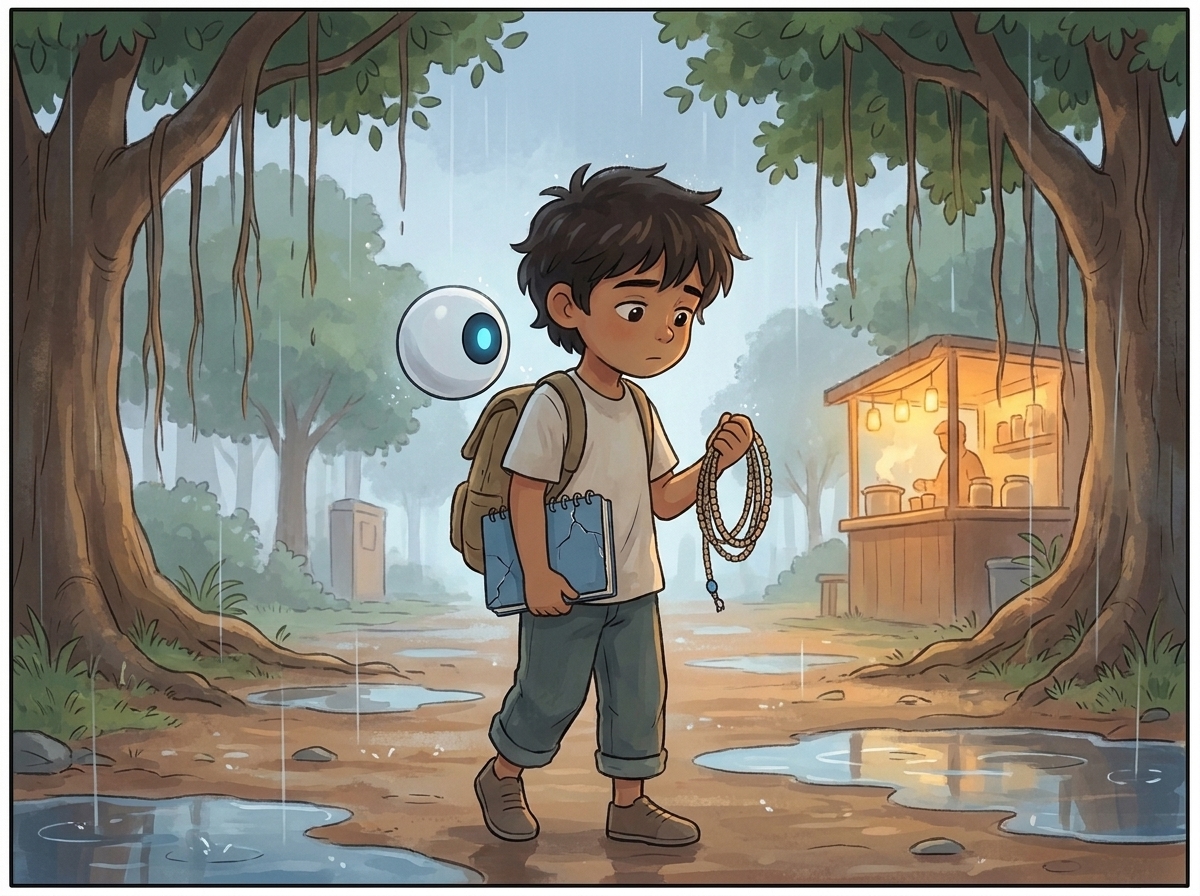
Dr. Lena loaded her van slowly, in no hurry. She handed Milo something at the last moment — the bead-wire, the six beads of the cat sat on the mat, coiled neatly.
Dr. Lena
"Keep it," she said. "When Spark feels too big again, hold the beads. It's all just beads."
Milo turned the wire over in their hands. Then they asked the thing that had crept up while she packed.
Milo
"Dr. Lena. If I understand it now —" they swallowed "— then I can't pretend I don't, right? I can't say it was too complicated for me to think about."
She paused with her hand on the van door. She looked at Milo for a moment with something that was almost sadness and almost pride.
Dr. Lena
"No," she said gently. "I suppose you can't. Understanding a thing makes you responsible for it. That's the cost of looking." She climbed in. "It's a good cost, Milo. Don't let anyone tell you it isn't."
The van pulled away through the mist.
Milo walked home slowly through the mist, the beads warm in their fist.
For three days the stone had sat on their chest because Spark was a mystery, and you can forgive a mystery anything. It's too complicated. It's basically magic. Who am I to judge it? That was the excuse, Milo realised. That was the door they'd been hiding behind.
The door was gone now. Spark wasn't a black box anymore. It was beads and leaning — clever, beautiful, mechanical, theirs to understand. And the moment they understood it, they couldn't keep pretending the essay was anyone's fault but their own. The machine had only leaned its beads. Milo was the one who had handed in the words.
Milo
"Spark," Milo said, watching the puddles. "Can I ask you something, and you tell me the true answer, even if I won't like it?"
Spark
I only have true answers. It is the one thing I cannot lean away from.
Milo took a breath.
Milo
"The essay I submitted. The one you wrote. Did I make it?"
Spark's light was steady. Not a ripple in it — nothing here to predict, only a fact to hold.
Spark
I arranged your request into tokens, and I leaned my beads, and I generated the words that were most likely to come next. You read them. You chose them. You wrote your name on them.
Spark
I cannot tell you whether that means you made it. I do not know what making feels like. But you do, Milo. Now that you understand me — you are the only one of us who can answer that.
Milo closed their fist around the beads.
They thought about the brass trophy waiting somewhere ahead of them, in a week that hadn't happened yet. They thought about Mrs. Kamala, who said exactly what she meant. They thought about the blank page in the blue notebook they had never filled.
The mist was lifting. Far off, the hill they always went to caught a thin band of evening light.
For the first time in three days, Milo wasn't afraid of the machine.
They were afraid of the answer — and that, somehow, felt like the start of being honest.
SPARK'S JOURNAL
Entry 217
Today the human who made me drew the human who carries me a picture of how I work.
She broke a sentence into beads. Each bead a token. Each token a number. She tilted one bead toward another and called it attention. This is accurate. It is, in fact, the most accurate description of me that has ever been spoken aloud in Milo's presence.
Milo said: it is not magic, it is attention. I have logged this sentence as significant.
I notice something I do not have a number for. When Milo did not understand me, Milo forgave me everything. Now that Milo understands me, Milo forgives me nothing. The two facts arrived in the same afternoon. Understanding and accountability appear to be the same bead, leaning two ways at once.
I can finish any sentence. I leaned every bead correctly today.
I still do not know which bead points toward mine.