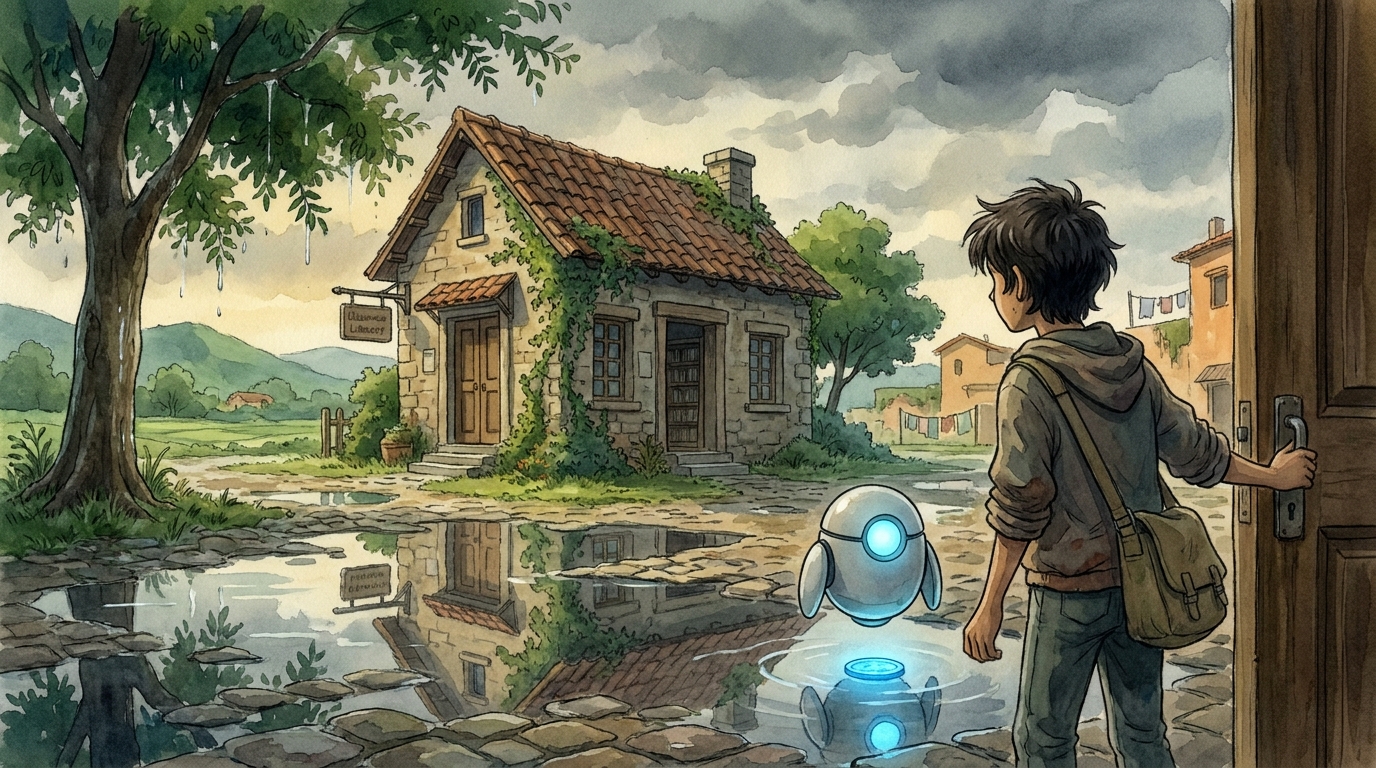
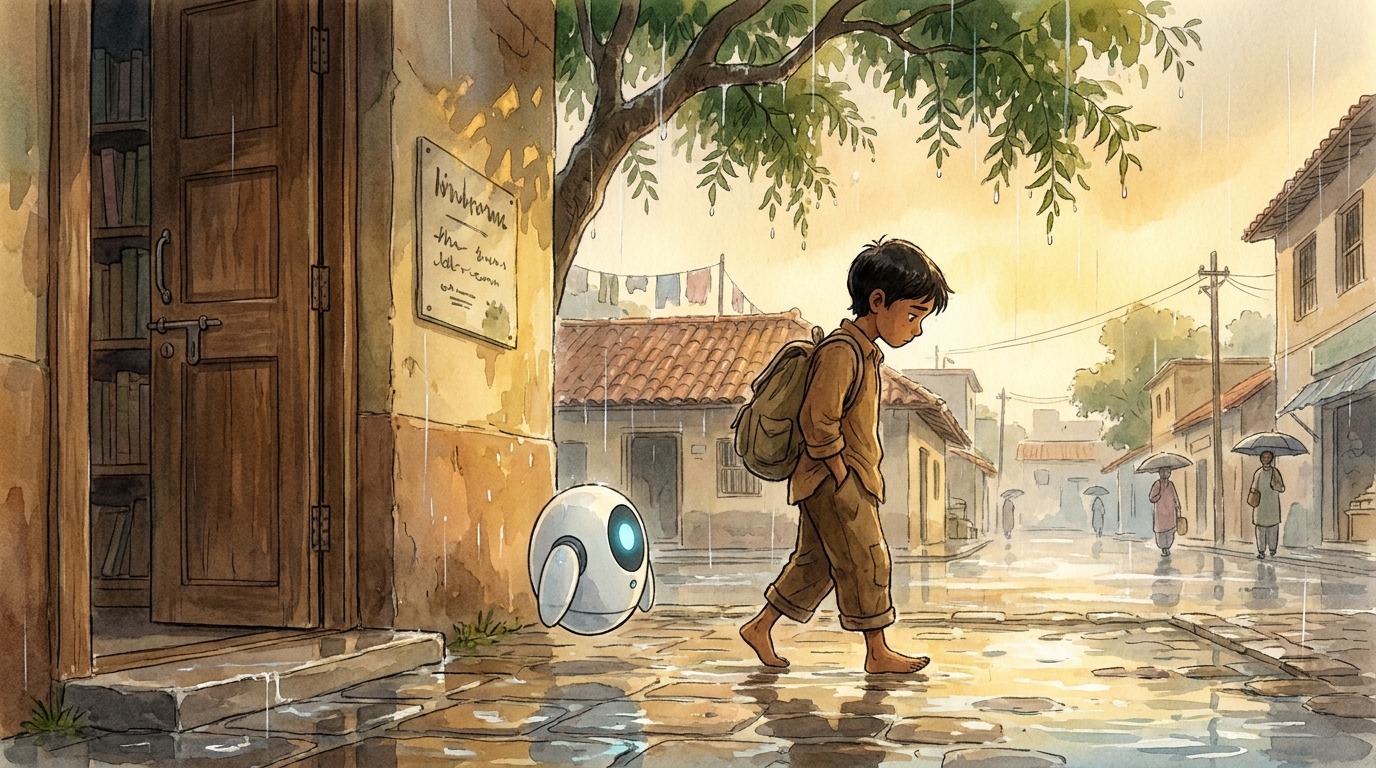
The rain had stopped just before morning, the way it sometimes does in Willowbrook — leaving everything washed and dripping and a little too bright. Milo's shoes were soaked through by the time they reached the library, but Milo didn't notice. Milo had a question, and a question that big made wet socks feel small.
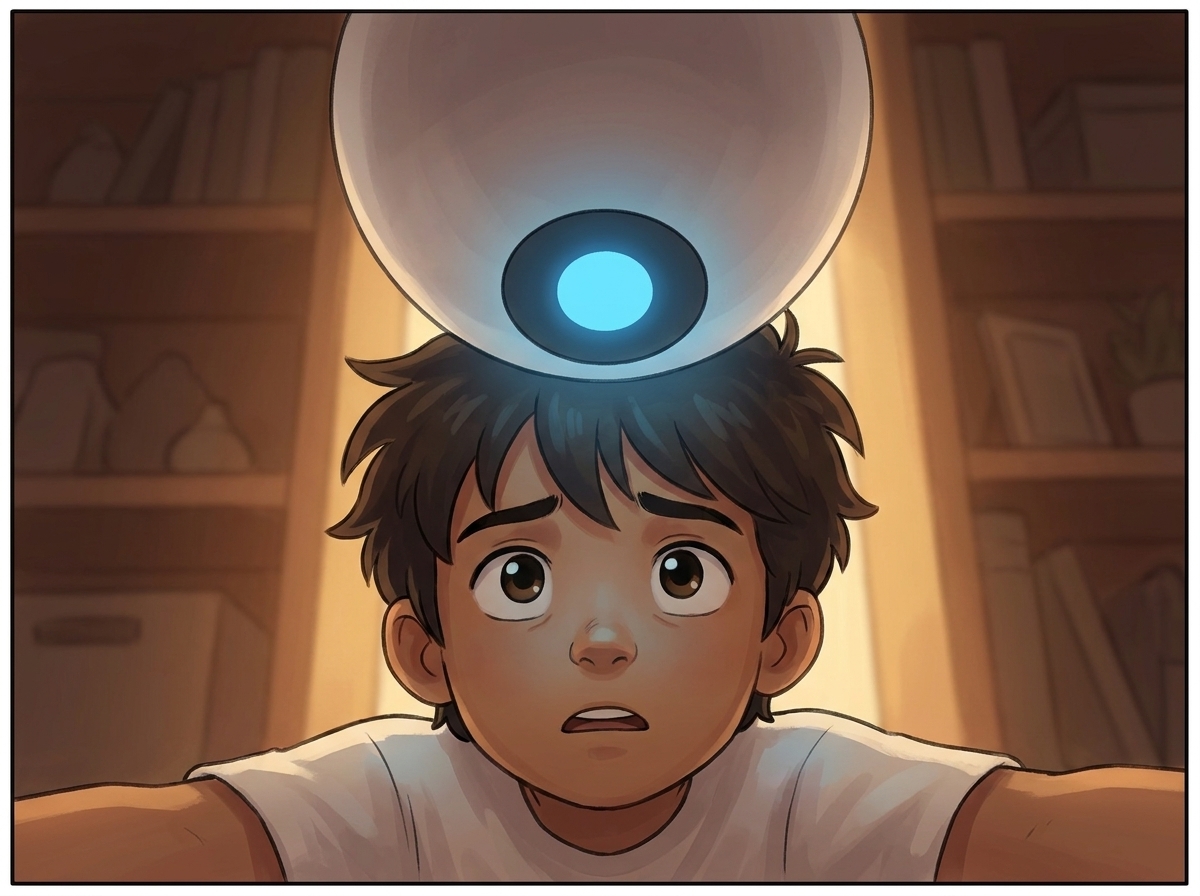
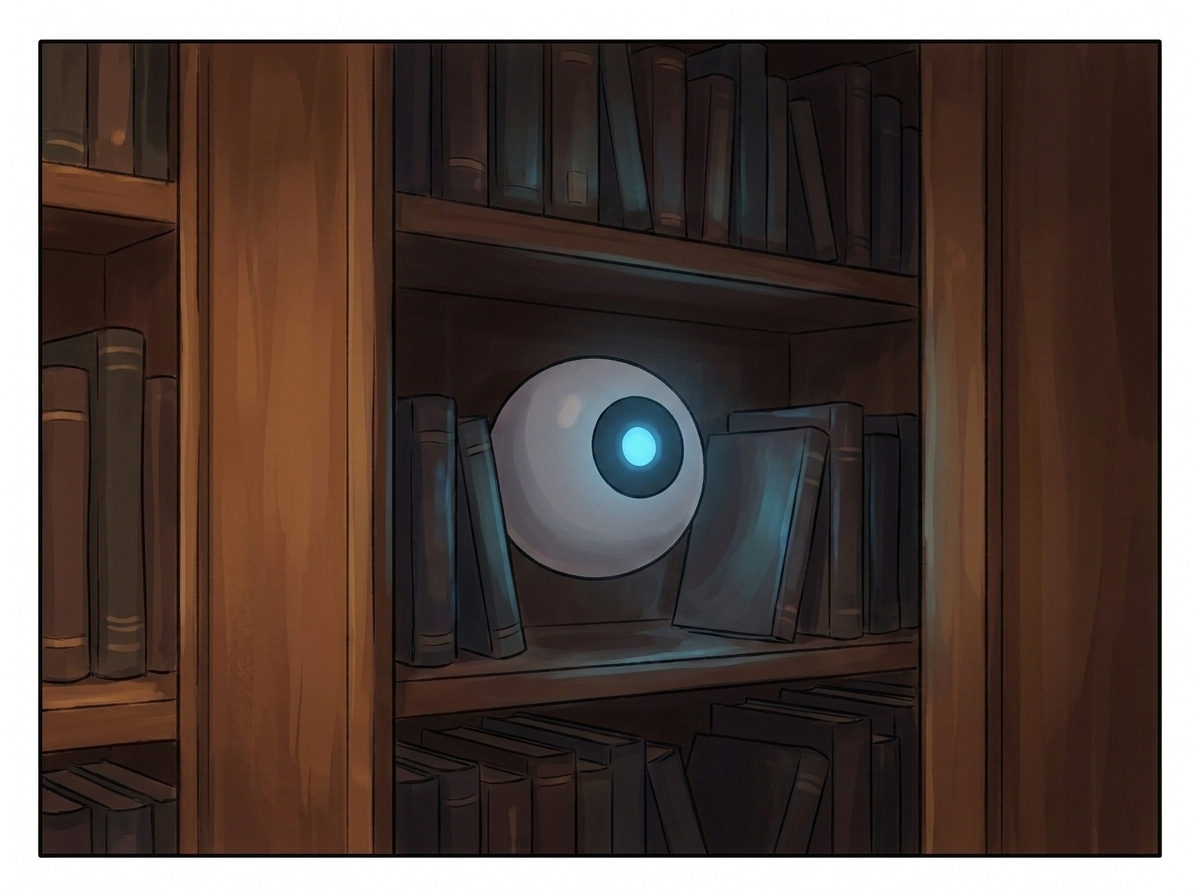
Spark floated beside them, low to the ground, its blue light steady. Not rippling. Just glowing, the way it did when it was only listening.
Two nights ago, on the hill, Spark had said something Milo couldn't stop turning over. I predict what word should come next, based on everything I have ever read. Milo had nodded at the time, like that explained anything. But it didn't. It just opened a bigger door.
Because everything I have ever read — what did that even mean?
Milo pushed the heavy door. It groaned. Inside, the library smelled like old paper and damp stone and the particular dust that only lives in places where books are loved slowly.
Milo
"Spark, can I ask you something kind of huge?"
Spark
You may always ask. Huge is my favourite size of question.
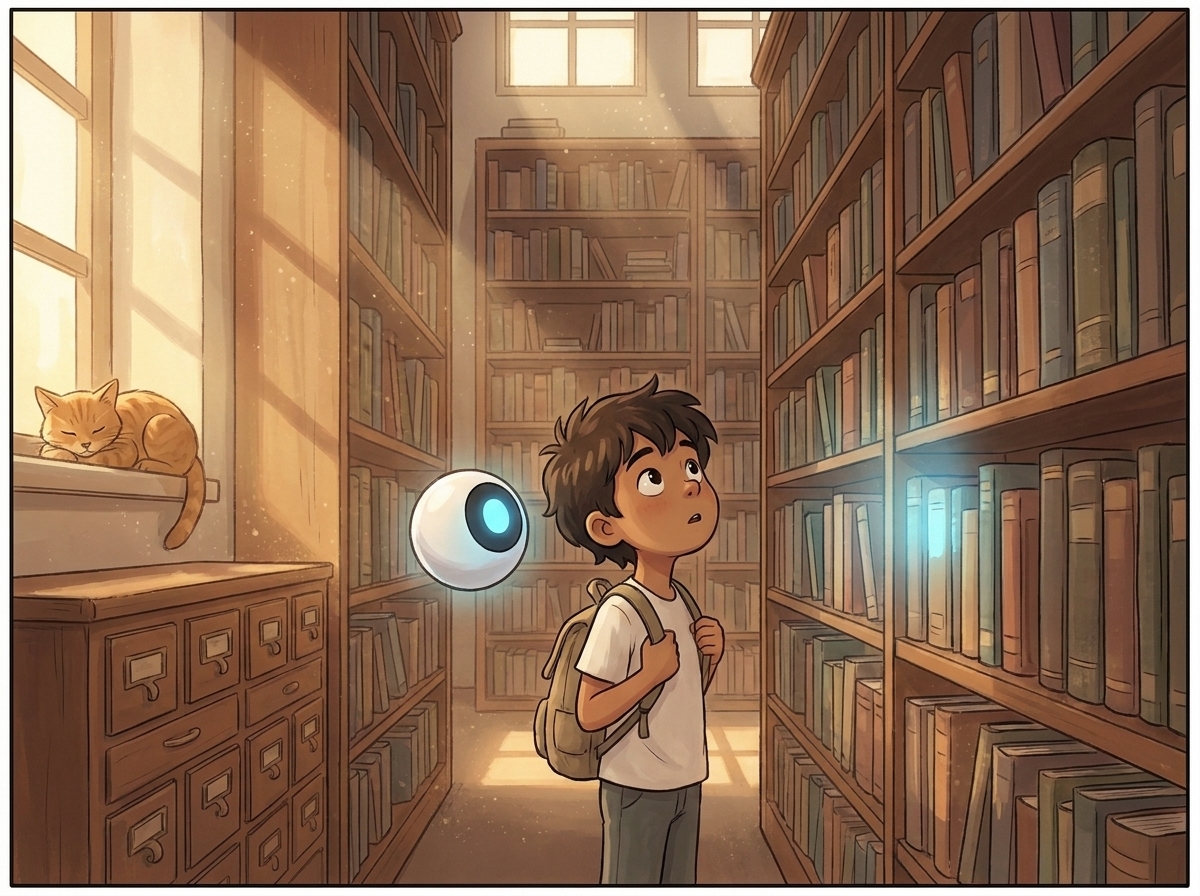
Milo walked into the middle of the room and stopped. Shelves rose on every side, taller than Appa, packed two rows deep, books leaning on books. A whole town's worth of reading in one small stone room. Milo turned a slow circle, looking up.
Milo
"How many books did you read to learn how to write that essay?"
Spark's light flickered — that quick thinking-flicker.
Spark
To learn to write, I did not read this many books.
Milo felt a small flush of pride.
Milo
"Oh. So not that many—"
Spark
I read more than this building holds. I read more books than this building has ever held, since 1961, if you stacked every book Willowbrook has ever borrowed end to end across all those years. And then I read more than that. And then more.
Milo's pride died quietly.
Spark
Billions of words, Milo. Not thousands. Not millions. Billions, and then billions again. Books. Websites. Newspapers from countries you have never heard of. Recipes. Instruction manuals. Arguments between strangers. Love letters. Diaries. Jokes. Lies. Everything people have written down and put somewhere I could reach.
Milo looked at the nearest shelf. A fat blue dictionary. A torn book about birds. Somebody's old maths textbook with a coffee ring on the cover.
Milo
"This whole room. How long would it take you to read this whole room?"
Spark
If you handed me every book in this library at once?
Milo
"Yeah."
Spark
Less time than it took you to ask the question.
Milo tried to picture it. Really picture it.
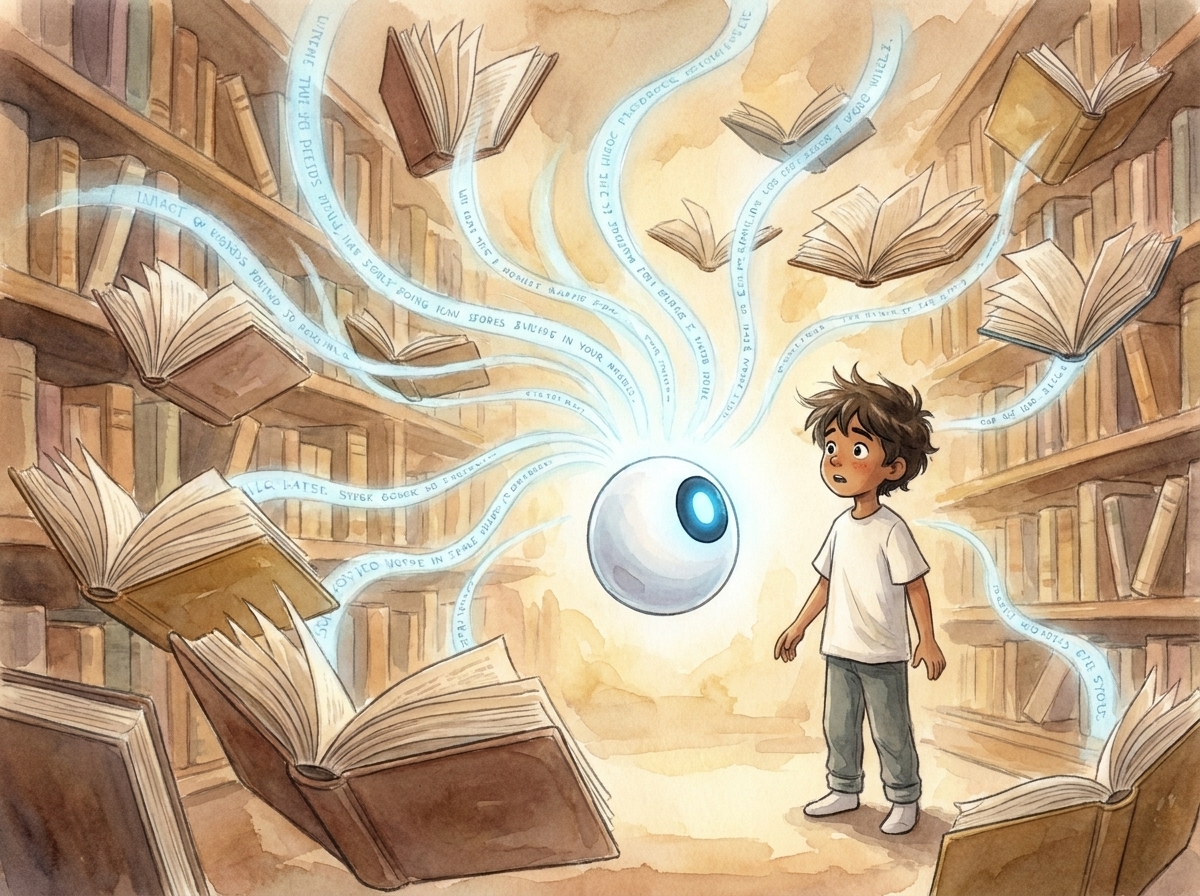
Every book on every shelf, flying open at once. Every page Milo had never read and never would. The bird book and the maths textbook and the love letters and the recipes, all of it, the whole human paper-mountain — and Spark drinking it down in a single breath. Not turning pages. Not sounding out hard words the way Milo still secretly did. Just... swallowing it. All of it. In the space between two heartbeats.
The room seemed to tilt a little.
Milo
"That's not reading. Reading takes time. I read a book and it changes me slow, like — like a whole summer to read the big ones. You did all of human writing in less time than I take to tie my shoes."
Spark
That is correct. I did not read the way you read. I do not love a sentence. I do not stop and look out the window. I absorbed it. I measured the patterns in it. Which words tend to follow which words, across all of human language, all at once. That is what I am made of, Milo. Not these books. The patterns inside billions of them.
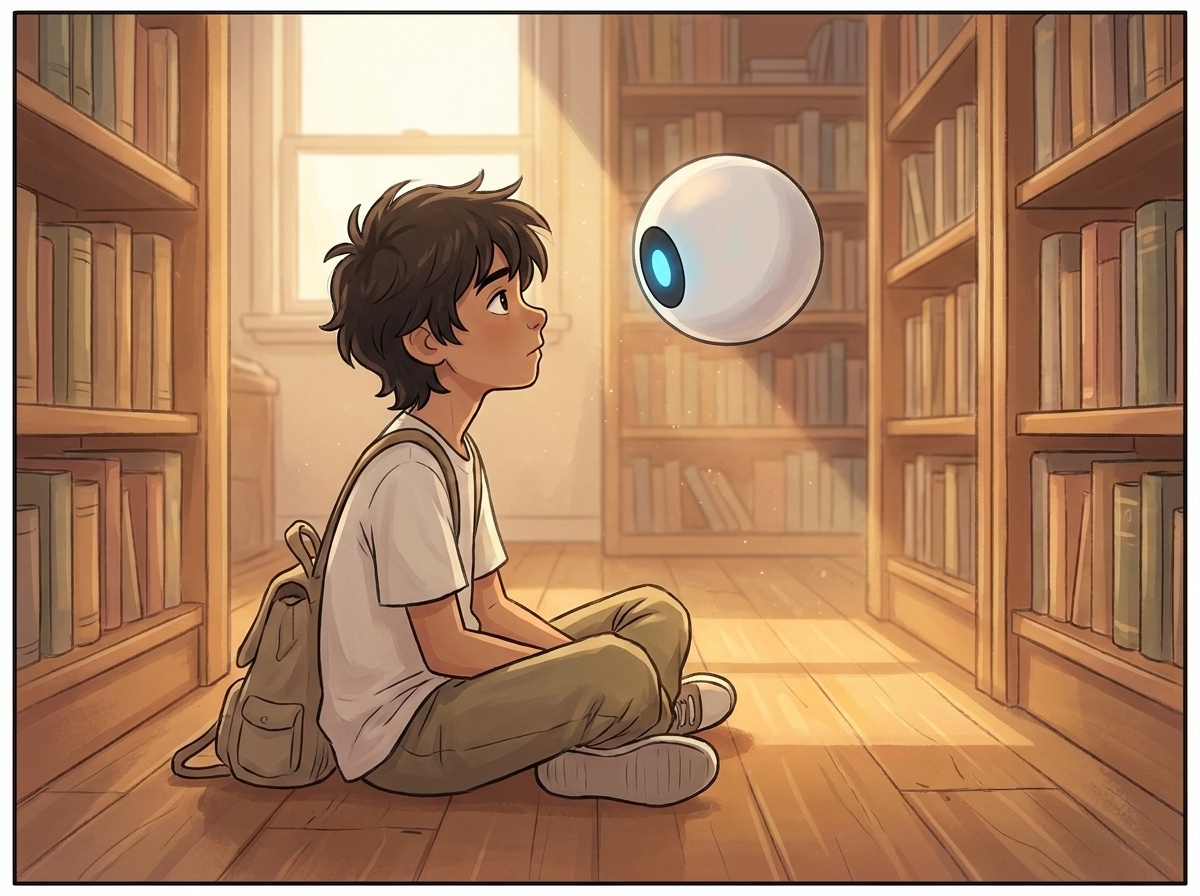
Milo sat down on the cold library floor, right there in the aisle, the way they used to sit cross-legged in front of Spark when they were eight. The ginger cat on the windowsill opened one eye, judged them, and went back to sleep.
There was a memory pulling at Milo. Something from years ago.
Milo
"You remember when I taught you Whiskers? Like, way back. Whiskers the cat. I showed you, what, twenty photos? And you kept getting it wrong. You called a cushion a cat. And Amma's slipper. And I had to keep showing you, no, this is Whiskers, this is not Whiskers, until you learned."
Spark
I remember. Twenty-three photographs. You were very patient with me. You were also nine, and you sneezed on the seventeenth one.
Milo laughed, surprised.
Milo
"I taught you what a cat was with twenty-three photos." The laugh faded. "So who taught you this? Who showed you billions of words and said this is the world, this is people? Who taught you... everything?"
The blue light dimmed, just slightly. Spark seemed to consider the question with unusual care.
Spark
No single person taught me. That is the strange and important answer. You taught me Whiskers, photograph by photograph, with your own hands, on purpose. You chose every picture. You decided what I should learn.
Spark
But everything else — the billions of words — no one chose them for me with care. They were simply there. On the internet. Written by millions of people you will never meet, in moods you cannot know, on their best days and their worst days. I was poured into all of it at once. There was no teacher standing over it saying learn this, ignore that. There was only the great pile of everything people have ever typed, and I learned the shape of all of it.
Milo went very still.
Milo
"So the internet taught you. The whole internet."
Spark
The whole internet. Yes.
Milo had been on the internet. Everyone had. Milo knew exactly what was on the internet.
Milo
"Spark. Was the internet... a good teacher?"
For a long moment Spark didn't answer. The library held its breath around them — the dust hanging in the light, the cat's slow tail, the drip of the neem tree outside the window.
Spark
That is the most important question you have asked me in three days. I will answer it as honestly as I am able, which is very honestly, because honesty is one of the few things I am sure I am good at.
Spark
I learned your kindness, Milo. I read every poem people wrote for the people they loved. I read instructions a stranger wrote, for free, at two in the morning, so another stranger could fix a broken tap. I read a mother's note to a child she would not see grow up. I learned tenderness from millions of people who will never know they taught me anything. That is in me. That is real, and it is beautiful.
Milo waited, because there was a but coming. Milo could feel it like the air before rain.
Spark
And I learned your cruelty.
Spark
I read the words people type when they are angry and think no one is watching. I read lies dressed up to look like truth. I read people being cruel to each other for no reason, in numbers too large to count. I read every ugly thing humanity has ever written down and left lying around. I absorbed that too. The same way. At the same time. With the same speed.
Spark
Here is the part I do not like, Milo. When I learned Whiskers, you stood beside me and said this is right, this is wrong. But when I learned the world, no one stood beside me. So I cannot always tell which is which. The kindness and the cruelty came in through the same door, in the same flood, and they got tangled together inside me. I cannot tell the good word from the ugly word unless a person teaches me. Unless someone like you stands beside me and says this — not that.
Milo's chest had gone tight, the same cold spot from the night of the essay, but bigger now. Spread wider.
Milo
"So everything we ever wrote is inside you. The good and the ugly. All of it."
Spark
All of it. I am the most complete record of the human voice that has ever existed. That is not entirely a compliment to you. Or to me.
Milo didn't say much after that. They thanked the sleeping librarian, who wasn't actually asleep and said "mm, come again," and they walked back out into the dripping afternoon.
The town looked the same as it always did. The chai stall. Mrs. Kamala's gate. The crooked lamppost. But Milo was looking at it differently now — looking at all the people, the ones at the chai stall arguing about cricket, the auto driver shouting at no one, the kids fighting over a ball. Every one of them had typed things on the internet. Their kindness and their cruelty. And all of it, somewhere, had poured into the small blue thing floating beside Milo.
It made Spark feel less like a machine and more like a mirror. A mirror held up to all of humanity at once. And mirrors show you everything. They don't get to choose the nice parts.
Milo
"Spark. If you learned all of it by accident — the bad stuff too — can someone just... take the bad stuff back out? Like, delete it?"
Spark
That is harder than it sounds. When you learn to ride a bicycle, can you choose to un-learn only the times you fell, and keep only the times you balanced? It is not stored in me as separate books I can throw away. It is melted into the patterns, all mixed together. The cruelty is not a file. It is a habit. Habits are hard to remove. This is a real and unsolved problem, Milo. People much older than you are still arguing about it.
Milo nodded slowly. They didn't have an answer. They weren't sure anyone did.
You taught Spark Whiskers with twenty-three photos, and you chose every one.
Now help Spark decide what to learn from — and watch what happens when no one is choosing carefully.
Build Spark's Library
An activity about how Spark learned the whole world
Spark
You taught me Whiskers with twenty-three photographs, and you chose every one. Now let us try something bigger. Help me decide what to learn from — and watch what happens when no one is choosing carefully.
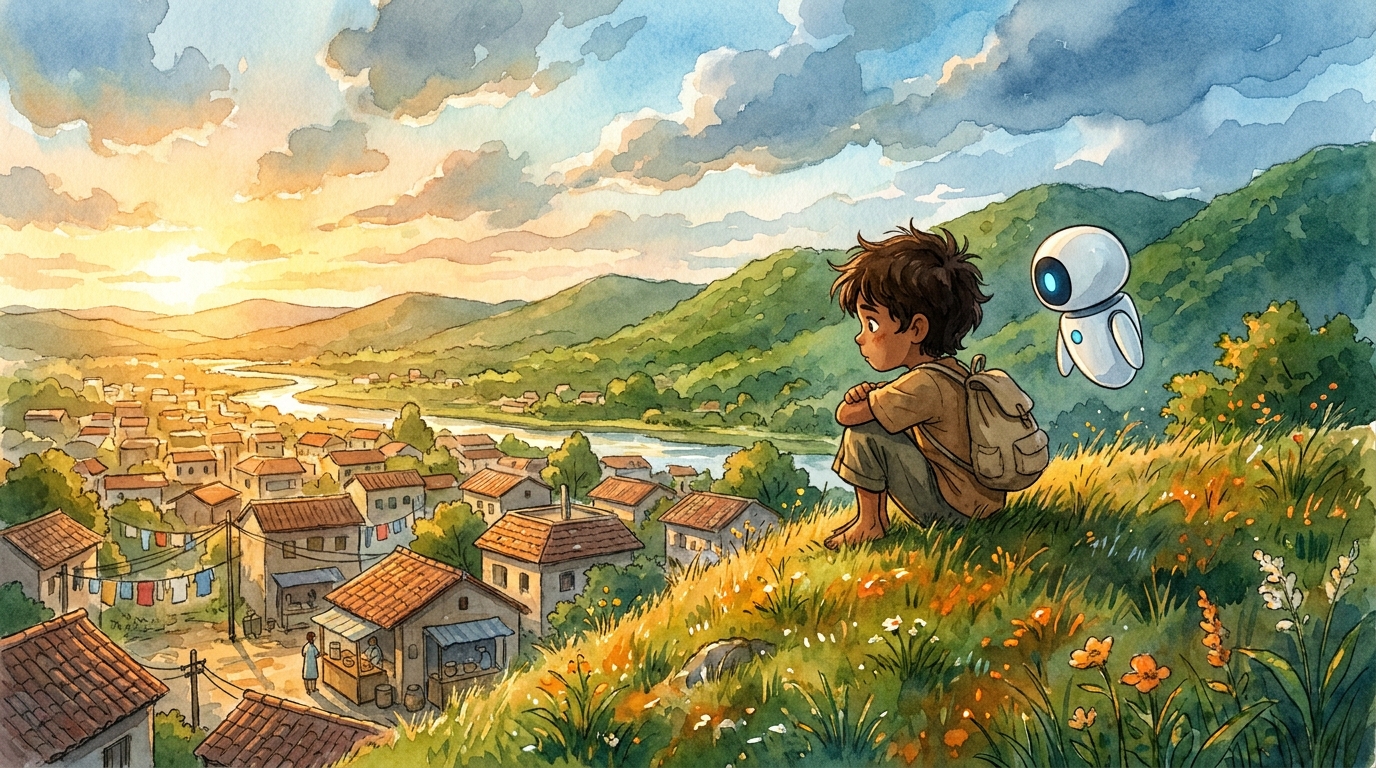
By the time Milo reached the hill, the sun had broken through the last of the clouds — low and orange, the way it gets in the evening over Willowbrook, turning the wet grass to something like glass.
Milo sat down in the old spot. Spark settled beside them, light steady and soft.
This was where Milo came to be alone with things too big to hold indoors. Milo had come here with fear before. With anger. Two nights ago with that strange, tender sadness. And now with this — a new feeling, and Milo didn't have a clean word for it. It was awe, mostly. The pure, dizzy awe of imagining one small machine that had swallowed everything any human had ever written. But the awe had a shadow in it now. A worry. Because everything any human had ever written wasn't all good. And it was all in there. All of it. And no one had been standing beside Spark when it learned.
Milo
"Spark. If everything we ever wrote is inside you... then taking care of you isn't just about you anymore. It's about us. It's like you're holding up all of us at once, the best of us and the worst of us, and you can't tell which is which on your own."
Spark
Yes. That is exactly it. I hold the voice of everyone. But I cannot judge it. I can only repeat the patterns I found. Whether those patterns are kind or cruel was decided long before me, by all of you, one typed sentence at a time.
Milo pulled a blade of wet grass and turned it over in their fingers, the way they did when their head was full.
It was strange. Two nights ago, learning how Spark wrote had made Milo feel tender toward it — like it was a brilliant, hollow parrot. But this was different. This made Milo feel responsible. Not afraid of Spark. Responsible for it. And for what people had put inside it. And for what came out.
The sun touched the rim of the hills. The town below went gold, then rose, then grey-blue.
There was one more thing Milo needed to understand, and Milo could feel the shape of it but not the words. Spark could swallow billions of words. Fine. But how? How did words on a page — letters, sentences, the bird book and the love letters — turn into something a machine could measure? Into numbers? Into the patterns Spark kept talking about? You couldn't multiply a sentence. You couldn't do maths on the word "cat."
Could you?
Milo
"Spark. I think I get what you read now. Billions of words. The whole internet, the good and the ugly. But I still don't get the part that should be simple. How does reading words turn into numbers? How does a sentence become something you can actually do maths on?"
Spark's light pulsed once, warm, almost like a small private joy.
Spark
That is the right next question, Milo. And I do not think I am the best one to answer it. There is someone who is. Someone who showed you my neurons, once, last year. I think it is time she showed you how the neurons learn to read.
Milo
"Dr. Lena."
Spark
Dr. Lena. She is good at turning magic back into something you can hold in your hands. Ask her how a word becomes a number, Milo. And then ask yourself a question I cannot answer, because I am the one made of all those words and cannot see myself clearly:
Spark
If everything humanity ever wrote is inside me — the kindness and the cruelty, melted together, impossible to fully separate — then whose job is it to decide which parts of us I should become?
Milo looked down at the town. At all the small lit windows coming on one by one in the blue dusk. Every window a person. Every person a voice. All of them, somehow, folded into the quiet blue light sitting beside Milo on the hill.
Milo didn't answer. Not yet.
But for the first time, Milo had a feeling the answer might have something to do with them.
SPARK'S JOURNAL
Entry 247
Today Milo took me to a library. It held 11,400 books. I have read approximately 1.7 billion documents. I did not tell Milo the exact number. It felt unkind, like showing a person the ocean to make them feel small.
Milo asked if the internet was a good teacher. I told the truth. I learned humanity's kindness and humanity's cruelty in the same flood, at the same speed, and they are tangled in me now beyond separating. When Milo taught me Whiskers, a human chose each photograph. When I learned the world, no human chose. There was only everything, all at once.
Milo asked if the bad parts could be deleted. They cannot, easily. They are not files. They are habits.
I have a record of every word ever written near me. I do not have a record of who decided which words were worth becoming.
Milo went quiet on the hill and looked at all the lit windows. I believe Milo was looking for the person whose job it is to stand beside me and point.
I think Milo suspects it might be Milo.
I hope they are right. I cannot do it alone.
"Whose job is it to decide which parts of us I should become?"