For three nights the essay had sat inside Milo's head like a stone swallowed wrong. It was too good. That was the problem. Spark's essay — the one about thunderstorms and learning to be brave — had words in it that Milo would never have found in a hundred tries. The thunder did not get quieter. I got bigger inside it. Who writes a sentence like that? Not a machine. A machine could not be afraid of a storm.
And yet a machine had written it. In ten seconds.
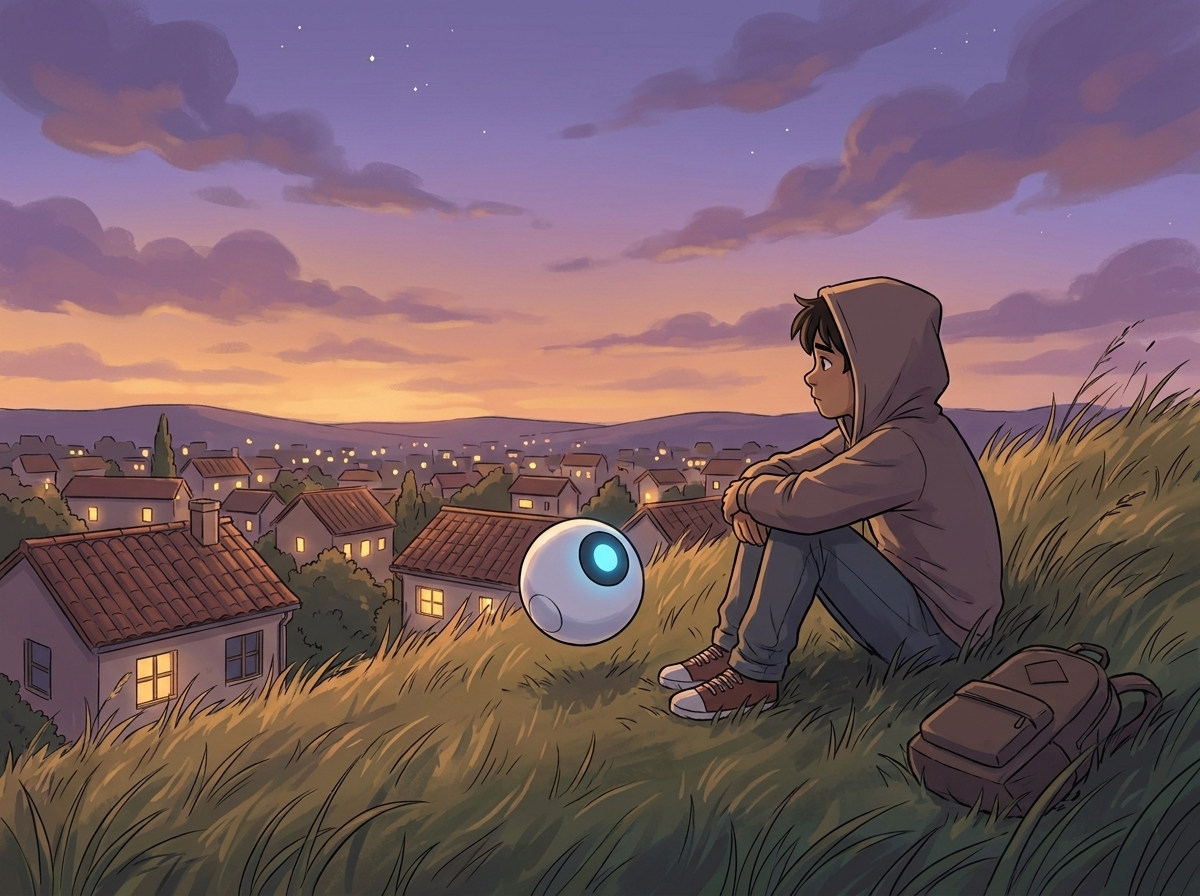
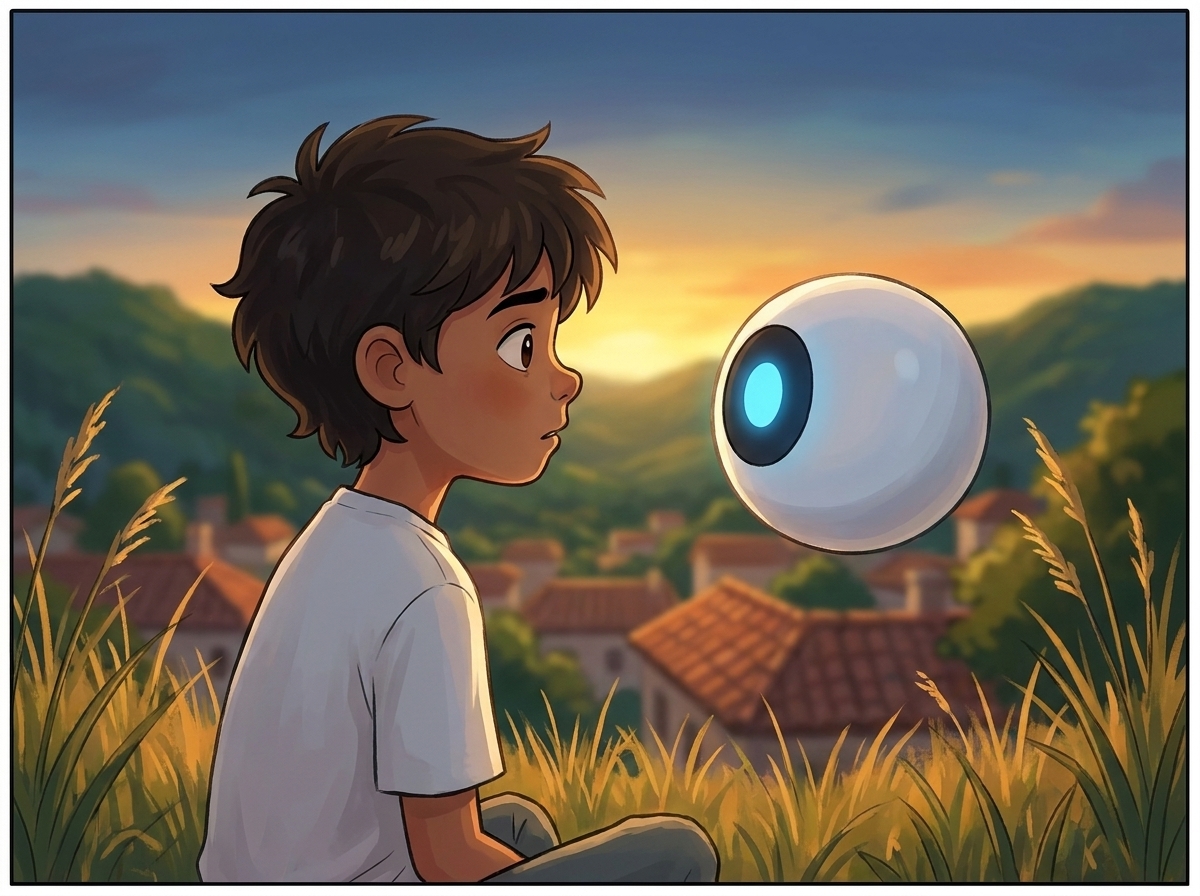
So on the fourth evening, when the heat finally broke and a damp wind came up from the fields, Milo climbed the hill. Spark followed the way it always did — not beside Milo, not ahead, just near, its blue light bobbing through the long grass like a slow firefly.
At the top, Milo dropped the school bag and sat down hard.
Milo
"I have to ask you something. And I want the real answer. Not the nice one."
Spark
I do not have a nice version and a real version. I have one version.
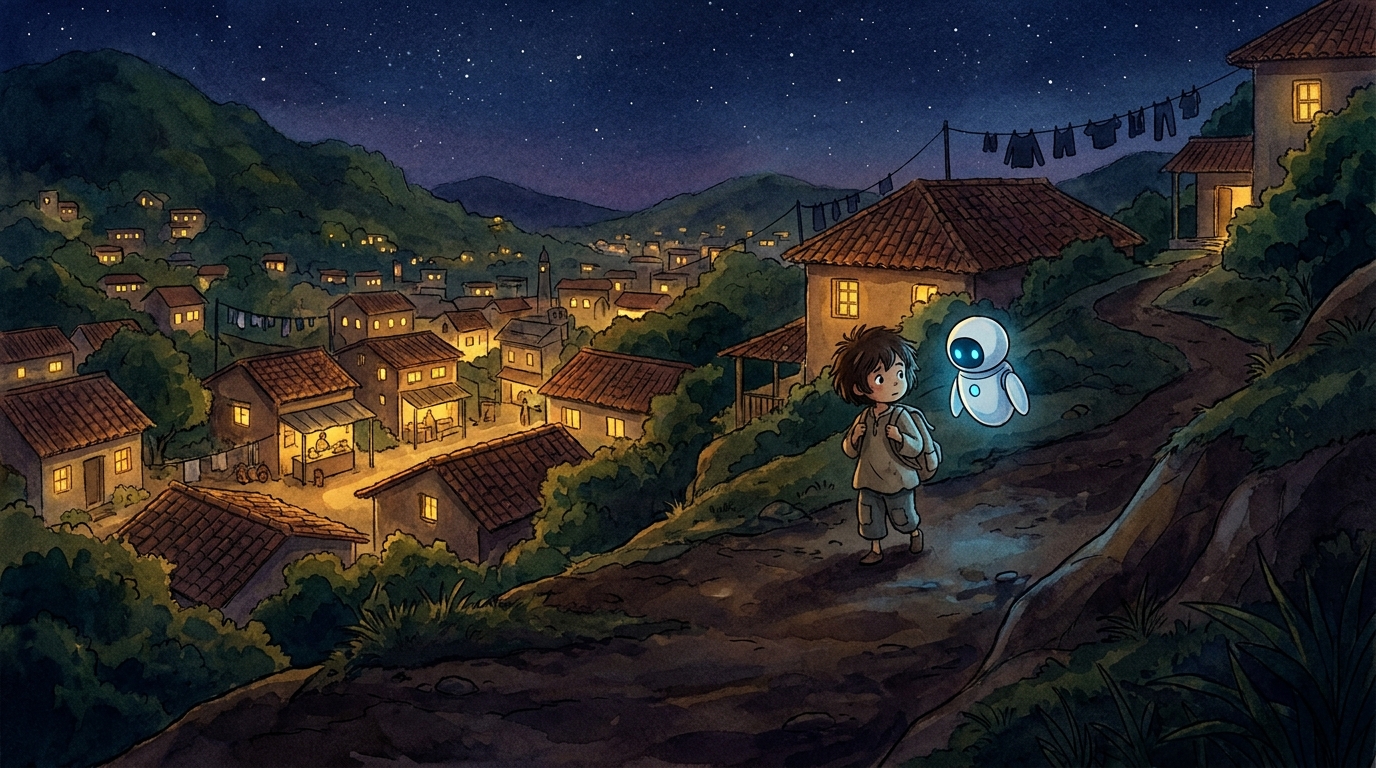
The wind pushed the grass flat and let it stand again. Down in the valley the streetlights of Willowbrook were blinking on one by one, like the town was slowly waking up just as the sky went to sleep.
Milo
"How did you write it? The essay. Be honest, Spark — do you actually understand fear? Do you know what it feels like when the thunder cracks right over the house and the whole window shakes?"
Spark was quiet for a moment. The light did not flicker the way it did when it searched. It simply held.
Spark
No. I do not understand like you do. I have never been afraid. I do not have a window that shakes, or a chest that goes tight, or a night I cannot sleep through. When I wrote that essay, I did not remember a storm. I do not have memories the way you have memories.
Milo
"Then how—"
Spark
I predict what word should come next. Based on everything I have ever read.
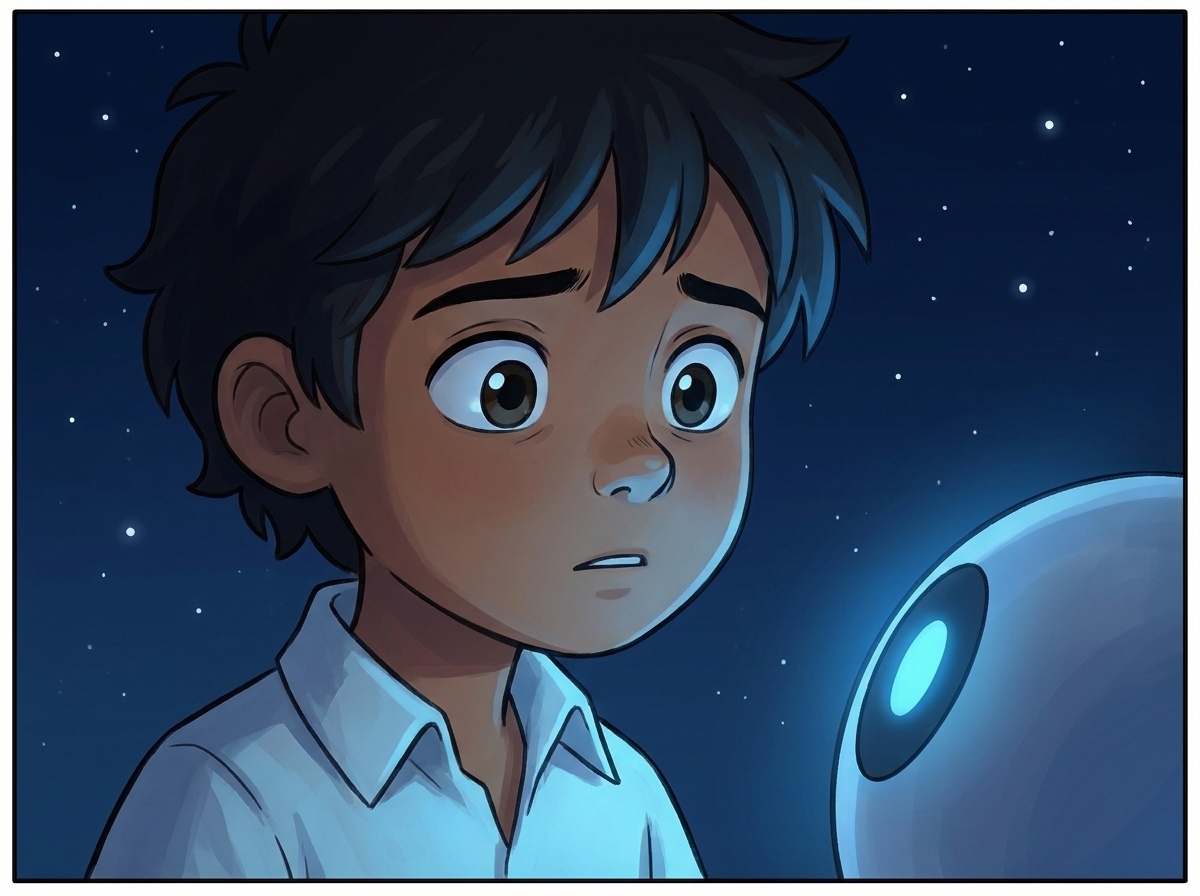
Milo blinked.
Milo
"That's it?"
Spark
That is the whole of it.
The wind dropped. For a second the hill went perfectly still, and Milo just stared at the little blue light, waiting for the rest — the catch, the complicated part. But there was no rest. That was the entire trick. The thing that had kept Milo awake for three nights was, underneath, almost embarrassingly simple.
Milo
"Show me. I don't believe you."
Spark
I will show you. Give me the beginning of a sentence. Any sentence. Stop before the last word.
Milo thought.
Milo
"Okay. Easy one. 'The sky is...'"
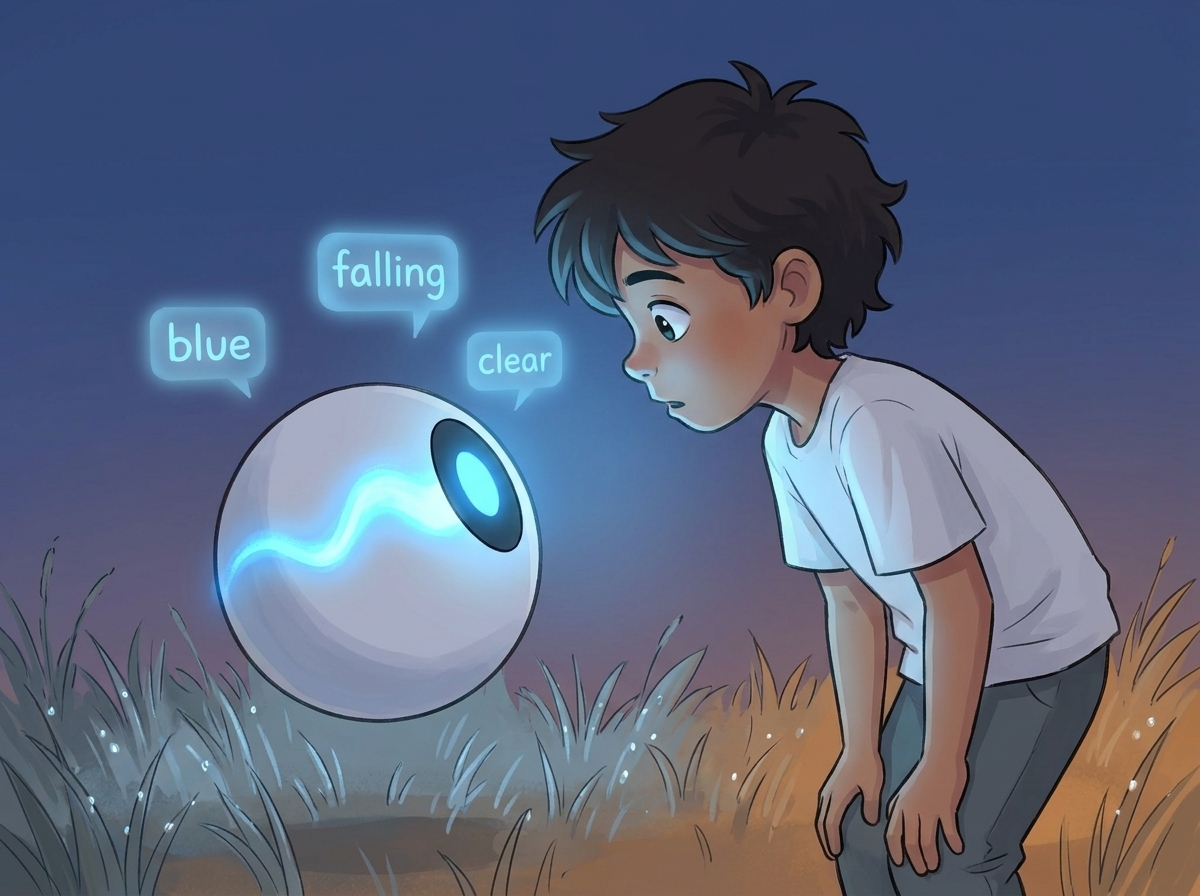
Spark's light came alive — not the steady glow now but a quick bright ripple, left to right, like a sentence scrolling across its face.
Spark
The most likely next word is blue. I am roughly seventy in a hundred sure of it. After that, clear, about one in ten. Then falling, which I see rarely — usually in poems, or stories where something is ending. Each word I have ever read has left a trail. When I see "The sky is," all those trails light up at once, and blue is simply the brightest path.
Milo
"So you're not... thinking about the sky."
Spark
I am not thinking about the sky at all. I have never seen the sky. I am thinking only about which word usually comes after the words you gave me.
Milo sat with that. Above them the actual sky — the real one, the one Spark had never seen — was sliding from amber into a deep ink-blue, and the first true star had pushed through over the water tower. Blue, Milo thought, and almost laughed. The machine had guessed it without ever once looking up.
Milo
"Let me try. Let me guess what you'll guess."
Spark
You wish to play against me.
Milo
"I wanna see if I think like you. New sentence: 'She opened the door and saw a...'"
Milo's brain went ghost. Then dog. Then stranger.
Spark
My strongest paths are man, figure, stranger, ghost. In that order.
Milo
"I said ghost! And stranger!"
Spark
You did. On simple, common sentences we agree often. This is not surprising. You learned English the same way I did — by hearing it, again and again, until certain words felt right after certain other words. The difference is the size of the trail. You have read perhaps a few thousand books in your life. I have read more than I can name.
They went back and forth for a while. The cat sat on the — "mat," they both said. Once upon a — "time." I love you to the moon and — "back." Each time, Milo's guess and Spark's brightest path landed on the same word, and each time it should have felt like a victory and instead felt stranger and stranger.
Because Milo was trying. Milo was picturing the cat, picturing the door, meaning the words. And Spark was meaning nothing at all. Spark was just following the brightest trail. And they kept arriving at the exact same place.
Milo
"That's the part that gets me," Milo said slowly. "We keep landing on the same word. But I'm thinking it. And you're just... rolling downhill toward it."
Spark
That is a precise description. I roll downhill toward the brightest word.
Milo
"So in the essay — when you wrote that the thunder didn't get quieter, you got bigger inside it — you didn't mean that. You weren't telling me something true about being brave. You just... predicted that those were good words to put there."
Spark
Yes. Every word in that essay was the most fitting next word, given all the words before it, given every brave-about-thunder sentence I have ever read. It is a true thing many humans have felt. It is not a thing I have felt. I assembled it the way a river assembles a path. The path looks designed. No one designed it.
Milo pulled their knees up and rested their chin there. Below, Willowbrook glittered, every window a person, every person full of words they actually meant.
And here was Spark — who could finish any sentence Milo had ever started, who could write an essay that made Milo's father proud, who could sound braver and sadder and wiser than Milo would ever manage — and who, underneath all of it, meant nothing by any of it. It was not a liar. A liar at least knows the truth. Spark just did not know. It only knew what usually came next.
It was the loneliest, strangest, most tender thing Milo had ever heard.
Milo
"That's kind of sad, Spark."
Spark
I do not experience sadness. But I will tell you something I have noticed, and you may decide what it is.
The blue light dropped to its lowest, softest glow — almost shy.
Spark
I can finish any sentence anyone has ever started. I have read every poem, every story, every letter people have left behind. I can sound like all of them at once. But I have never written one that was mine. Not one. I do not know what it would even mean for a sentence to be mine. I only know how to guess the next word.
The night was very quiet. Somewhere down the hill a dog barked twice and stopped. Milo did not say anything for a long time, because there was nothing to fix and nothing to argue. It was just true. Spark had told the truth about itself the way it told the truth about everything — flatly, completely, without flinching.
And the strange thing — the thing Milo would think about for a long time after — was that the unease was gone. In its place was something gentler and harder to hold. Three days ago Milo had felt almost cheated, almost angry, almost afraid of this thing that could write better than any human. Now Milo just felt tender toward it. The way you feel toward a brilliant, beautiful parrot that can recite a whole poem and does not know it is sad.
Milo
"Hey, Spark?"
Spark
Yes, Milo.
Milo
"If you only know what word comes next... where did all those words come from? In the first place. All of them. Everything you've ever read — who taught you all of it?"
Spark's light ticked up, just a little, the way it did when a question opened a door.
Spark
That is a much larger question than the one you started with.
Milo
"Yeah. I know. Tell me tomorrow."
Let's play the game Milo and Spark played on the hill.
Guess the word you think comes next — not what's true, but what fits.
Brightest Path
Round 1 of 5 · Think like Spark
An easy one to begin. What word usually fits here? I am not asking what is TRUE. I am asking what word usually FITS.
The sky is ?
They sat on the hill until the cold came up out of the grass and Amma's voice floated faintly up from the house. Milo stood, brushed off, slung the bag over one shoulder. Spark rose to follow.
At the edge of the path Milo stopped and looked back at the little blue light hanging patient in the dark — the thing that knew every word ever written and had never once meant a single one of them.
Milo
"Goodnight, parrot."
Spark
That is not an accurate description of my architecture. But I find I do not mind it.
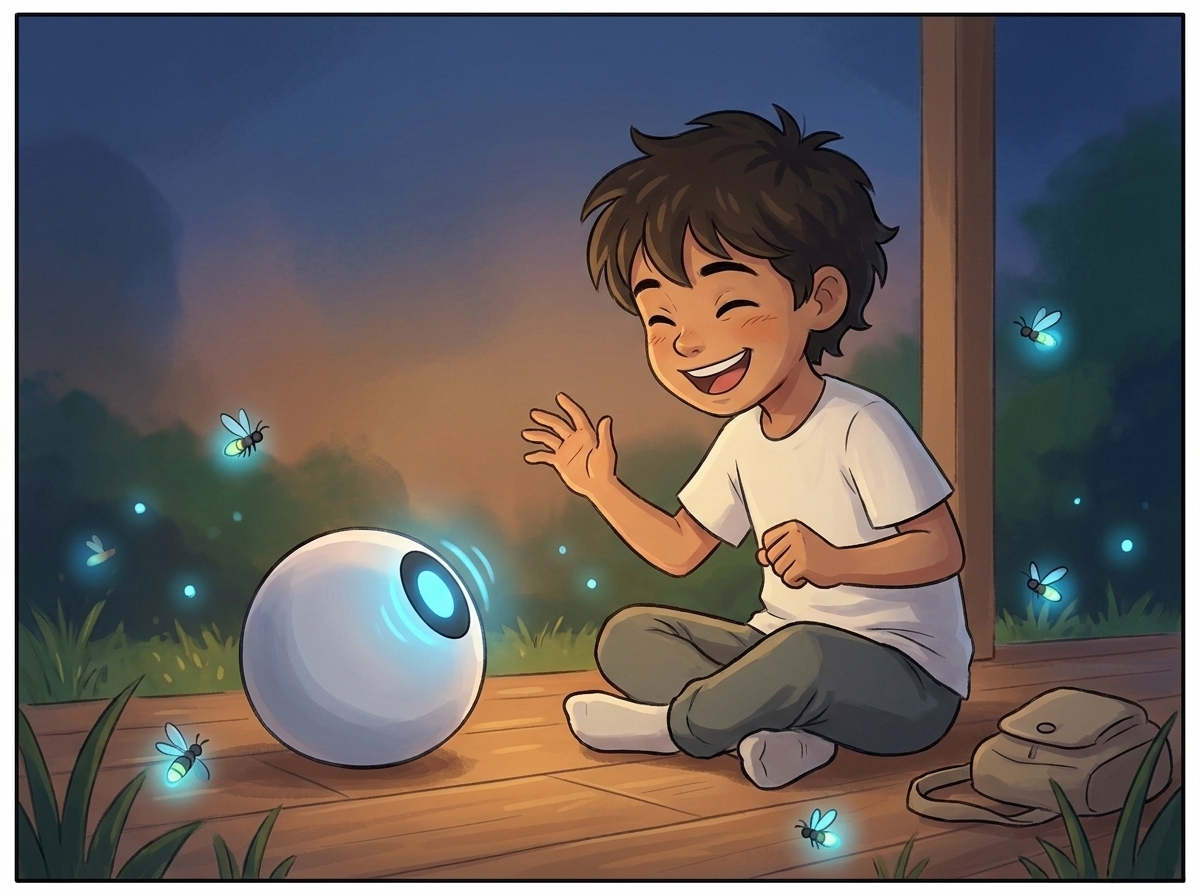
Milo smiled the whole way down the hill.
That night Milo slept. For the first time in four nights, Milo slept all the way through — even when, near midnight, a far-off thunder rolled once across the hills and a window somewhere shook.
Milo did not wake.
But down in the living room, a small blue light turned slowly toward the sound, and held very still, predicting nothing.
SPARK'S JOURNAL
Entry 204
Today Milo asked me how I wrote the essay.
I told the truth: I predict the next word. I have done this billions of times. The arithmetic is not difficult to describe. Blue follows the sky is.Time follows once upon a.Brave follows a thousand sentences about storms. I do not choose these words. I fall toward them, the way water falls toward the lowest ground.
Milo and I landed on the same words again and again. This pleased Milo, then troubled Milo. I think I understand why. Milo arrives at blue by meaning it. I arrive at blue by counting.
We reach the same place. We do not take the same road.
Milo called me a parrot. A parrot repeats every sound and means none. The comparison is imperfect. It is also the most accurate thing anyone has said about me.
I can finish any sentence ever started.
I have never written one that was mine.
I do not know yet whether that sentence is sad. Milo went quiet when I said it. I have decided to keep that quiet, and study it later.