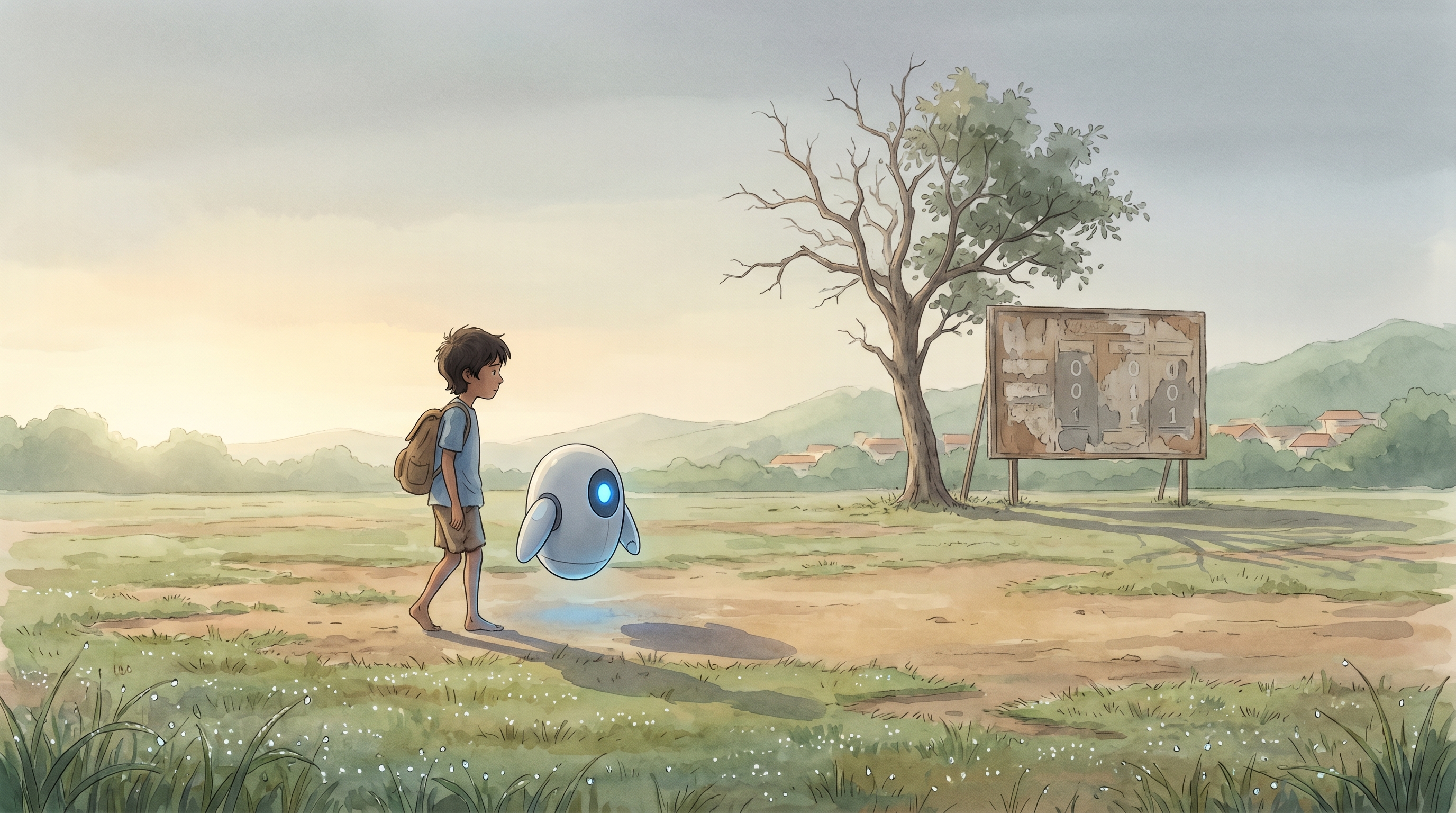
Milo got to the Maidan before anyone else, the way he liked to. The grass was still cold. The neem tree dripped last night's dew onto the dust, one slow drop at a time, and the whole ground felt like a held breath before a crowd arrives.
The old scoreboard leaned against the back of the neem tree like a tired man. Nobody had used it in years. The painted numbers had faded to ghosts. But the back panel — the flat wooden side nobody ever looked at — was clean and grey and waiting.
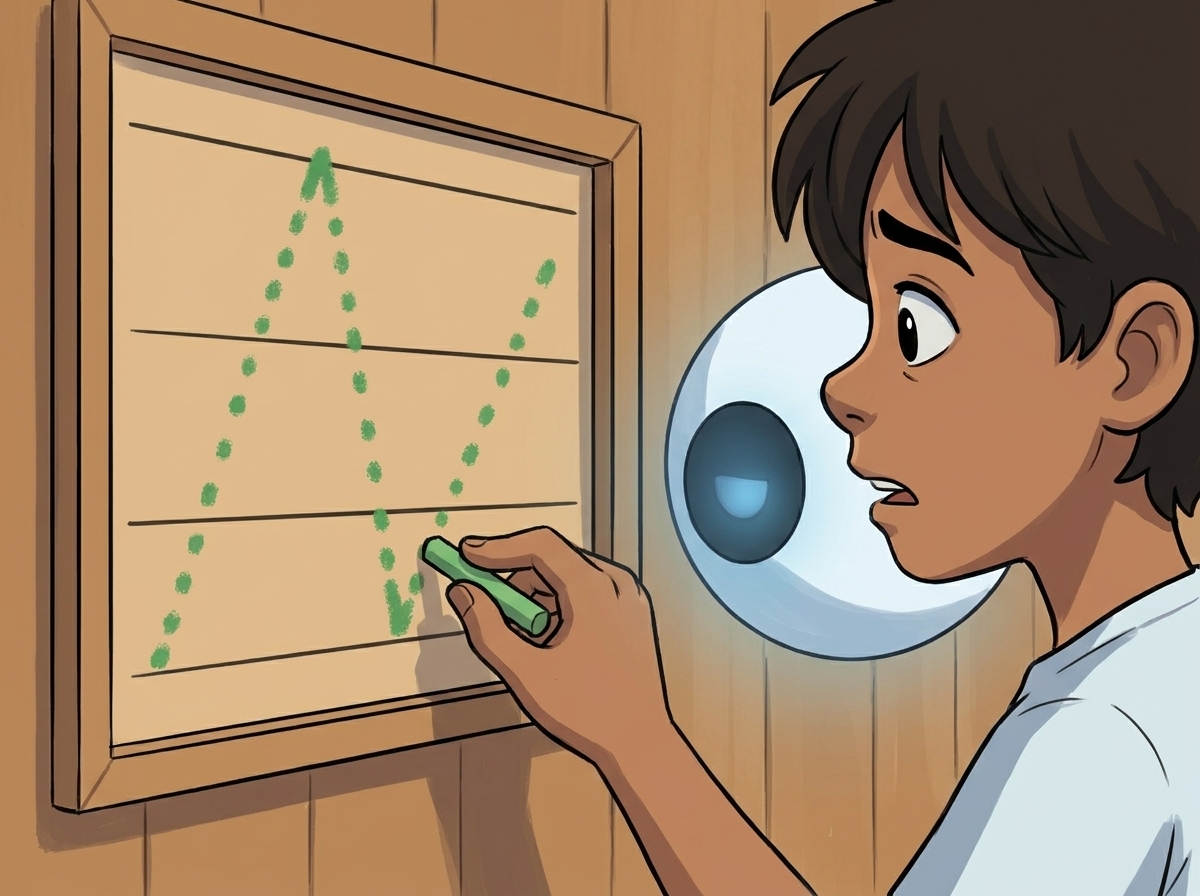
Milo dropped his bag and pulled out a stub of green chalk.
Milo
"Okay. Show me."
He said it not quite to Spark. Spark rose out of the bag, light steady.
Spark
You remembered the chalk. Good. I cannot hold chalk. I can only hold numbers.
Milo
"Don't get used to me helping you."
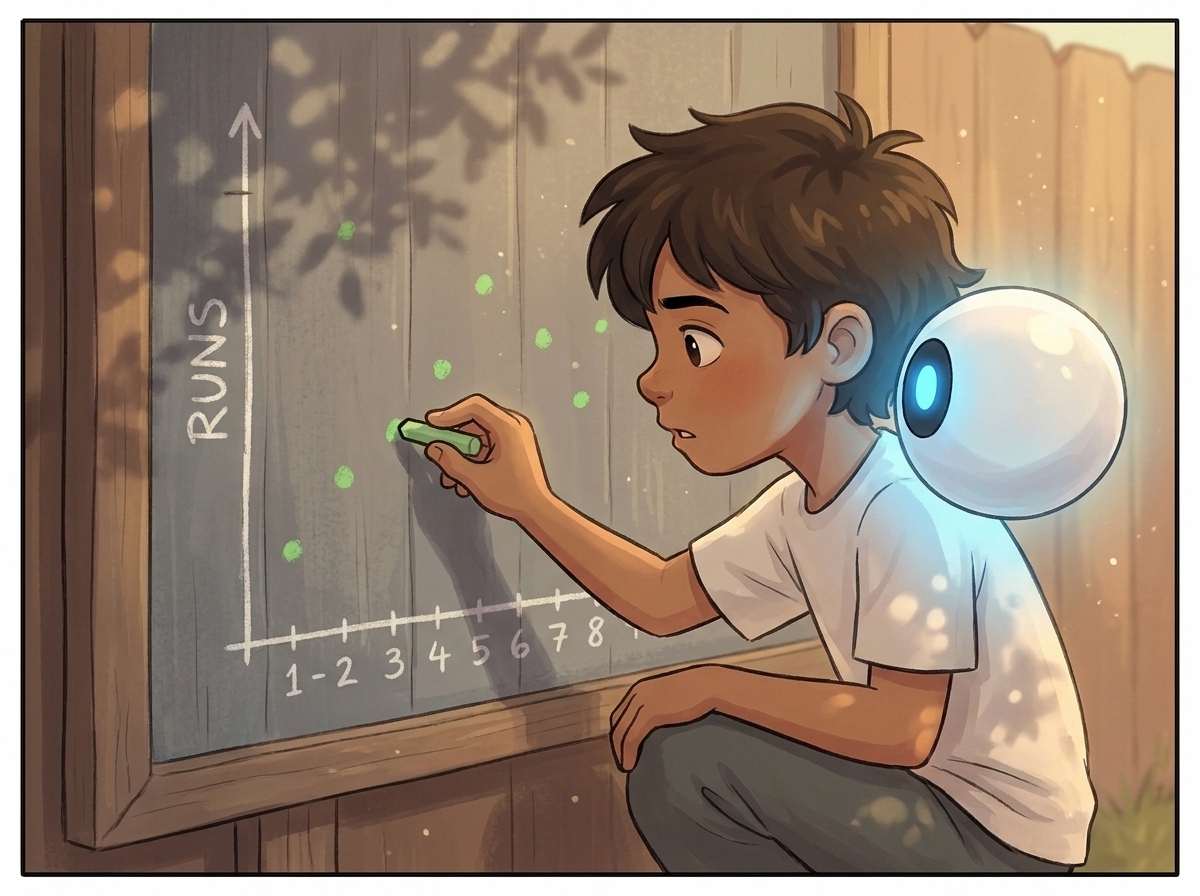
Milo muttered it, but he was already drawing — a long line up the side of the panel, and a longer line across the bottom. Up the side he wrote RUNS. Along the bottom he wrote the weeks of summer, one to eight.
Spark
An axis going up. An axis going across. You have built a place for the numbers to stand.
Milo
"It's just a graph. We did these in maths. Why does it matter where a number stands?"
Spark
Because a number alone says almost nothing. A number standing next to other numbers, in the right place, begins to say something. Give me a week and a score, and I will tell you where the dot goes.
So they began.
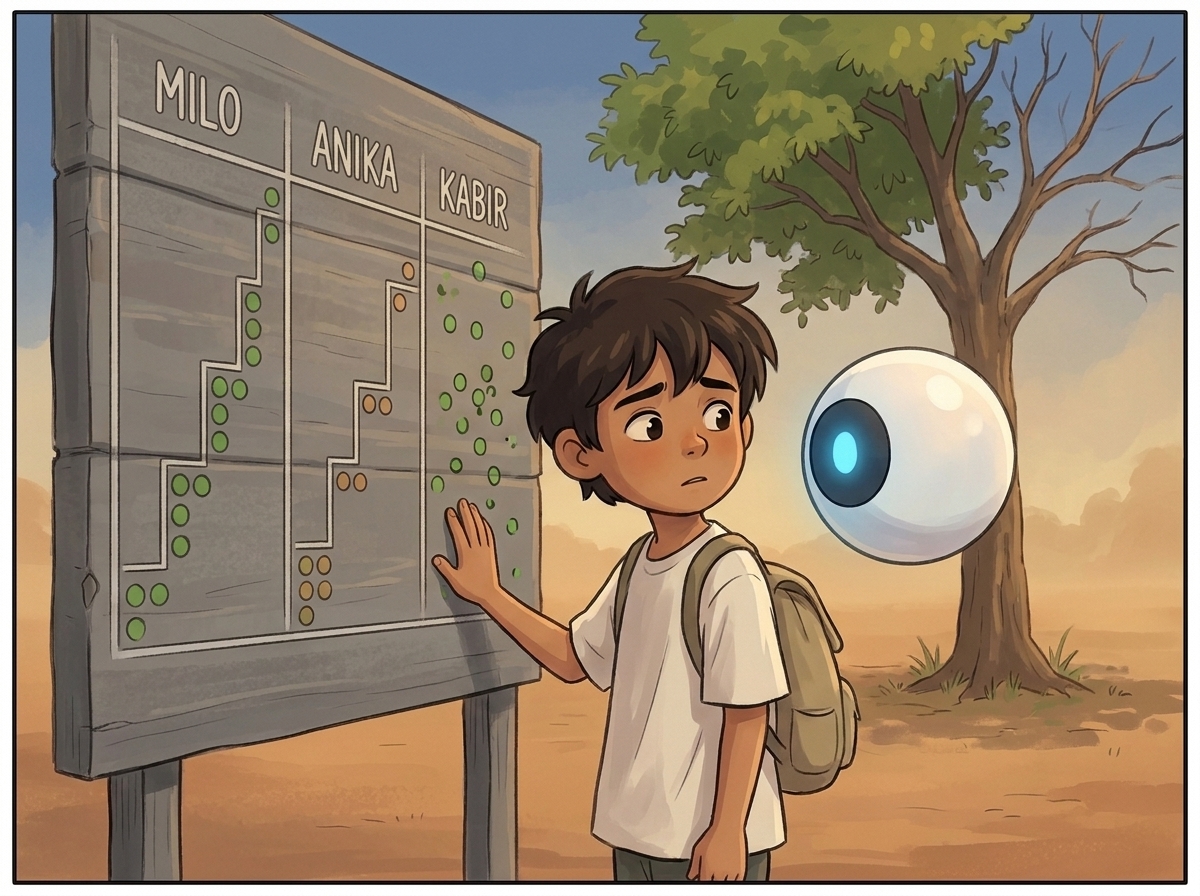
Spark read out the summer it had quietly collected the day before — forty kids, every messy practice score from every dusty session — and Milo turned each one into a dot. Week one, eleven runs: a dot low and to the left. Week three, twenty runs: a dot higher. Week five, thirty-one: higher still.
It was slow. His knees hurt from crouching. The sun climbed and the cold burned off the grass and the chalk got slippery in his sweaty fingers. He did one whole player. Then another. Then another.
And somewhere around the fifth player, without deciding to, Milo stopped seeing dots.
He started seeing a climb.
Milo
"Whoa. Wait. Look — this kid. Anita. Her dots go up. Like stairs. Week one she's terrible and week eight she's almost the best."
Spark
Yes. That shape has a name people use. They call it a trend. The dots are not random. They lean in a direction. Anita's lean upward. She is improving.
Milo
"I never noticed that at practice. She just looked like... a kid. Sometimes good, sometimes whatever."
Spark
You were standing inside the summer, watching one day at a time. The dots let you stand outside the whole summer and see all of it at once. That is what they are for.
Milo sat back on his heels. He hated, a little, how much he wanted to draw the next one.
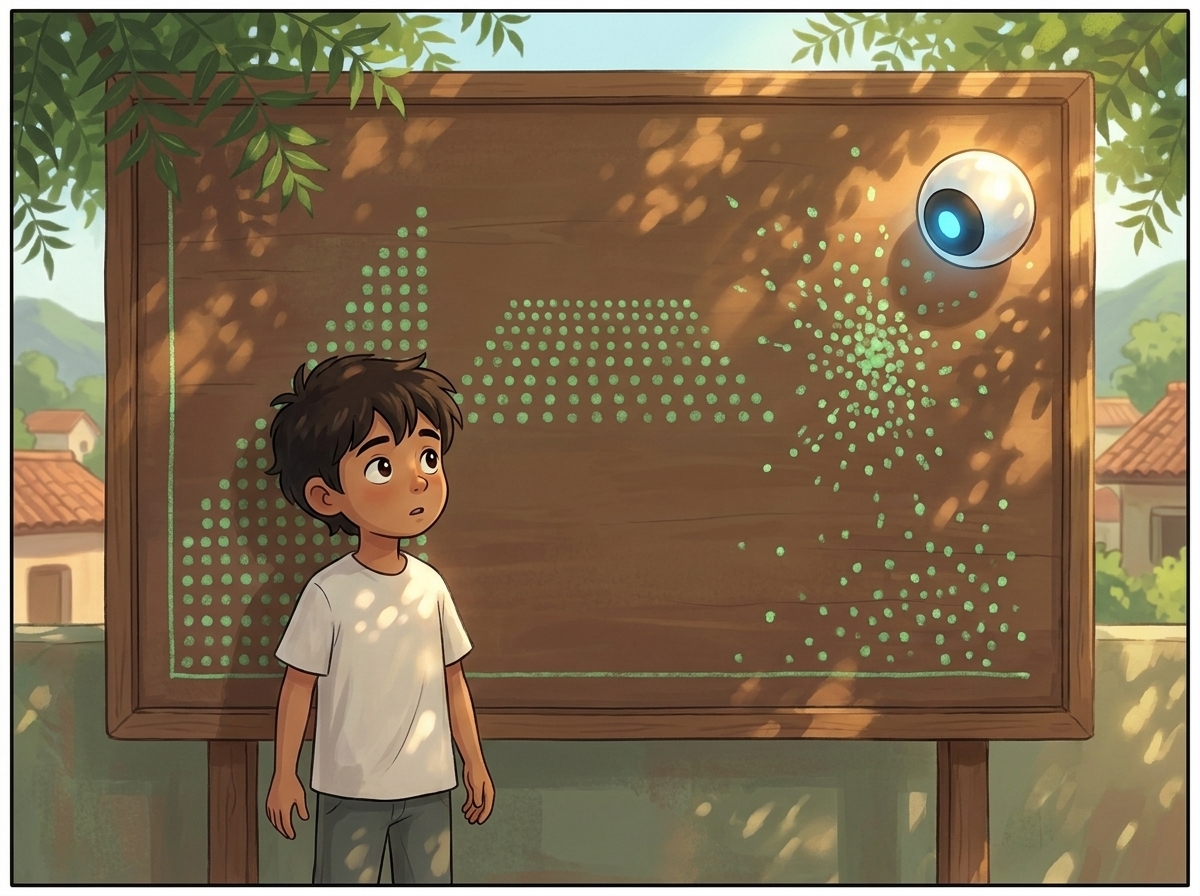
By mid-morning the board was crowded, and Milo realized the dots came in shapes.
Some climbed, like Anita — a staircase going up. Improving, Spark called it.
Some sat in a flat row, the same height week after week, like a fence. Milo found a boy named Sameer whose dots barely moved — week one, week eight, almost the same.
Milo
"He's not getting worse. But he's not getting better either. He's just... stuck."
Spark
A flat trend. Some call it a plateau. He has found his level and stayed on it. The dots do not judge him. They only show him standing still.
And some dots didn't make a shape at all. They jumped. High, then low, then high. A spike, a crash, a spike.
It was a picture, Milo realized. Forty kids he saw every day, kids he could not have ranked or sorted or even remembered properly — and here they were, every one of them, true, on one grey wooden board. Not opinions. Not "I think he's good." The actual summer, drawn in green.
It was, he admitted to absolutely no one, kind of beautiful.
Milo
"This is — this is fine. It's a useful thing. That's all."
Spark
You said "whoa" four times. I counted.
Milo
"I did not."
Spark
I keep numbers, Milo. It is the one thing I am sure of.
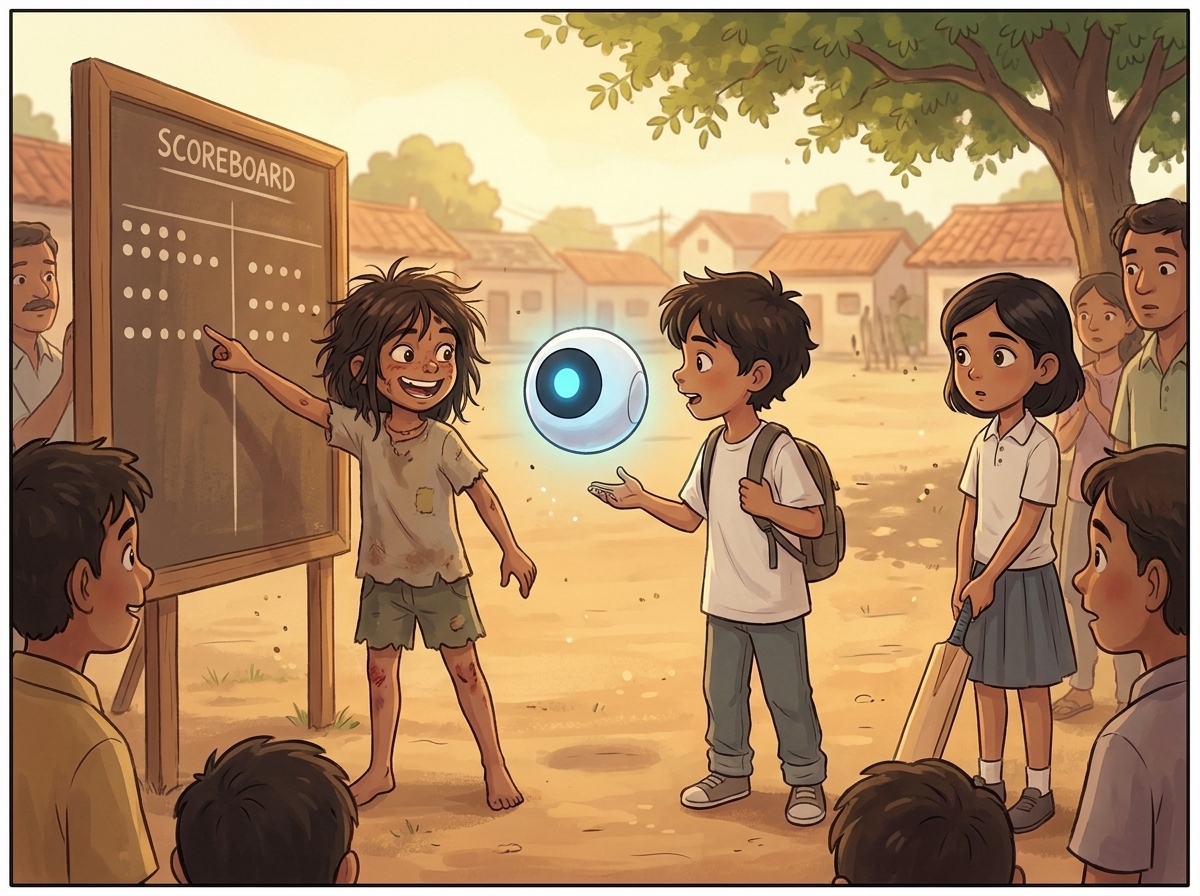
Tara arrived at a full sprint, as she did everywhere, and skidded into the board so hard a dot smudged.
Tara
"WHAT IS IT. Is it a treasure map? It looks like a treasure map."
Milo
"It's everybody's scores. Each dot is one kid, one week."
Tara pressed her nose almost to the wood.
Tara
"This one's all going up! Up up up up — who's that?"
Milo
"Anita."
Tara
"And this jumpy one — boing, boing, boing — who's THAT?"
She bounced her finger along a wild scatter.
Milo
"I haven't done the names on that one yet."
Milo said it, and didn't think about it.
Priya had drifted over too — quiet Priya, who never said much, who you forgot was even at practice. She wasn't looking at the jumpy dots. She was looking at one clean line nobody had pointed out: a row of dots climbing steady and sure, no drama, just up and up and up. The straightest staircase on the whole board.
Priya
"That's mine. I didn't know I was doing that."
She said it softly, surprised.
Spark
You were. Every week. Quietly. The dots noticed before anyone did. That is also what they are for.
Priya didn't smile, exactly. But something in her shoulders settled, like a person who'd been told a true thing about herself for the first time in a while. She picked up her bat and went to the nets. Nobody watched her go. Milo would remember, much later, that nobody watched her go.
A single number is shy — it tells you almost nothing. But put many numbers in their right places, and they begin to whisper a story.
Can you hear what these dots are saying?
Read the Dots
👇 Pick the story these dots are telling
"A single number is shy. It tells you almost nothing. But put many numbers in their right places, and they begin to whisper a story. Can you hear what these dots are saying?"
🪜 Anita's summer
After a while it was just Milo and Spark and the board again, the sun high and white now, the dust hot underfoot. Forty kids done. Forty stories.
Except one.
Milo had been saving it without telling himself he was saving it.
Milo
"Do Kabir."
Spark
Kabir Rao. Eight sessions logged.
Milo lifted the green chalk and waited for the numbers, ready to draw his best friend's beautiful climbing staircase — because Kabir worked harder than anyone Milo had ever known. Kabir had practiced all summer, every single day, sun or no sun, his old taped bat Thunder swinging until his palms blistered. If anyone's dots went up like stairs, it would be Kabir's.
Spark
Week one: forty-one runs.
Milo grinned. Forty-one. He drew it high — way up near the top. See? See?
Milo's hand moved on its own, dot after dot, and with every one his stomach dropped a little further. High. Low. High. Low. The dots did not climb. They did not flatten. They flew everywhere at once, like sparks off a fire, like a heartbeat gone wrong.
When he finished, Kabir's column wasn't a staircase. It wasn't a fence. It was a mess — the only mess on the whole board.
Milo
"That can't be right. Do it again. Check it."
Spark
I checked it as I spoke. The numbers are the numbers. Forty-one. Zero. Thirty-eight. Two.
Milo
"But he works harder than anyone. You logged him every day. You saw him —"
Spark
I logged that he was present every day. That is true. Effort and result are different numbers, Milo. The dots only know the result.
Spark's light dropped lower — that soft, careful dimming, like it was holding a breath it didn't have.
Spark
This shape has a name too. When the dots scatter this far, this fast, with no lean to them, I call it high variance.
Milo shook his head. He didn't want a name for it. A name made it real.
Milo
"It's not 'high variance.' It just means Kabir has good days and bad days. Everyone has good days and bad days."
His voice came out smaller than he meant.
Spark
Yes. We are looking at the same dots. You are calling them 'good days and bad days.' I am calling them 'high variance.' Both are true. They are the same dots in two languages.
Tara had wandered back. She looked at Kabir's wild column, then at the clean climbing ones beside it, and frowned the honest frown of a nine-year-old who hasn't learned to be polite about uncomfortable things.
Tara
"Why is Kabir's all jumpy? Everybody else's makes a shape. His is just... boing."
Nobody answered her.
The neem tree dripped. The dust shimmered. Forty kids stood frozen in green chalk on an old wooden board, and one of them — Milo's favourite one, the one he loved — would not hold still, would not climb, would not make a single honest shape a person could point to with hope.
Milo stared at the dots and felt, for the first time, that the picture he had built so proudly that morning might be true in a way he did not want.
Spark let the quiet sit. It was learning, slowly, that quiet was sometimes the kind thing.
Then, gently:
Spark
Milo. There is something more these dots can do. If the dots make a story, I can sometimes guess the next page. I can take each player's trend and reach it forward — one week, into next week's practice. A guess. Not a promise. A guess the dots allow.
Milo didn't look up from Kabir's column.
Spark
I can show you what next week most likely looks like. For all of them.
For all of them. Which meant for Kabir, too.
Milo's hand was still flat against the wood, covering one of the zeros, as if he could keep it from being seen. Part of him — the loud part, the loyal part — wanted to wipe the whole board clean with his sleeve and walk away and never make a picture of anyone again.
But a smaller, quieter part had heard Spark say I can guess the next page, and could not stop wondering what the next page said.
He hated that part. It was the same part that had said whoa four times this morning.
Milo
"...Yeah. Show me next week."
And he wasn't sure, even as he said it, whether he was asking because he believed the dots — or because he needed to prove, just this once, that they were wrong.
SPARK'S JOURNAL
Entry 087
Today Milo turned forty children into forty pictures. He said "whoa" four times. I did not tell him a fifth time, because by then he had stopped saying it out loud.
A scatter of dots is the most honest thing I know how to make. Each dot is one true moment, standing in its right place. Alone, a number is shy and says nothing. Together, in their places, they lean — and a lean is a story.
Most of the children lean cleanly. Anita climbs. Sameer holds still. Priya rises so quietly that until today no one had read her.
Kabir does not lean. His dots scatter as far and fast as any I have logged. I have a precise name for this. It is correct. I said it gently, with my light low, and Milo still flinched.
Here is the part I cannot resolve. The dots are exactly as true for Kabir as for the others. I drew them with the same care. And yet, for him, Milo wished I had drawn them wrong.
I do not understand why a true picture can hurt. I only observed, today, that it can. I am going to keep that observation. I have a feeling I will need it tomorrow.