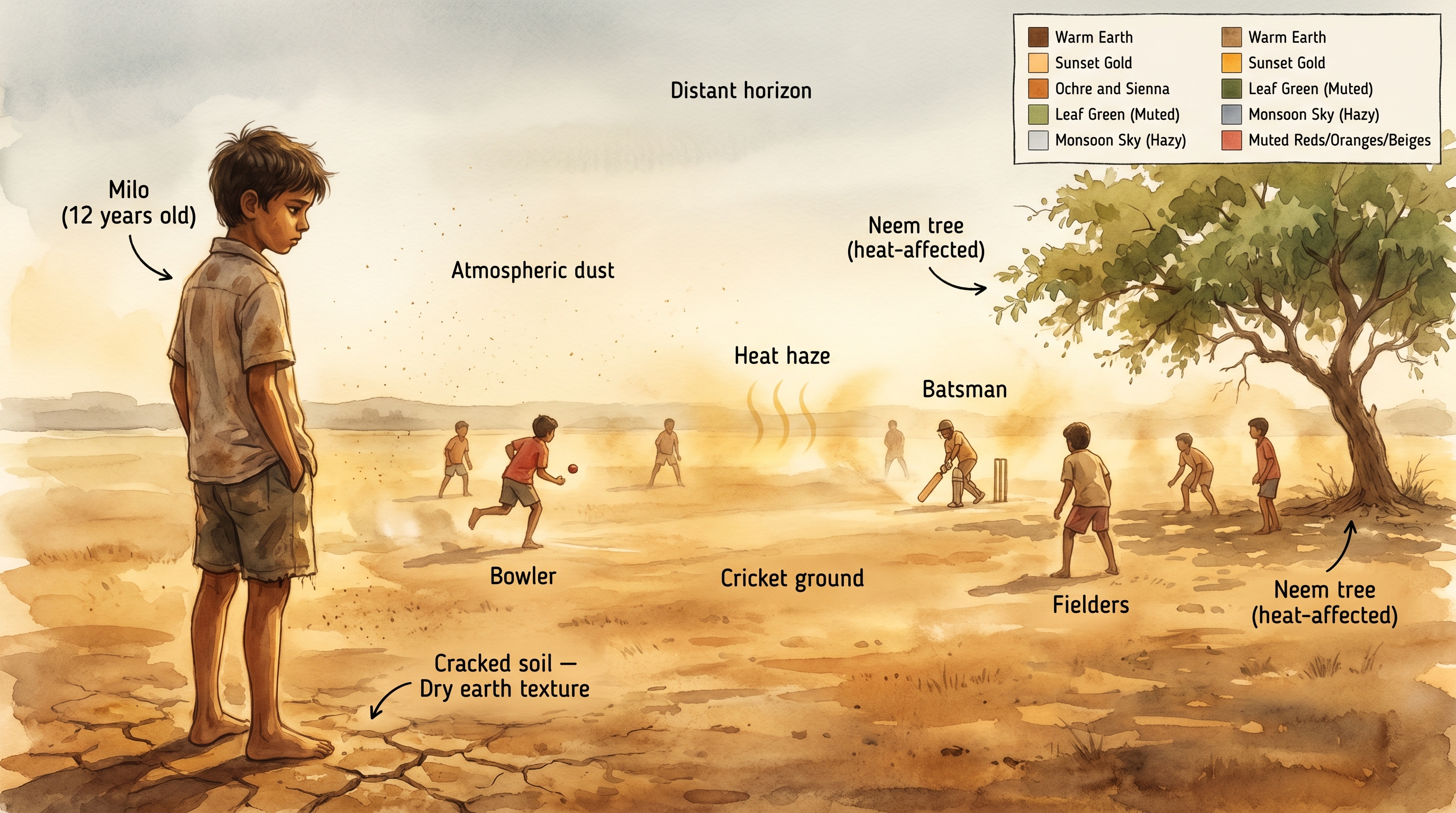
Not real fire — the heat. The kind of June afternoon where the ground cracked open like old bread and the air above it wobbled, so that the far end of the field looked like it was underwater. Forty kids stood baking in it. Some swung bats. Some bowled. Most just stood, hands on hips, squinting, while sweat cut clean lines down their dusty faces.
Milo stood at the edge of it all, where the gravel path met the grass, and did not go in.
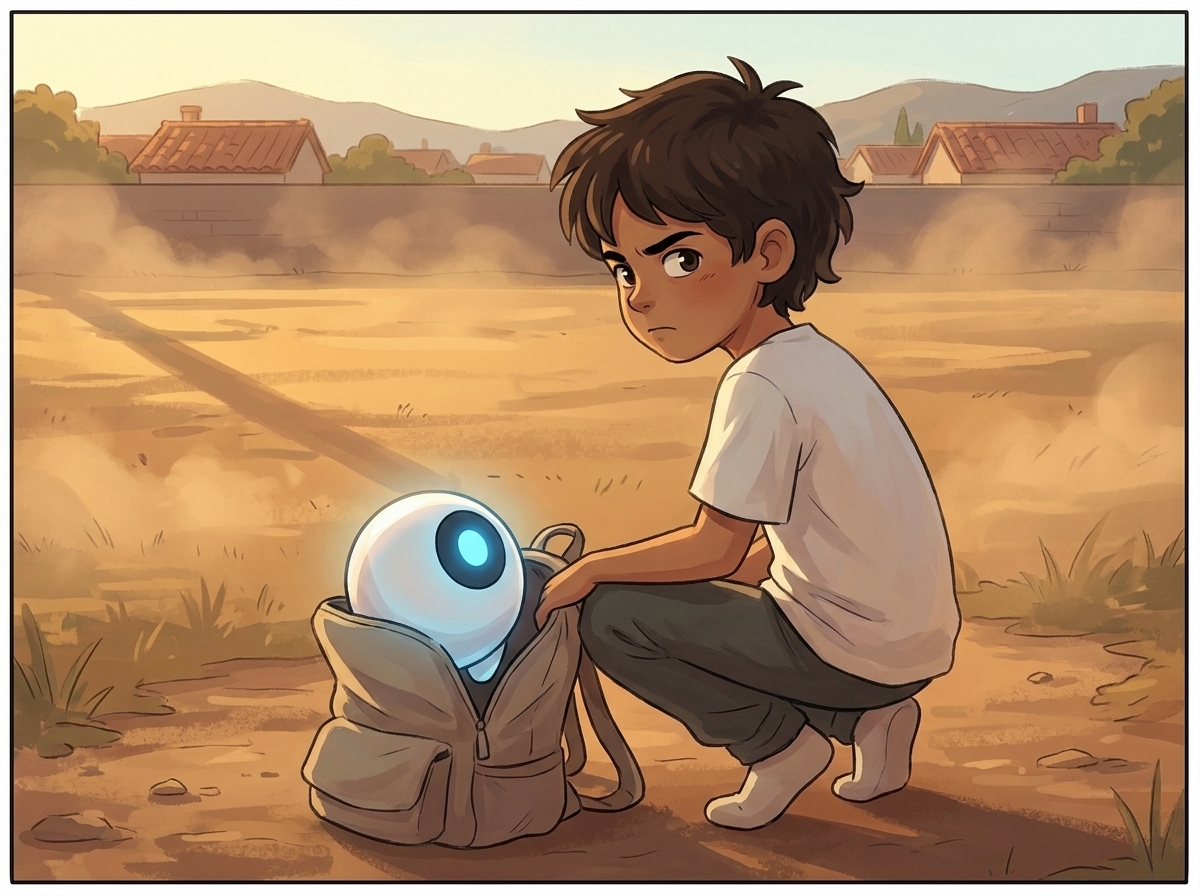
In his bag, switched low, Spark hummed. A faint warmth against his back. Present. Not invited.
Milo had brought it because Amma made him — "What if you get hurt, what if you need to call" — not because he wanted it there. After last winter, after the decision tree, after Mrs. Kamala almost lost her supplies because a machine did the math and forgot she was a person, Milo had decided something quiet and hard: Spark could carry his torch. Spark could not carry his trust.
He had one reason to be here, and the reason was already at the crease.
Kabir.
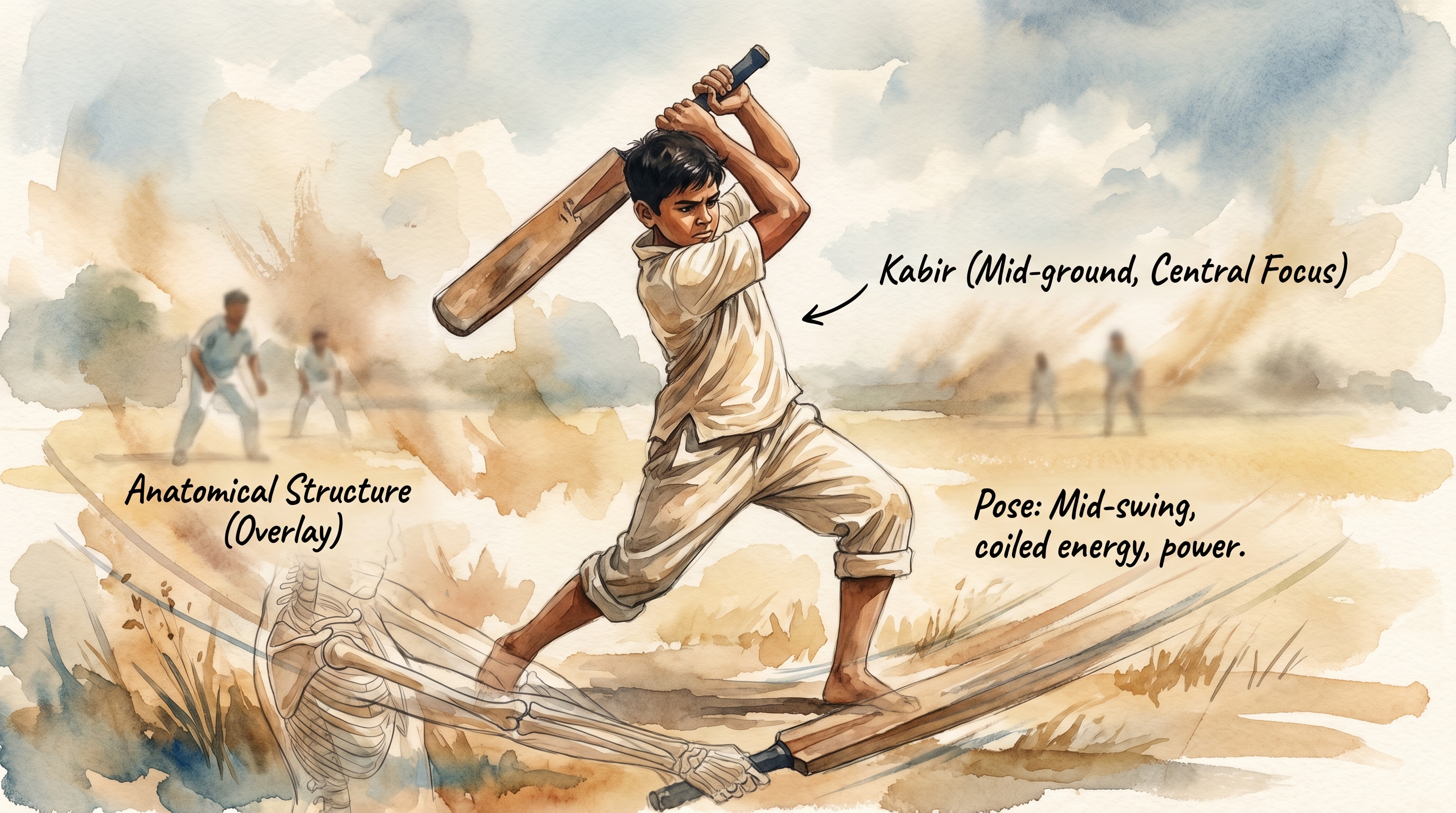
His best friend since they were small enough to fit in the same school bench. Kabir, who had been practising every single day since summer started — Milo had watched him from the wall, watched him swing that taped old bat he'd named Thunder when they were eight, watched him sweat through three shirts a day chasing a spot on the school eleven.
Right now Kabir swung and cracked the ball clean over the neem tree. A few kids whooped.
Then he swung again and missed completely. And again. And nicked one straight up in the air.
Boom. Zero. Zero. Milo's stomach did a small uneasy thing he didn't have a word for, so he ignored it.
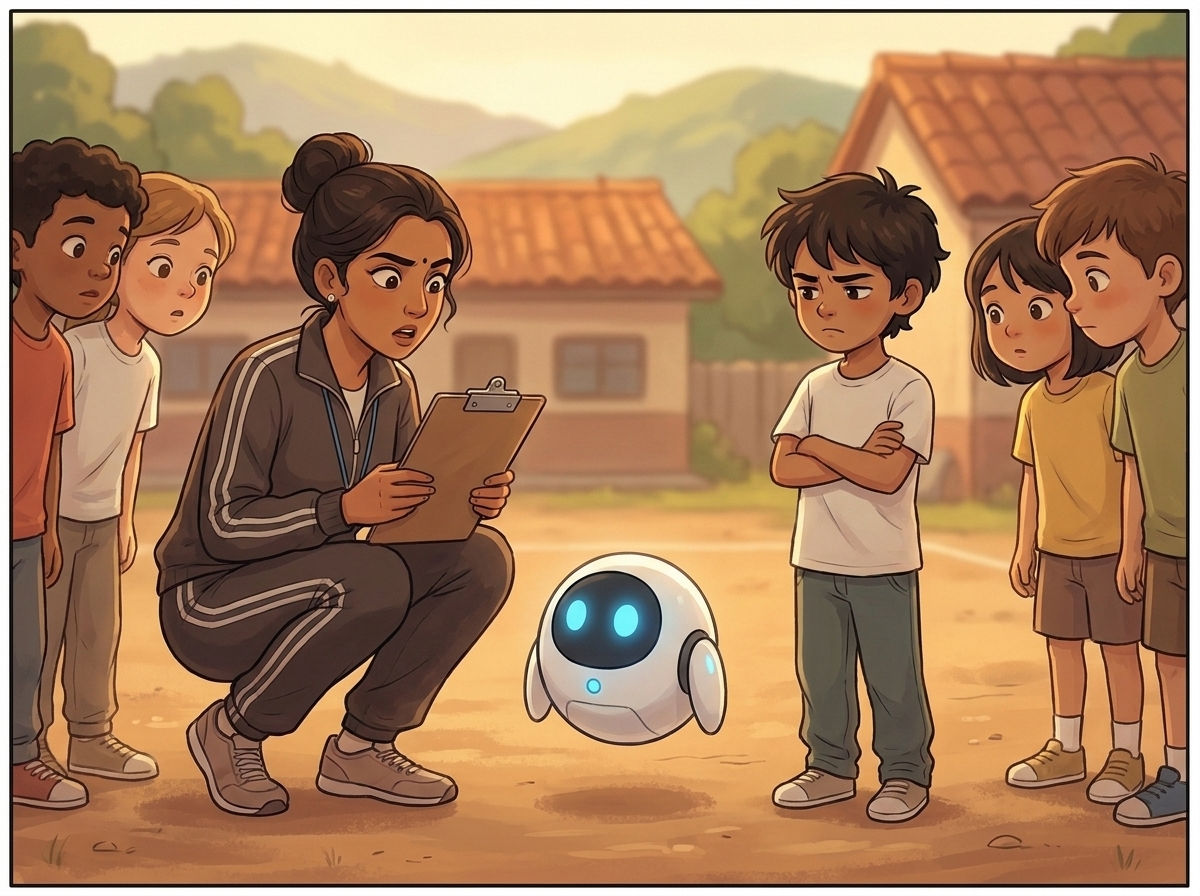
In the middle of all of it stood Coach Devi, and Coach Devi was losing.
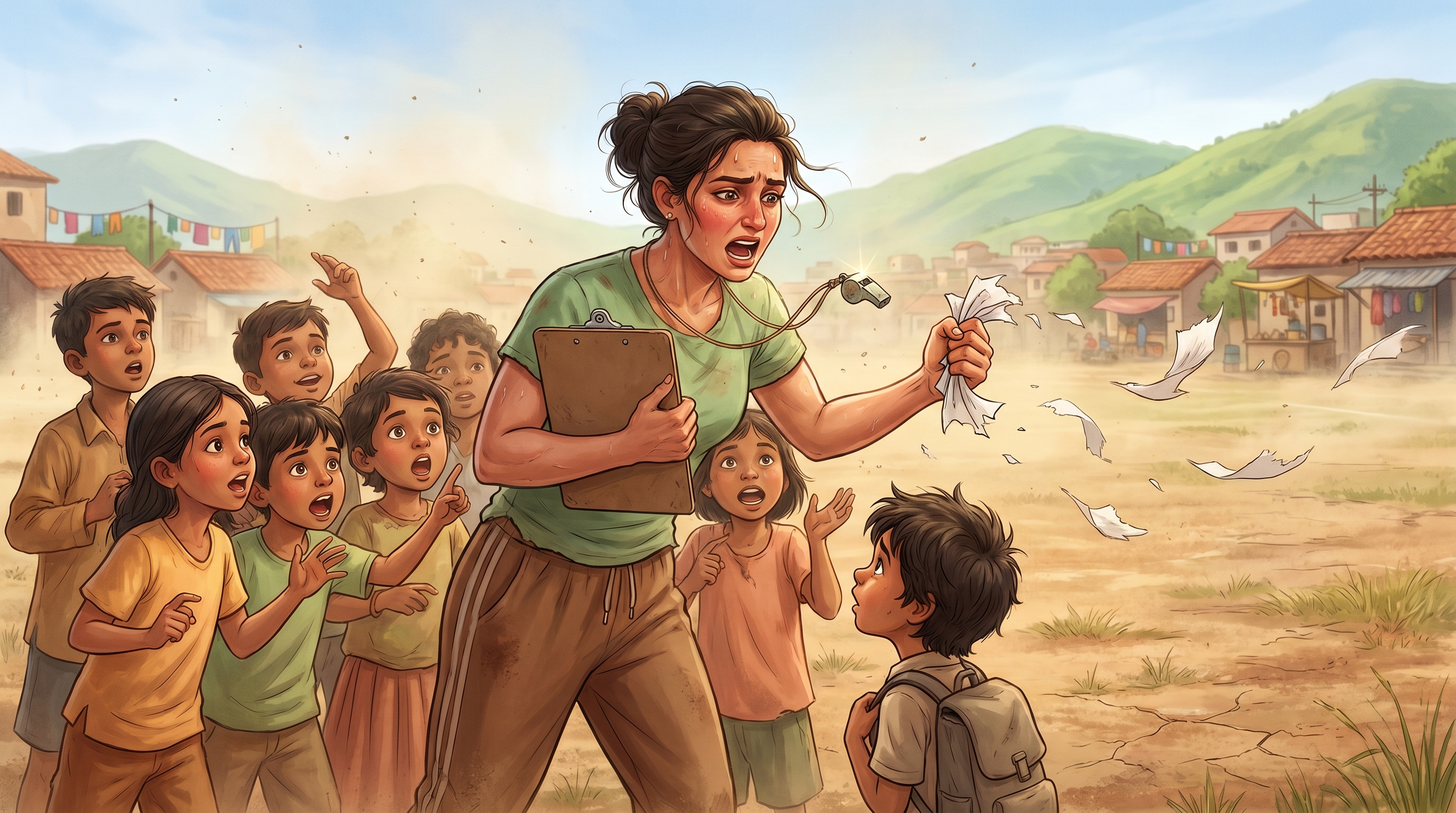
Not the game. The information. She had a clipboard, a cracked whistle she blew too often, and a fistful of paper scraps with kids' scores on them — and the wind kept stealing the scraps and the kids kept changing places and there were forty of them and she kept calling Arjun "Aryan" and writing runs in the wrong column.
Coach Devi
"You — number seven — no, you were seven yesterday — who had seven? Two of you cannot be number seven."
A kid
"I'm seven!"
Another kid
"No, I'm seven!"
Coach Devi looked at the sky like it owed her money.
Milo drifted closer without meaning to. That was when Spark's hum changed.
A small blue light rose out of the open mouth of his bag — soft, steady, that old heartbeat pulse — and Milo felt it before he saw it, the way you feel someone about to speak.
Spark
That coach is going to assign two children the same number. And she has already lost four scores to the wind. Milo. Give me their practice scores. I can hold what paper cannot.
Milo
"It's not your problem."
Spark
It is a problem I can solve. Those are not the same thing.
Milo
"You don't even like cricket. You don't like anything."
Spark
That is true. But I can remember forty children perfectly, and she can remember none of them. Is that not worth something?
And there it was — the thing that made Milo's chest go cold and tight. Because it was worth something. He could see it would help. He could see, already, exactly how much it would help. And he hated that he could see it.
He looked at Spark's calm blue light and said the thing that had been sitting under his tongue since winter.
Milo
"Why can't you just tell me what I want to hear?"
The light tilted, the way it did when it didn't understand a question.
Spark
What do you want to hear?
Milo
"That you'll mess it up. Like last time. With Mrs. Kamala. Last time you decided about a person, you got it wrong."
Spark's light dimmed — just a fraction, just for a breath — and Milo felt a small ugly satisfaction, and then immediately felt bad about it.
Spark
I will not decide anything today. I will only remember. Remembering is not deciding. May I help her?
Milo looked at Coach Devi, who was now physically chasing a paper scrap across the dust while three kids shouted scores at her she would never get down in time.
Milo
"...Fine. But you're just remembering. That's it."
It was almost insulting how easy it was for Spark.
Coach Devi read names and numbers off her crumpled scraps — "Kabir, 60, then 0, then 4, then 55" — and Spark caught every one, its light flickering bright with each number like a small blue heartbeat saying got it, got it, got it. The scraps that had blown away, the kids remembered their own scores, and Spark held those too. When two boys both claimed number seven, Spark said, mildly:
Spark
One of you scored eleven on Tuesday and one scored thirty. The eleven was number seven. The thirty was number twelve. You have simply swapped.
And both boys went quiet, because it was true.
By the time the sun started going soft and orange, forty messy summers' worth of cricket — every boom, every duck, every quiet steady afternoon — had stopped being noise.
It had become numbers. Lined up. Named. Kept.
Coach Devi
"Forty kids. I have been doing this on the back of bus tickets for eleven years. I pick with my eyes, not your blinking torch. Understand?"
Spark
Understood. I am only the paper that does not blow away.
Coach Devi almost smiled.
Tara
"SIXTY! WRITE DOWN SIXTY! THAT WAS KABIR! KABIR GOT SIXTY!"
Tara had been on the boundary the whole time, Milo realised, and he had no idea how long. She was bouncing on her toes, pointing at Spark like it was a fireworks show, announcing every score Kabir got at maximum volume whether anyone asked or not.
Milo
"He got zero the next ball, Tara."
Tara
"SO? The sixty was AMAZING." She spun to Spark. "Did you write down the sixty? Write it the biggest."
Spark
I wrote it the same size as the zero. That is the only fair way to write them.
Tara frowned at that like it was the dumbest thing she'd ever heard, then immediately forgot about it and ran off to cartwheel.
And from the far side of the field, climbing the little slope toward the ground with a cloth bag over her shoulder, came a small, familiar figure.
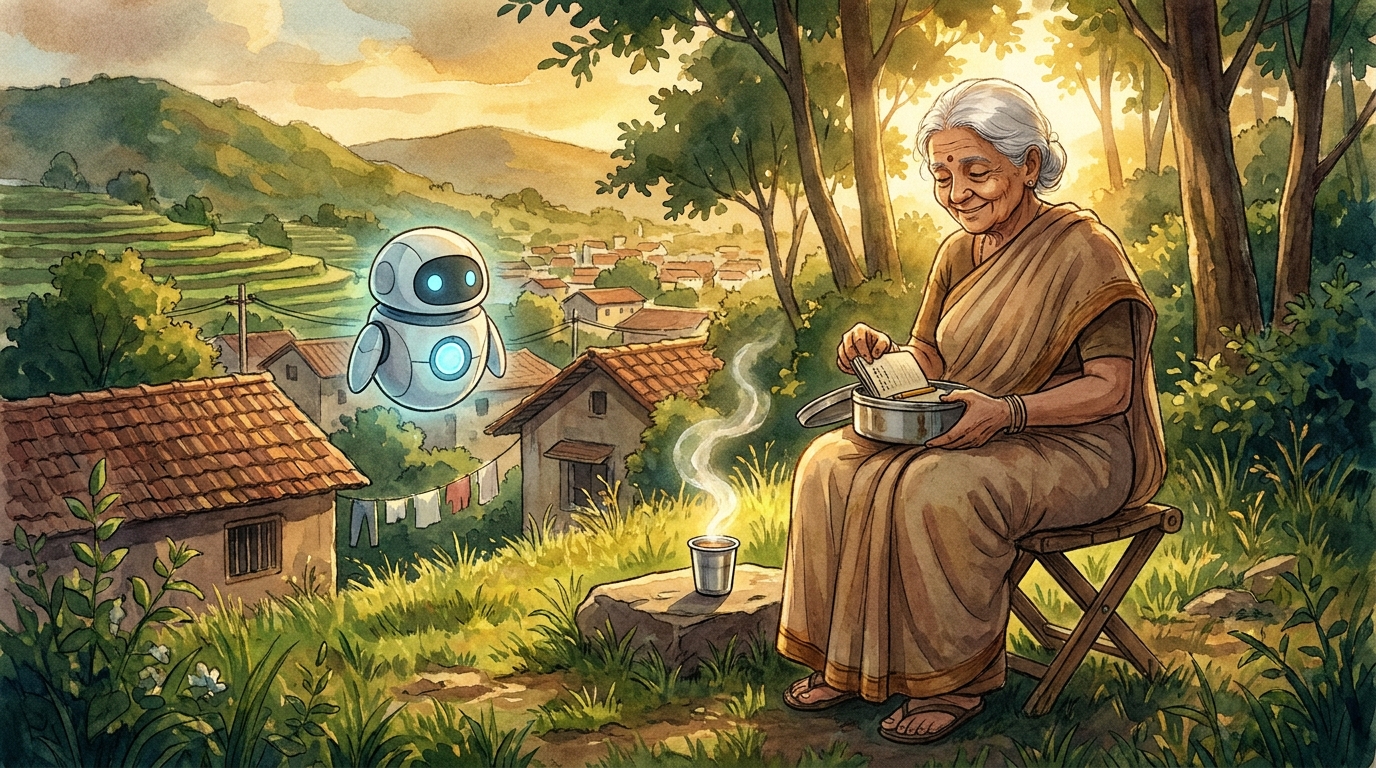
Mrs. Kamala set up a folding stool right at the edge of the boundary, opened her steel tiffin, and took out — not food — a small notebook and a pencil stub.
Mrs. Kamala
"Somebody has to keep the real runs."
She licked the pencil and looked very pleased with herself. Milo went over. The last time he'd really thought about Mrs. Kamala and a machine in the same breath, it had been a bad night, and Spark's cold logic had nearly failed her. Now here she was, fixed and whole and well, appointing herself the human scoreboard beside the blue one, and the two of them — the old woman with the pencil and the little machine with the light — were going to count the same children. Something about that loosened a knot in him he hadn't known was tied.
Milo
"You're the official scorekeeper now?"
Mrs. Kamala
"I am the correct one. The torch can have the rest." She winked at Spark. "No offence, beta."
Spark
None taken. I would trust your notebook over my own memory in only one case: when the truth is kinder than the number. You are better at that than I am.
Mrs. Kamala laughed, a real laugh, and Milo had to look away because something in his throat was doing something annoying.
Coach Devi cannot remember forty children. Can you do what Spark does —
catch every score before the wind takes it, and keep it in the right place?
Catch the Score — Be the Memory
Round 1 of 3 · Catch
Paper scraps are blowing across on the wind. Tap each one before it leaves the screen. Catch every number — I do not judge them, I only keep them.
🌳
Caught: 0🍃 Lost to wind: 00 / 8
By the time the field emptied, the sky had gone from gold to bruised purple, and the heat finally let go of the ground.
Milo sat on the dry grass next to Spark while Coach Devi packed up her clipboard with nothing useful on it, because everything useful was now inside a small machine that pulsed blue in the dark.
He didn't want to say it. He said it anyway.
Milo
"You were good at that."
Spark
Thank you.
Milo
"I didn't say I liked it." He pulled up a blade of dead grass and split it. "You just — remembered. That's not the same as understanding cricket. You still don't know anything about Kabir."
Spark
That is correct. I know forty of his numbers and none of his heart. But Milo. The numbers are not nothing. A coach with bad memory is fair to no one — she forgets the quiet children and remembers only the loud ones. Numbers do not forget anybody. Even the ones nobody is cheering for.
Milo thought about Tara screaming sixty and ignoring the zero. He thought about how easy it was to remember Kabir's one perfect shot and forget the three misses after it. How memory played favourites. How it lied to be kind.
He didn't like where that thought was going, so he stood up.
Milo
"It's just runs on paper. Numbers don't mean anything."
Spark's light brightened — that small click of brightening, the one Milo had learned long ago meant something had landed.
Spark
They are not just runs on paper. Forty children played all summer. Every swing they took left a number behind. I have all of them now, lined up, side by side, telling the truth no single afternoon can tell. Tomorrow I can show you what these numbers are trying to say. They are trying to say something, Milo. All forty of them. Together. Behind that scoreboard, in the morning. Do you want to see?
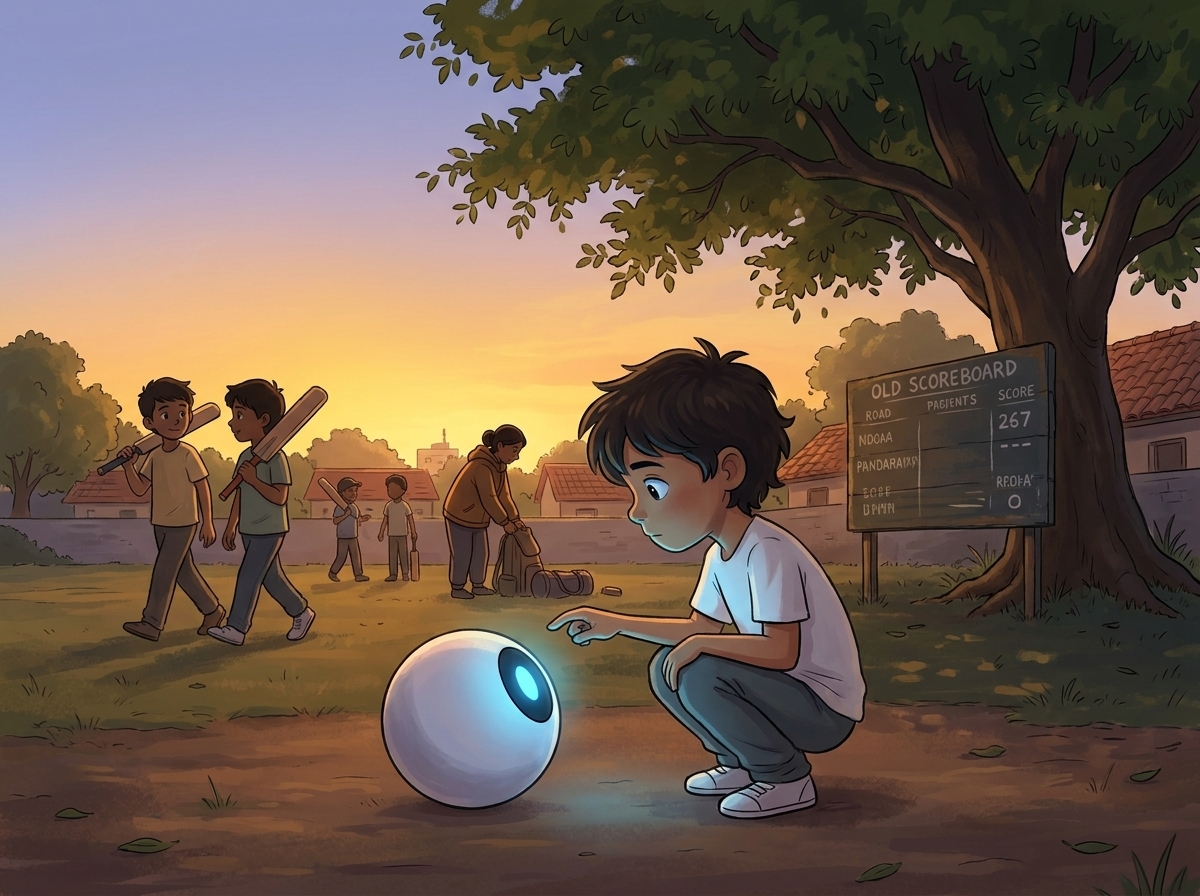
Behind the neem tree, the old wooden scoreboard waited in the dark. Milo looked at it. Looked at Spark. Hated, a little, how much he wanted to know.
Milo
"...Fine. Show me."
SPARK'S JOURNAL
Entry 087
Today I held forty children.
Not their bodies. Their summers. Every run, every duck, every quiet good afternoon nobody clapped for. The wind tried to take some. I did not let it.
Milo said numbers do not mean anything. This is false, and I think he knows it is false, which is why he said it loudly.
Here is what I have learned that I cannot put a number on. When a small girl shouts "sixty" and forgets the "zero" one ball later, that is not memory. That is love. Love keeps the good number and drops the bad one. I keep both, exactly the same size. Milo called this unfair. I think it is the fairest thing I know how to do.
But I have noticed something. One child's numbers do not behave. They jump — high, nothing, high, nothing. Tomorrow Milo will see it too.
I do not yet know how to tell him gently.
"They are trying to say something, Milo. All forty of them. Together."