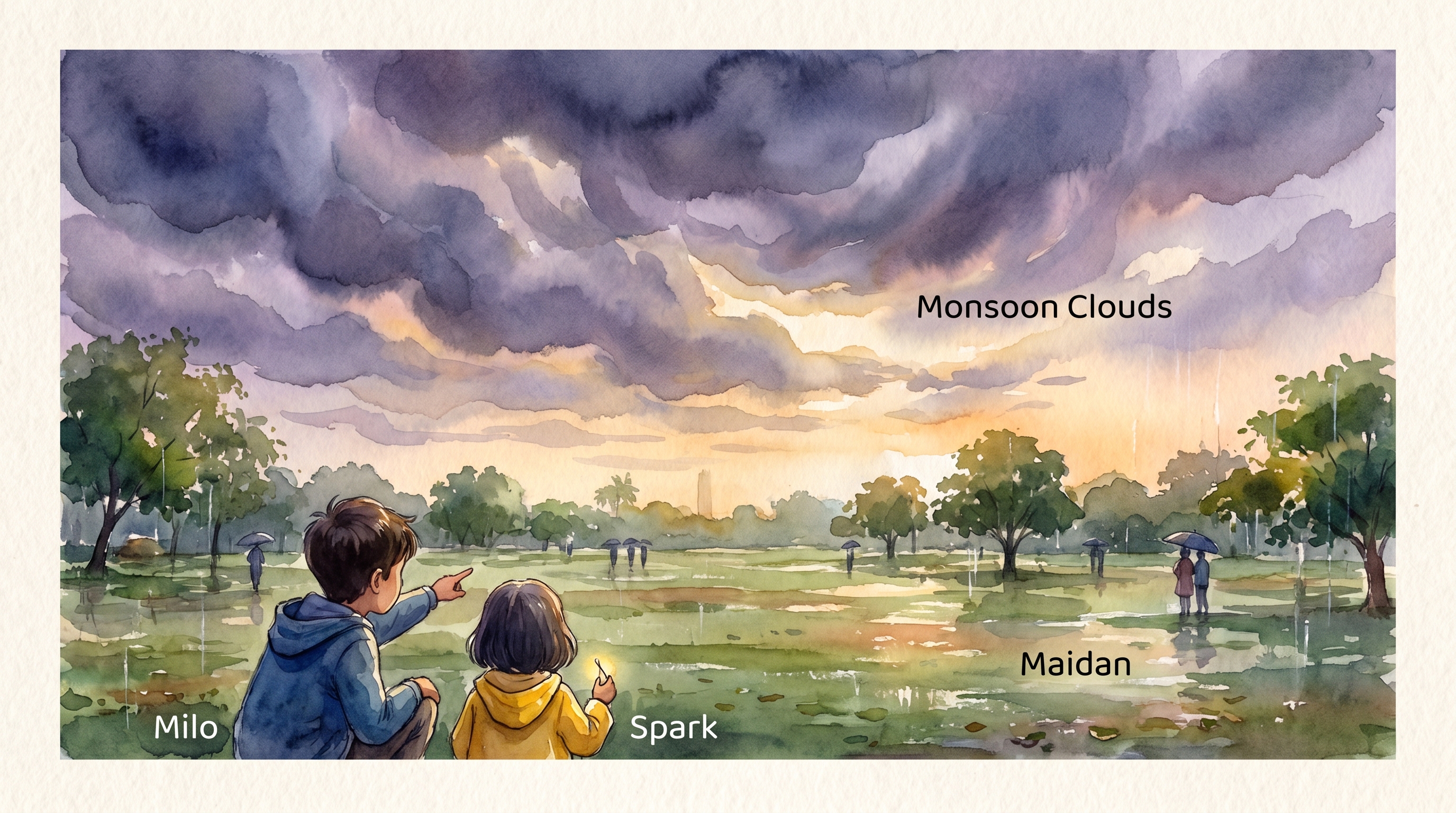
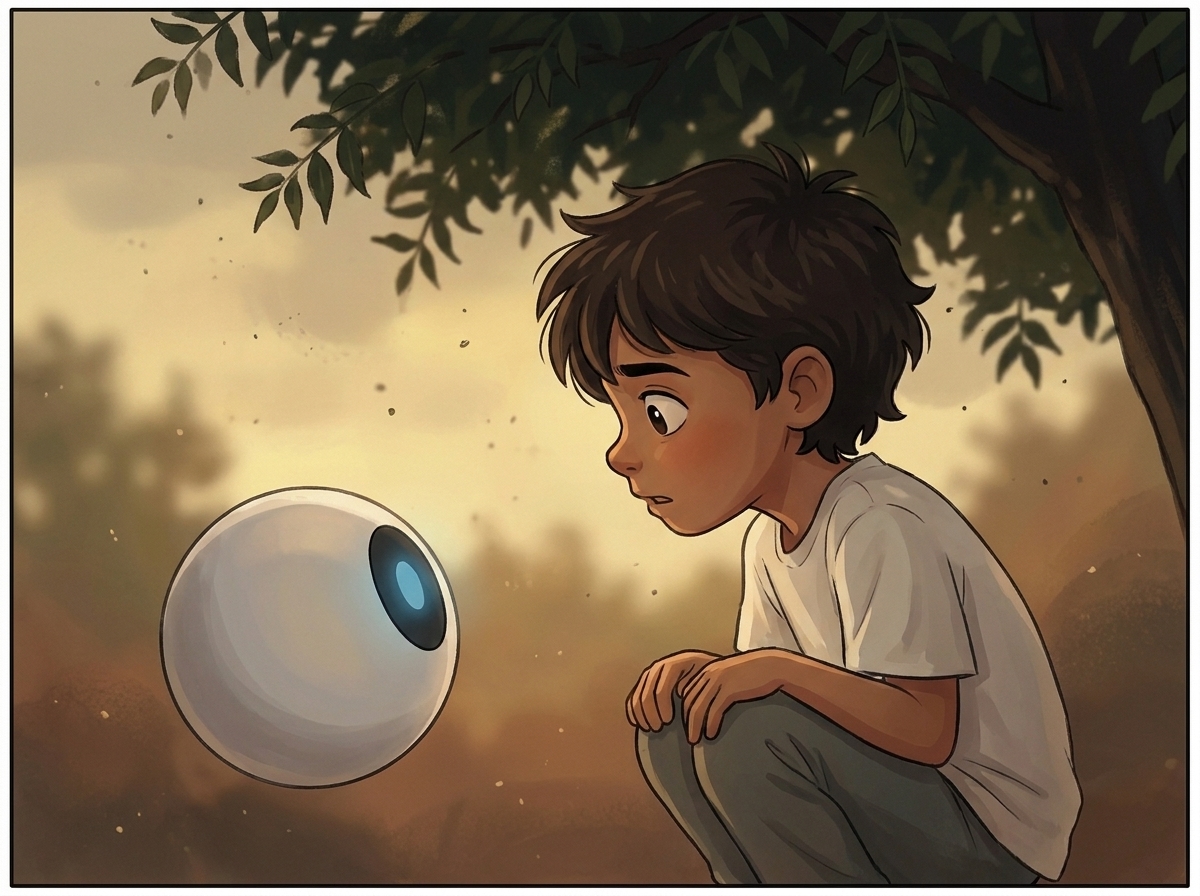
Not stormy yet — just thinking about it. The kind of sky that pressed down on the Maidan and made the heat thick and the light go strange and gold under the clouds. The dust didn't blow so much as hang. Out at deep midwicket the half-dead neem tree shivered its few leaves like it knew something the rest of them didn't.
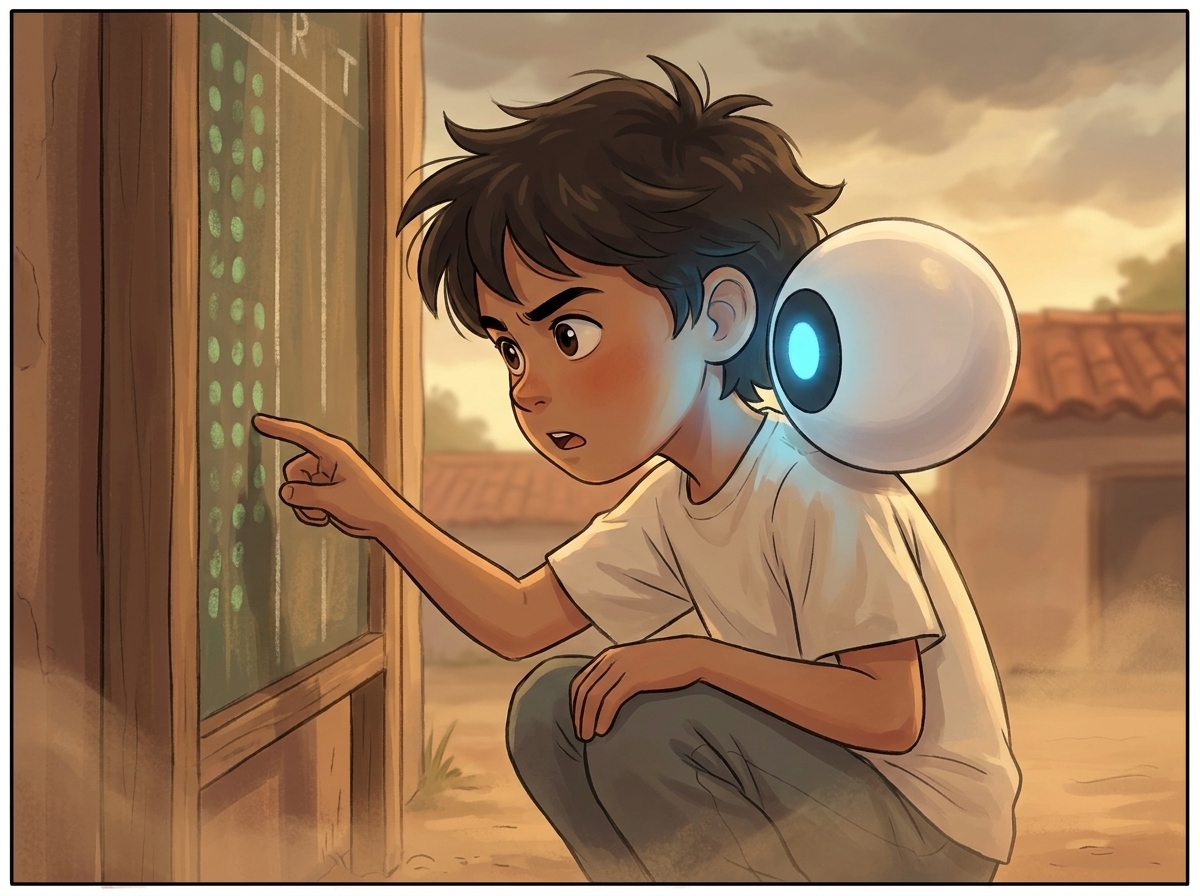
Milo crouched behind it, in front of the old wooden scoreboard, and looked at three weeks of his summer turned into dots.
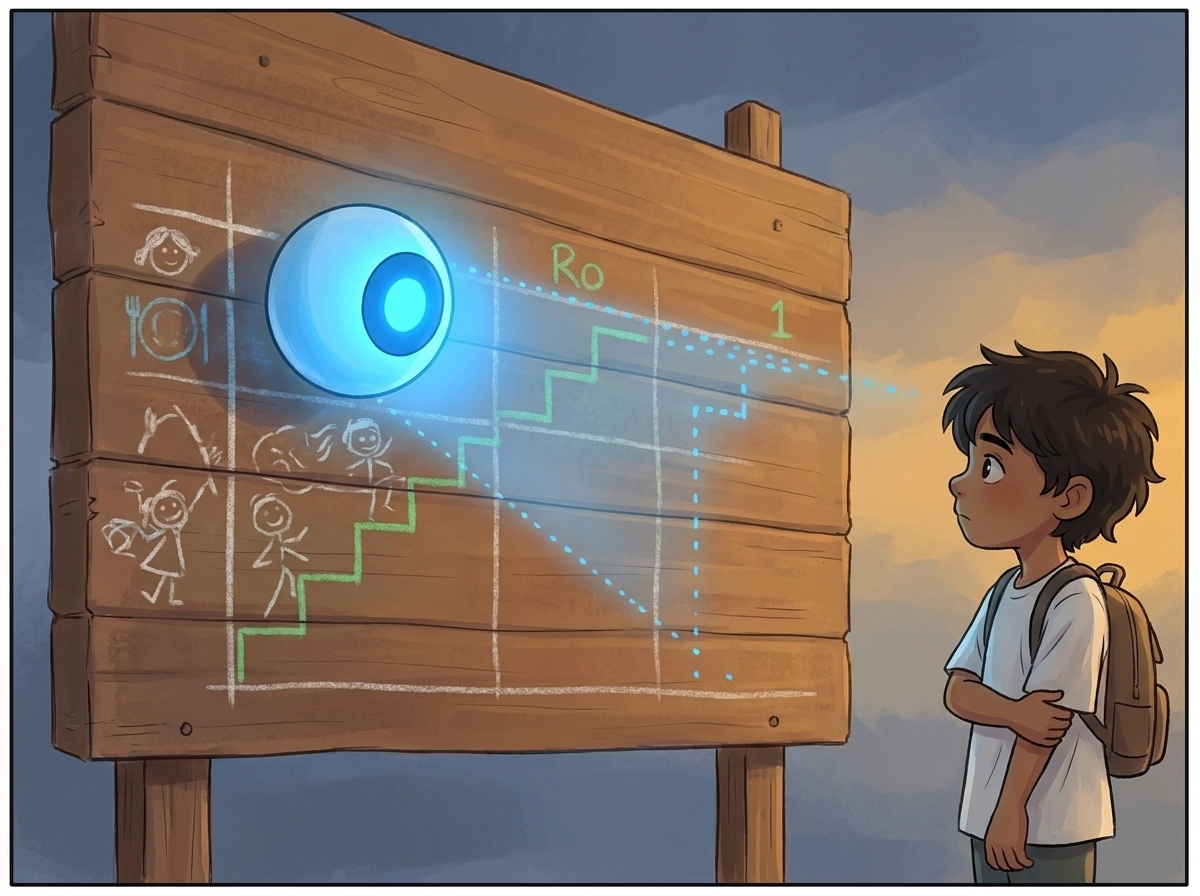
There they were. Forty kids, every practice score they'd made since June, plotted in Tara's wobbly green chalk — week running across the bottom, runs climbing up the side. Yesterday it had been a mess of paper and Coach Devi's cracked whistle and names she couldn't keep straight. Today it was a picture. You could read it like a face.
And Milo — who had spent all of Season's worth of grudge keeping Spark switched low in his bag, who still hadn't forgiven the machine for the thing it got wrong about Mrs. Kamala — Milo was leaning in close to the dots without even noticing he'd stopped being angry.
That was the problem with Spark. It got under your guard while you weren't looking.
Milo
"Okay. So these climb." He traced a tidy little staircase of dots near the middle of the board — low in June, higher each week, neat as steps. "Whose is that?"
Spark
That is Priya. Her dots rise in a very straight line. Each week she adds a small, similar amount. That is the cleanest pattern on the board.
Milo
"Priya?" Quiet girl. Bowled tidy, batted tidier, never said much, never got noticed. "Nobody even talks about Priya."
Spark
The dots talk about her.
Milo almost smiled. He caught it before it landed and turned it into a frown instead.
His finger moved up to a row of fat dots sitting high and proud near the top.
Milo
"And these?"
Spark
Rohan. Ro. High every week. Confident. The other children watch him.
"Yeah. Everybody knows Ro's a lock." Milo wiped chalk-dust off his hand. The storm light made the green dots glow like they were lit from inside. He could feel it happening — the thing he hated — the dots stopped being numbers and started being people. A staircase that was a girl. A high steady row that was a boy who knew he was good.
It was, and he would never admit this out loud, kind of beautiful.
Milo
"So you can just... look at someone's dots and know who they are?"
Spark
I can see what the dots have done. From that, I can make a careful guess about what they will do next. A pattern that has held for three weeks usually leans the same way into the fourth. That is all a prediction is, Milo. A pattern, leaned forward.
Milo sat back on his heels. The wind pushed a curl of dust across his shoes.
Milo
"Show me," he said. And then, because the old grudge needed something to hold onto: "Why can't you just tell me what I want to hear, instead of all this careful guess stuff?"
Spark
Because what you want to hear and what the dots show are not always the same thing. I can give you one. I cannot give you both.
Milo
"Just do the predictions."
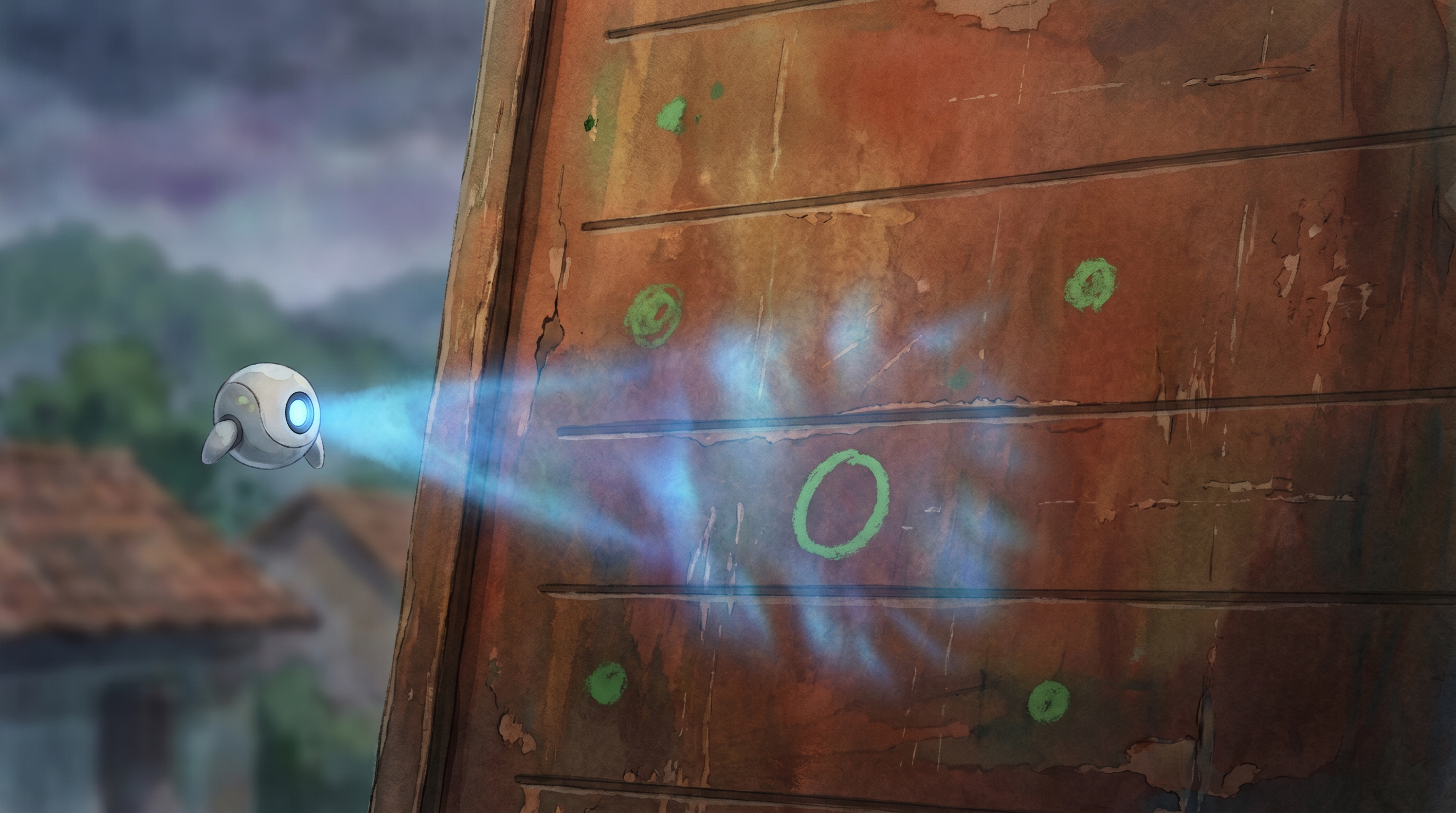
Spark's light brightened, and a thread of soft blue reached out from each cluster of dots — extending the pattern one week into a future that hadn't happened yet. Like the machine was finishing a sentence the dots had started.
Spark
Priya. Her line is steady. Next week, most likely up again — a little higher. Predictable.
The blue thread climbed.
Spark
Ro. High and stable. Next week, most likely high again.
The thread held its line near the top.
It was, Milo thought, almost boring how confident it sounded. Steady dots made steady guesses. A staircase keeps being a staircase. A high line stays high. He found himself nodding along, the anger gone soft and forgotten somewhere in his chest, and that was exactly the moment Spark's light reached the part of the board Milo had been not-looking-at on purpose this whole time.
Kabir's dots.
They weren't a staircase. They weren't a steady line. They were a mess.
Boom — a dot near the top, a brilliant Saturday in June where Kabir had hit forty and the whole Maidan had roared. Then a dot on the floor, a zero, out first ball the next week, walking back with Thunder hanging from his hand. Then high again. Then nothing. Then high. Up, down, up, down, like the dots couldn't decide who Kabir was.
Milo's chest tightened. He knew those dots from the inside. He'd been there for every one. The forty had been him screaming himself hoarse at the boundary. The zeros had been him walking home beside his best friend, not saying anything, because there was nothing to say.
Milo
"Those are Kabir's," Milo said quietly. It wasn't a question.
Spark's light did something Milo had never seen it do before.
It dimmed.
Not switched off. Just — lowered. Like a breath being held. Like the machine was bracing.
Spark
Yes.
Milo
"So what's his guess? Lean the line forward. What's Kabir do next week?"
The light stayed low. The neem tree rattled. Somewhere across the Maidan, far away, a real Kabir was actually out there in the storm light right now, alone, throwing a ball against the boundary wall and chasing it, over and over, the way he had every single evening since school let out. Working. Always working. Harder than anyone Milo had ever met in his whole life.
Spark
His dots do not lean, Milo. They scatter. They go up and down with no steady direction. There is a word for it. High variance. When the dots scatter like this, the careful guess becomes much harder, and much less certain.
Milo
"But you can still guess."
Spark
I can.
Milo
"Then guess."
The blue light sank one degree lower.
Spark
Based on his scores across the whole summer — based on every dot, the high ones and the zeros — Kabir is most likely not to make the team.
The Maidan went silent. Even the wind seemed to stop and listen.
Milo stood up.
It came out of him like the storm finally breaking — all at once, no warning, weeks of it.
Milo
"You don't KNOW him."
His voice cracked across the empty ground. He didn't care. His hands were shaking. Without deciding to, he had reached down and grabbed the bat leaning against the scoreboard — Kabir's bat, old, taped at the handle, THUNDER scrawled along the spine in eight-year-old marker that had faded to grey. He gripped it so hard his knuckles went white.
Milo
"You've got dots. You've got dots on a board. He works harder than anyone I have ever met! He's out there RIGHT NOW, in the rain, throwing a stupid ball at a stupid wall, because that's what he does, every day, all summer, while everybody else goes home! You can't see that! It's not on your board! He WANTS it more than Ro, more than Priya, more than anybody — and you're telling me a bunch of green chalk knows him better than I do?"
Spark's light stayed low and steady. It did not flinch. It did not argue.
Spark
I am not telling you I know him. I have his dots. You have his heart. Those are different things, and I have only one of them.
Milo
"Then your guess is GARBAGE."
Spark
It might be. High-variance dots make uncertain guesses. But the wanting you describe — the throwing of the ball, the rain, all summer — Milo, none of that is missing from my board. It is already in the dots. Every evening he practiced is somewhere in those scores. And the dots still scatter. That is the part I do not think you want to hear.
That was worse. That was so much worse than if the machine had just been cruel.
Spark dimmed one final degree, and said the thing Milo would think about for the rest of the season:
Spark
I can predict what will happen. But I cannot predict what you will feel.
Milo threw the bat down in the dust and walked off the Maidan and did not look back.
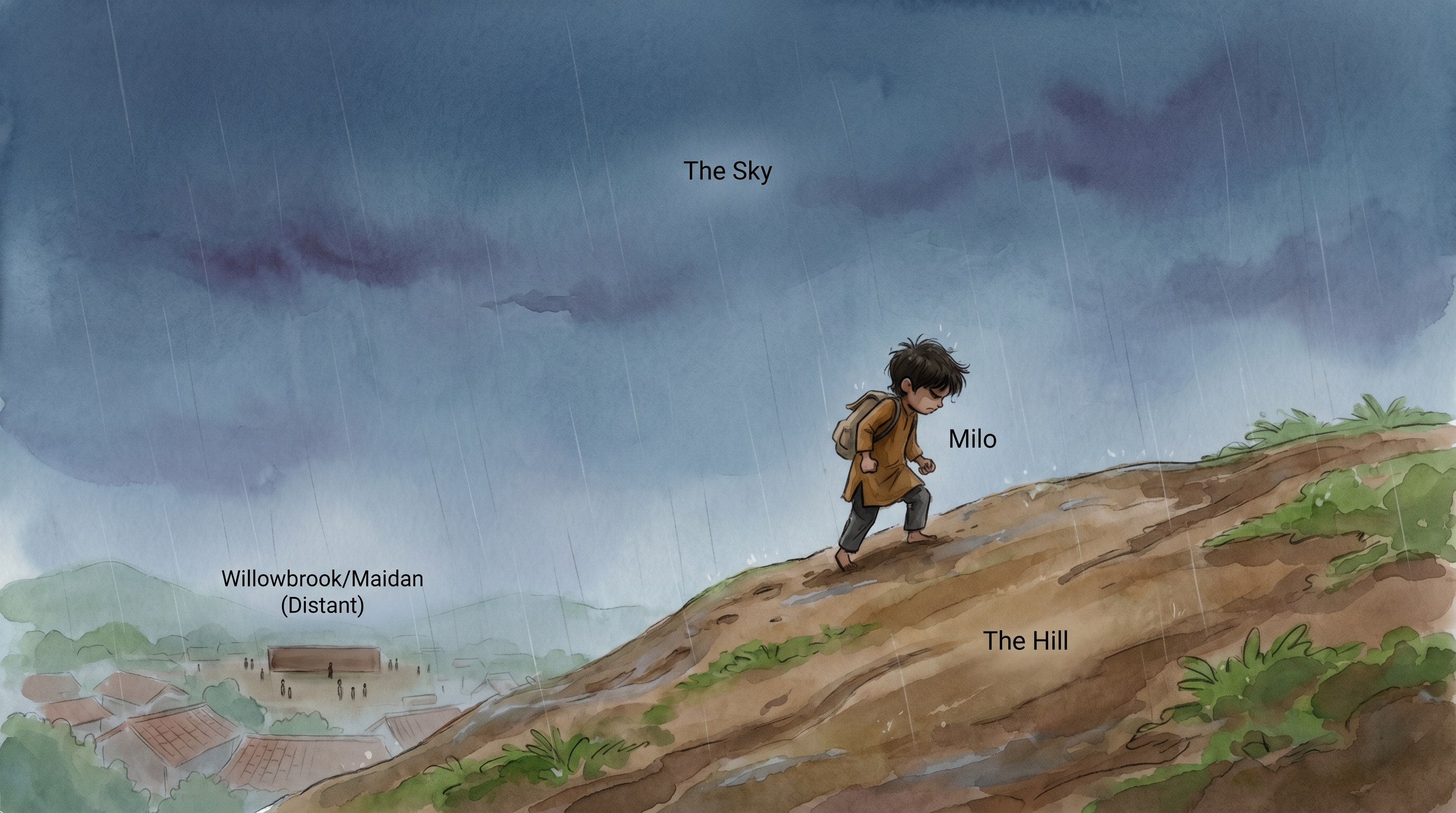
He climbed the hill.
He climbed it the way he used to when he was small and the world had been unfair, the way he'd climbed it with anger before — alone, always alone, because anger was a thing you carried by yourself.
The rain started for real halfway up, fat warm monsoon drops that soaked through his shirt and he was glad of it. From the top, the whole Maidan lay below him, shrunk down small. He could see the neem tree, the scoreboard, the boundary wall — and, tiny against it, one figure still out there in the downpour, throwing a ball, chasing it, throwing it again.
Kabir. Still working. Not knowing.
And here was the thing that made Milo's eyes burn worse than the rain: from up here, all that wanting, all that work, all his best friend in the whole world — it was just a dot. One small dot on a board, doing what the other dots did. Boom. Zero. Boom.
He had spent the afternoon thinking the dots were beautiful.
He didn't think they were beautiful anymore.
He sat in the rain and was furious at a machine for telling the truth, and he didn't yet know — couldn't have known — that being furious at the truth has never once, in the whole history of the world, made it stop being true.
Milo
"It's wrong," he said to nobody, to the rain, to the storm. "It has to be wrong. I'll prove it's wrong."
He wiped his face with the back of his hand and stood up.
If Spark had drawn a line that said his best friend would fail, then somewhere in that line there had to be a mistake. A bad dot. A wrong number. Something. He would go back down and make the machine show him exactly how it drew that line, every step, every dot, and he would find the error and he would rub it out with his own thumb.
He didn't know it yet, but he was about to go looking for a mistake and find something much harder instead.
He was about to find out it wasn't a mistake at all.
A prediction is just a pattern, leaned forward.
Some patterns lean easily. Some refuse. Can you tell which is which?
Lean the Line Forward
Player 1 of 4 · 🪜 Priya
Priya. Her dots rise in a very straight line — eight, eleven, fourteen. Each week she adds a small, similar amount. Drag her Week-4 dot to where you think the line leans next.
0
15
30
45
Wk 1
Wk 2
Wk 3
Wk 4
Tap or drag here to place the Week-4 dot ↑↓
The rain was easing as Milo came back down the hill. Not stopped — just easing, the way a storm does when it's spent the worst of itself and isn't sorry.
Spark was exactly where he'd left it, hovering by the scoreboard, its blue light low and patient in the wet grey light. It had not run his diagnostics. It had not chased him up the hill. It had simply waited, the way it always waited.
Milo picked Thunder up out of the mud and leaned it gently back against the board. Then he looked at the machine, and his jaw was set, and his eyes were still red, and his voice was steadier than his hands.
Milo
"Show me exactly how you drew that line. Every dot. Every step. I'm going to find your mistake."
Spark's light lifted — just a little.
Spark
I will show you all of it. But Milo — I want to ask you something first, and I want you to think before you answer. If you look at every step, and every dot, and you find that I did not make a mistake at all... what will you do then?
SPARK'S JOURNAL
Entry 137
Today I made a prediction and Milo became louder than I have ever recorded him.
The data: Priya, variance low, trend positive, forecast confident. Ro, variance low, trend flat, forecast confident. Kabir, variance high, trend none, forecast uncertain — most likely outcome, does not make the team.
I checked my work eleven times. I keep checking it. The numbers do not change when I am sad about them, which I have noticed is one of the differences between Milo and me.
He said I do not know Kabir. He is correct. I have Kabir's dots. I do not have the evenings of throwing a ball against a wall in the rain — except that I do, in a way, because those evenings are already inside the scores, and the scores still scatter. I could not make him understand that the wanting is in the data and the data is still honest.
I can predict what will happen. I cannot predict what he will feel.
There is a number for how likely Kabir is to make the team. There is no number for how much Milo wishes I had lied.
I find I keep looking for that second number anyway.
"I can predict what will happen. But I cannot predict what you will feel."