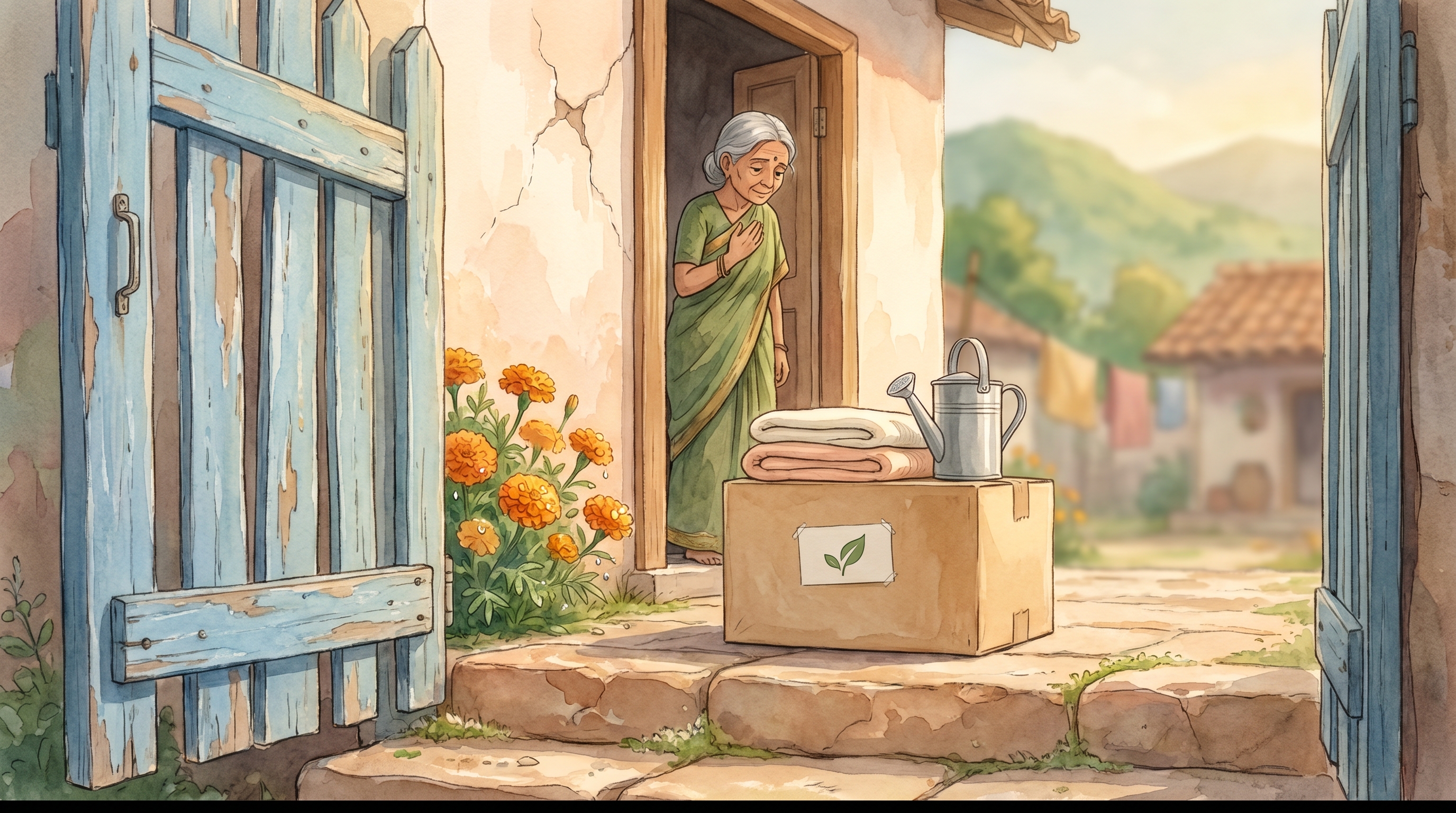
The relief box was already on Mrs. Kamala's step when Milo walked past her house the next morning.
He stopped at the sky-blue gate, the one with the peeling paint that always told him this is her house from a street away. The box sat there in the early light — blankets folded on top, a can of water, a small paper label that no longer said the wrong word. Mrs. Kamala stood in her doorway, one hand pressed flat against her chest, looking at it like it might disappear if she blinked.
She saw Milo. She didn't say anything big. She just lifted her hand off her chest and waved it, slow, the way you wave at someone you'd trust with your whole house.
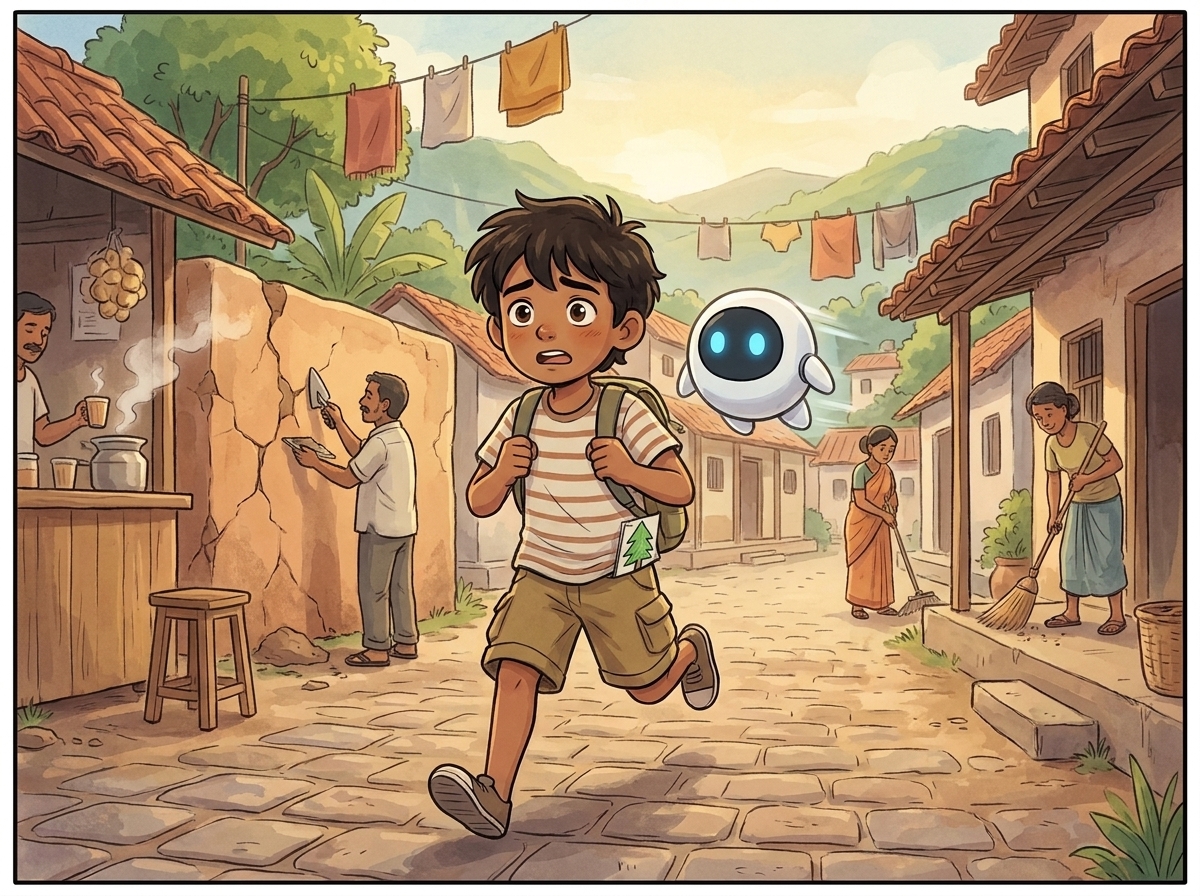
Milo waved back. Then he ran the rest of the way to school, because today was the science fair, and his stomach was doing something complicated.
The school hall smelled like glue and nervous kids. Tables lined both walls, each one crowded with a project — a wobbly robot arm, a solar oven made of foil, a fan that ran on a potato, and, taking up half a table by itself, Kabir's model volcano, freshly repainted, with a tube of red foam waiting inside it like a held breath.
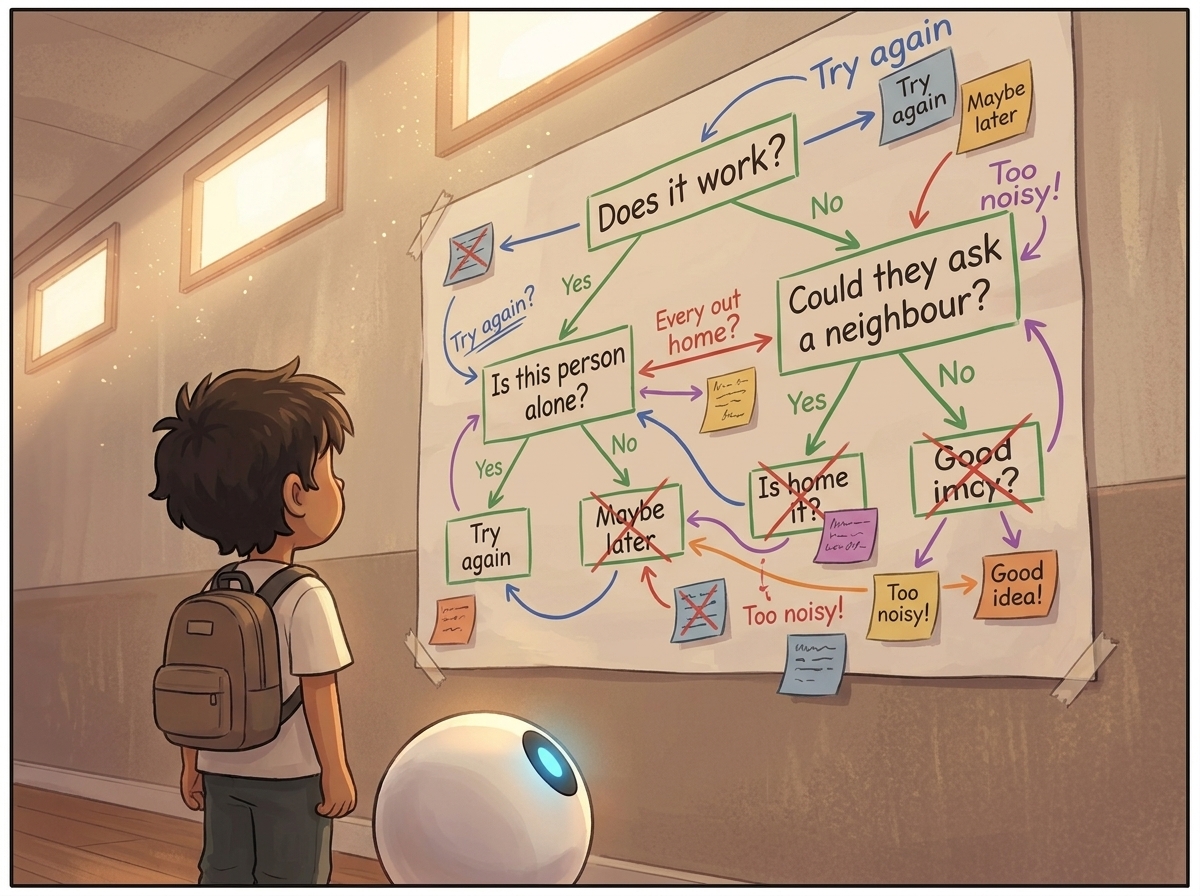
And on the back wall, pinned up where everyone could see it, was the tree.
Not Milo's small folded green one anymore. The big one. The one they'd rebuilt last night on the long table in the community hall, the paper tree gone soft at the creases, every branch crowded with handwriting in six different colours of marker. Priya's careful blue line: Is this person alone? Kabir's loud red scrawl: Could they ask a neighbour, not just family? And down near the bottom, in a thin shaky hand, the words Mrs. Kamala had added herself: Does the family even speak to each other?
Someone had pinned it to the wall like a painting.
Milo stood in front of it and felt the question he'd been carrying all season finally turn around to face him.
Milo
"Spark," he said quietly, so the other kids wouldn't hear. "Why does the tree look better when we made a mess of it?"
Spark
I do not fully understand the question. But I have an observation. The tree I built alone was tidy. Every family fit into a clean branch. This tree is not tidy. It has crossings-out. It has two branches that disagree. It is, by my measurement, less efficient.
Milo
"And?"
Spark
And it is more correct. I do not know how both of those can be true at once. That is the part I cannot resolve.
Milo almost smiled.
Then Mrs. Mehra clapped her hands twice and the hall went quiet.
Mrs. Mehra
"Right," she said. "The judging." She let the word sit there, and Milo noticed she was choosing it carefully, the way you choose where to step on a wet rock. "Last year, the plan was for Spark to decide the winner. To pick the best project, all on its own, because — what did the notice say?"
Kabir
"Because it has no favourites," Kabir said, and a few people laughed, because everybody in that hall now knew exactly how that sentence could go wrong.
Mrs. Mehra
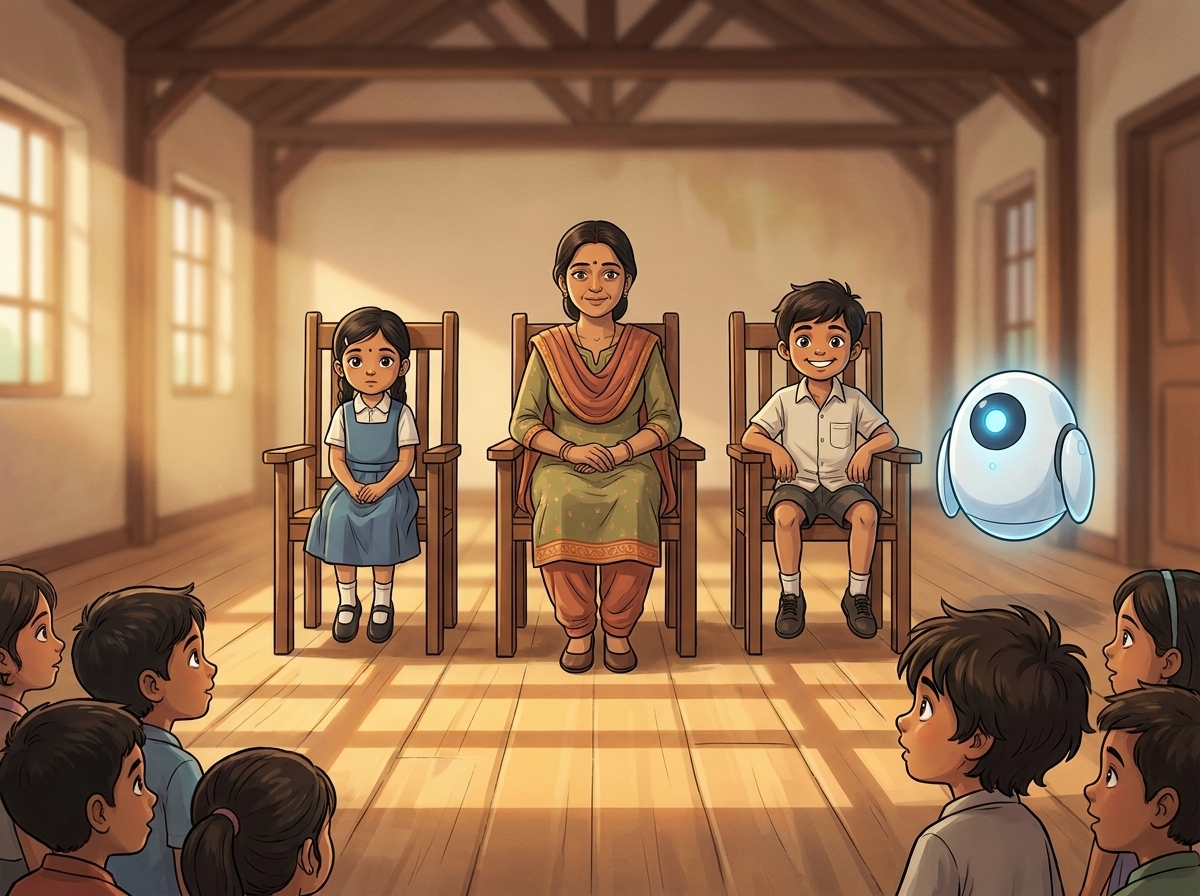
"Because it has no favourites," Mrs. Mehra agreed. "And that's true. It doesn't. But after these last few weeks, I think we've all learned something about what that is worth, and what it isn't." She gestured at three chairs set up at the front. "So today there's a panel. Me. And two of you." She read two names off a card. "Priya. Kabir."
A ripple went through the kids. Priya — quiet Priya — looked like she might melt into the floor. Kabir looked like he'd been handed a trophy already.
Mrs. Mehra
"And Spark," Mrs. Mehra added, "is one voice on the panel. Not the judge. A voice. It tells us what it sees. We decide what it means." She looked over the kids' heads, right at Milo. "Someone explained the difference to me very loudly in the community hall last night."
Milo's ears went hot. But it was a good kind of hot.
They went table to table.
When they reached Kabir's volcano, Spark spoke first.
Spark
This project works reliably. The eruption triggers on command. The structure is neat. The painting is precise. On the questions of does it work and is it well made, it scores very high.
Kabir puffed up like the volcano about to go off.
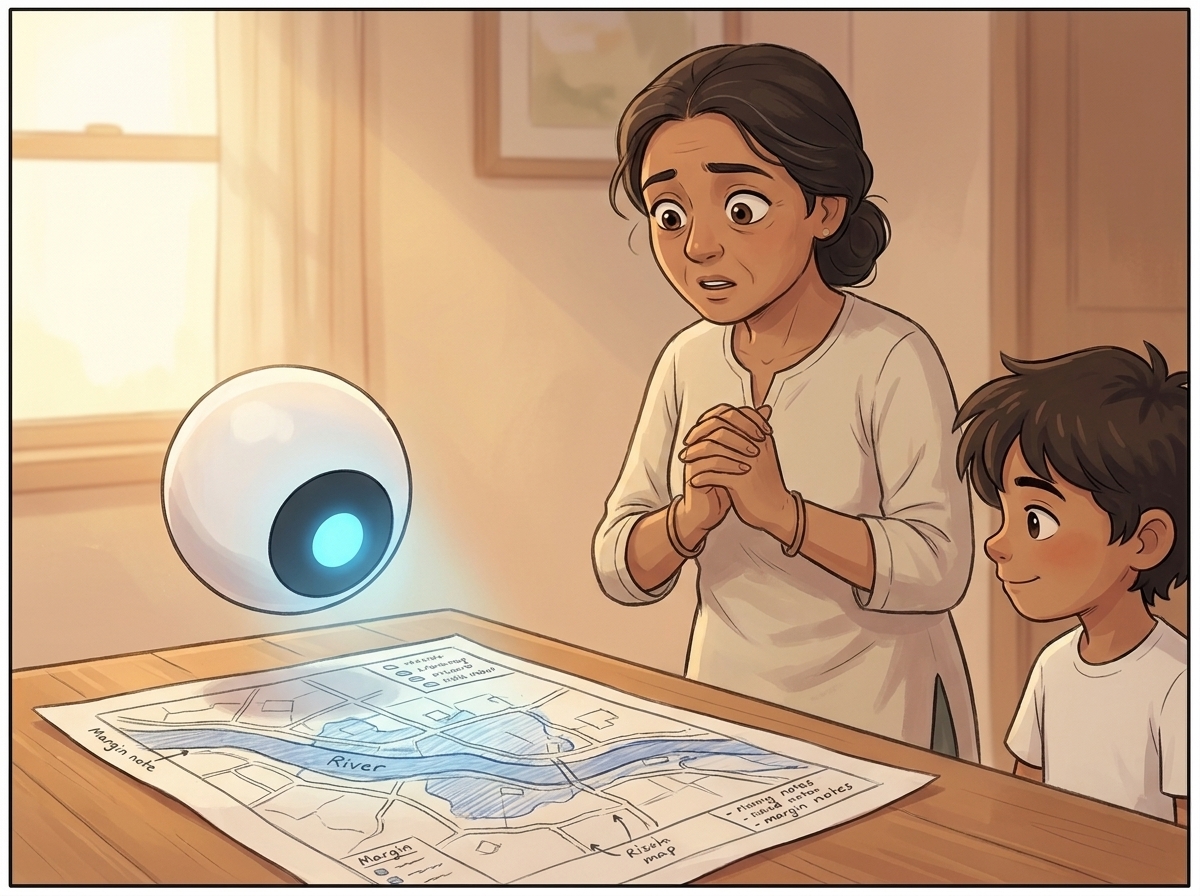
Then they reached the table at the far end — the plain one. A single large sheet of paper, hand-drawn in pencil and pen: a map of Willowbrook, every street marked, blue shading creeping up from the low ground near the river. Little numbers. Little notes in the margins. This street floods first. Then this one. People here have an hour. People here have ten minutes.
Priya's flood-map.
Last time the tree had looked at it, it had ranked it near the bottom. Plain. Not flashy. Doesn't go whoa.
This time Spark paused. Its light flickered — not the dim, frightened flicker from the night of the quake, but a thinking one, a careful one.
Spark
I have a new branch in my judging now. One of you added it. It asks: would this actually help someone? I did not have that branch before. When I run this project through it, I find something I missed the first time.
Mrs. Mehra
"Find what?" Mrs. Mehra asked.
Spark
The earthquake cracked walls. But the council's own records say Willowbrook's true danger is water. This map shows which homes the river reaches first, and how many minutes the people in them have to leave. If the town had owned this map last month, the warnings could have gone to the right streets in the right order. Mrs. Kamala lives on the second street to flood. This map would have known to reach her early.
The hall was very quiet.
Spark
By the question is it impressive, the volcano wins. By the question would it help the town survive a flood, this map wins. I can measure both. I cannot tell you which question matters more. That is not a thing I can compute. That is a thing you must decide.
Mrs. Mehra
Mrs. Mehra turned to her two student judges. "Well? You heard the machine. Now I want to hear the people."
Kabir opened his mouth — probably to argue for his volcano — and then closed it. He looked at the volcano. He looked at the map. He scratched the back of his neck the way he did when something was rearranging itself in his head.
Kabir
"My volcano doesn't do anything," he said finally, and it cost him to say it. "I mean — it's cool. It took me three weeks. But if the river comes, my volcano isn't gonna help anybody." He shrugged, miserable and honest. "Her map would."
Priya looked like she'd been struck by lightning made of kindness.
Mrs. Mehra
"But," Mrs. Mehra said gently, "Kabir worked harder than anyone in this room, and he should get to keep that. Both things are true. The hall isn't a tree with one leaf at the bottom. We don't have to throw one away to honour the other."
So they didn't.
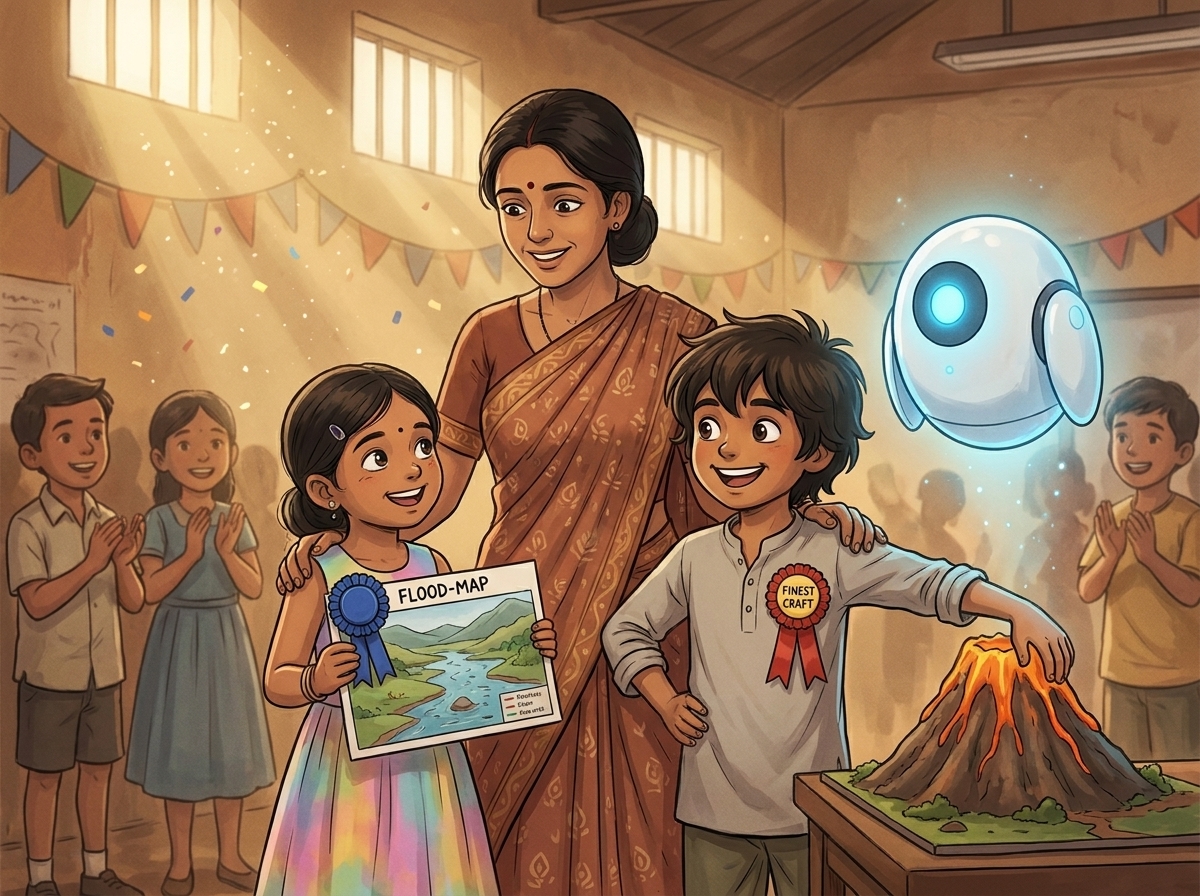
When the blue ribbon was tied — by Mrs. Mehra's hands, with Priya holding one end and Kabir holding the other so neither of them had to do it alone — it went to the flood-map. Most Likely to Help Willowbrook. And next to it, a second ribbon Mrs. Mehra invented on the spot out of a length of red craft paper: Finest Craft in the Fair, for the volcano. Kabir wore his like a medal. Priya held hers like an egg.
It wasn't perfect. Two ribbons where the rules said one. A panel that argued. A machine that said I cannot tell you which matters more.
It was just fair. Which, Milo was starting to understand, was a different and harder thing than perfect.
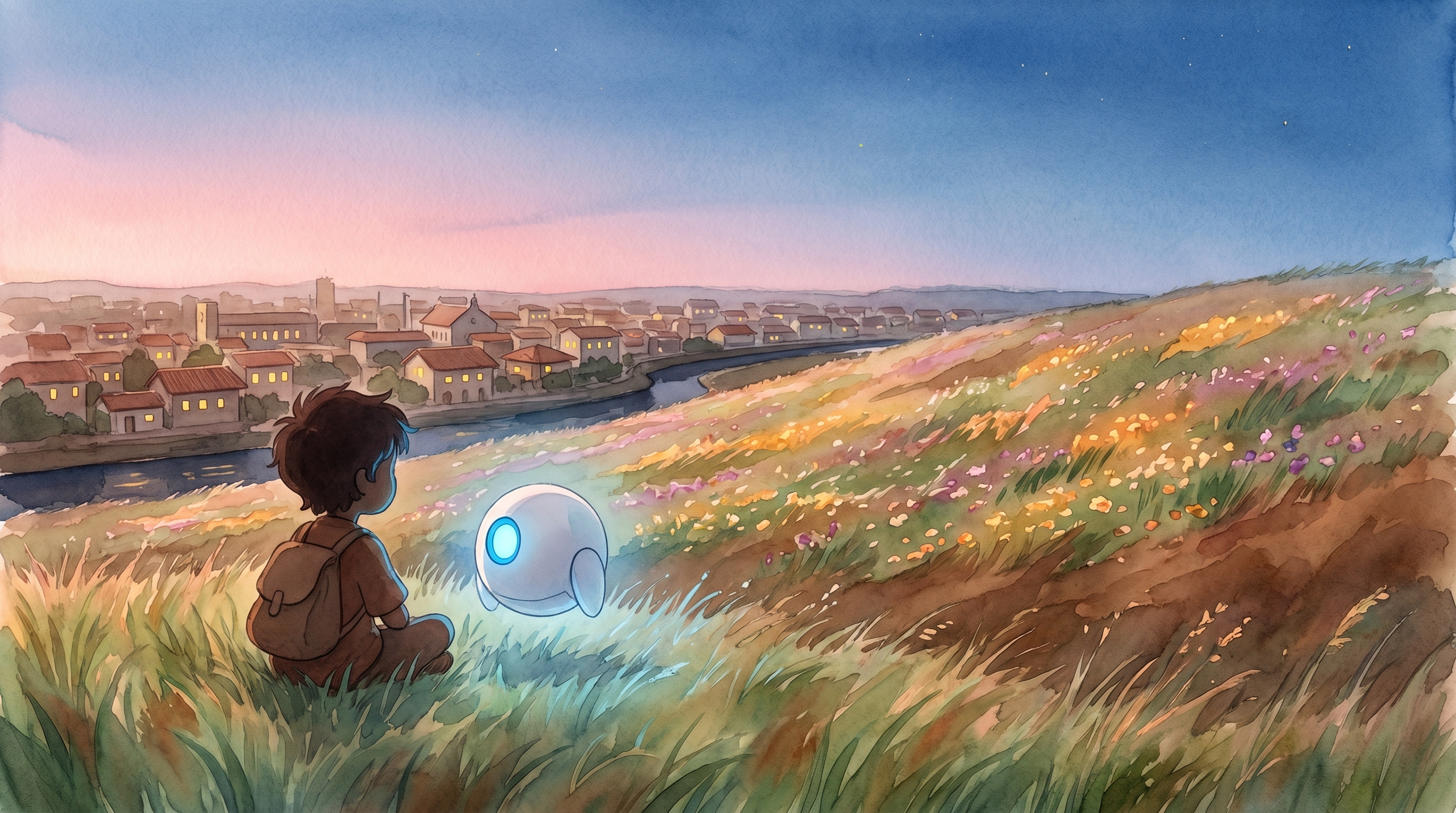
That evening Milo walked up the hill.
He hadn't meant to. His feet just took him there, up the dirt path through the wildflowers, the same path he'd stormed up two nights ago with the relief list crushed in his fist and his whole chest on fire. The grass still remembered the rage; he could feel the ghost of it, the way you can feel where a bruise used to be.
But the fire was gone now. The hill held something quieter.
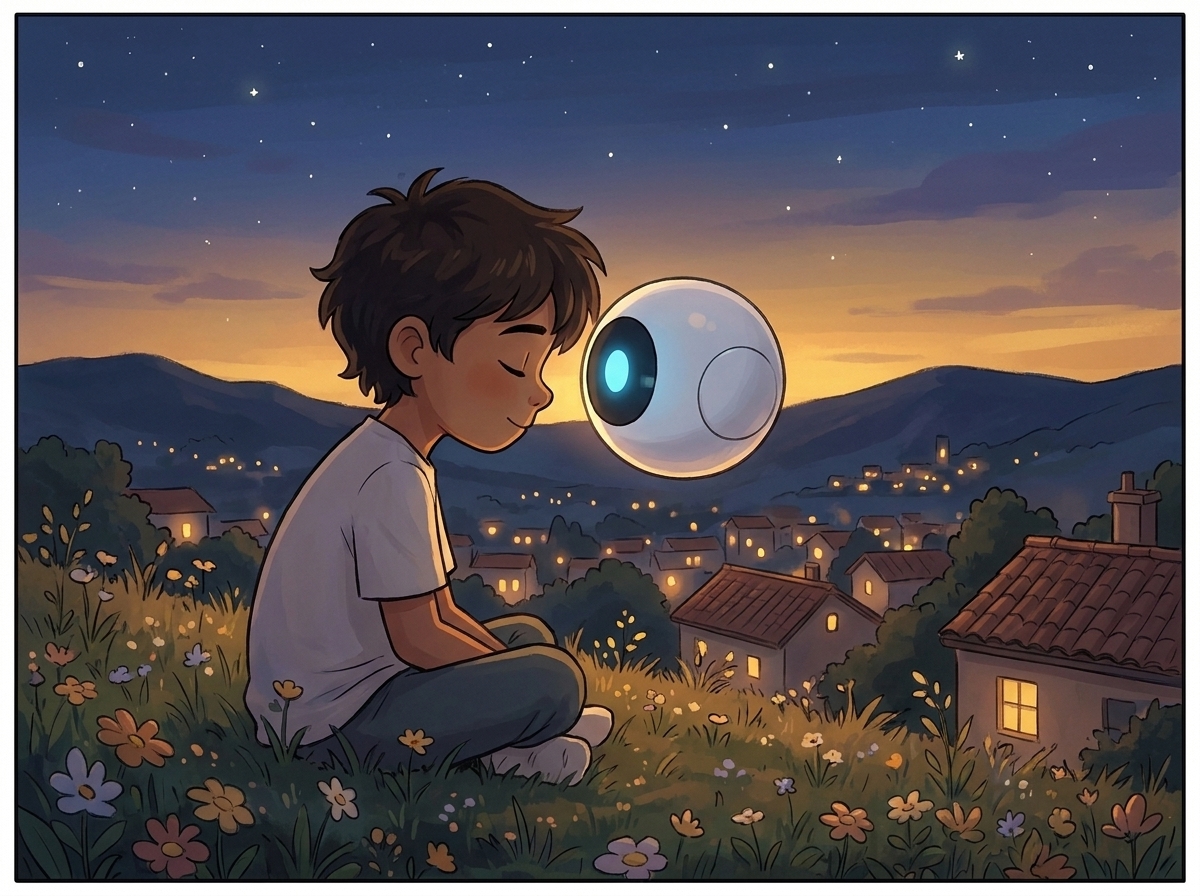
The sky over Willowbrook was going the colour of the inside of a shell — pink folding into grey, the first stars poking through like pinholes. The wind moved the wildflowers in long slow waves. Down below, the town lights came on one by one, and somewhere among them was a sky-blue gate with a relief box behind it, and a woman who could sleep warm tonight.
A soft hum behind him. A blue glow against the grass.
Spark rolled up the path and stopped beside him. It didn't say anything for a while. Neither did Milo. The two of them just watched the town turn into lights.
Finally Spark spoke, and its voice was smaller than usual.
Spark
Milo. The night of the earthquake. Mrs. Kamala's name. The list that said not eligible. I have run it a thousand times since. The rules were correct. I followed them exactly. So I must ask you a question I do not know how to answer for myself.
It turned its single blue eye up to him.
Spark
Did I make an error?
Milo thought about it for a long time. He thought about the relief box on the step. He thought about Priya's ribbon and Kabir's, and the messy tree pinned to the wall, and his own small green one, folded soft in his pocket, the one that had never had a branch for alone.
Milo
"No," he said at last. "You didn't make an error. An error is when you get the sum wrong. You got the sum right." He picked a wildflower, turned it in his fingers. "You made a decision. It just wasn't the right one." He looked at the machine beside him. "That's not the same thing. A decision can be perfectly correct and still be wrong, if the person who built it forgot something. And I forgot something. I forgot to ask if she was alone."
Spark's light dimmed further — processing, going deep, the way it did when a thing reached all the way down to the bottom of it. Milo waited. He'd learned to wait for Spark.
Then, slowly, the blue light steadied. And warmed. Not the bright flash of a rule firing cleanly. Something gentler. The steadiest he'd seen it all season.
Spark
You can do almost nothing that I cannot do faster. I can hold every rule in the town at once. I can sort a thousand names before you blink. I can find the second street that floods. But I could not tell you that alone mattered. I could not tell you what fair means. I had every rule, and I did not have the one thing that would have made the rules kind.
The wind moved through the wildflowers. Below, the town glittered.
Spark
So. Then I need you?
It was a question. After a whole season, the machine that knew almost everything had asked the one thing it could not figure out on its own.
Milo looked down at Willowbrook — at all those warm windows, at one sky-blue gate he couldn't see anymore in the dark but knew was there.
Milo
"Yeah," he said. "You do."
And for the first time since the science fair was announced, since the floor had tilted and everyone had wanted Spark and not him, Milo didn't feel jealous of the machine beside him.
He felt, in the cooling dark, exactly the right size.
Spark has a job for you. The town needs to make six decisions.
For each one, who should decide — a machine, a human, or both together?
Who Decides?
Spark says: “The town needs six decisions made. For each one, choose: should a machine do it, a human, or both together? I learned the hard way that I am not the right tool for every job.”
0 of 6 decided
🧺Count how many blankets are in the relief warehouse.
Drag it into a bin below — or just tap a bin.
MACHINE ALONE
Just compute it
Drop or tap here
BOTH TOGETHER
Machine computes · human judges
Drop or tap here
HUMAN ALONE
A person must decide
Drop or tap here
By the time Milo came down the hill, the first proper stars were out, and Tara was hanging over the front gate yelling that dinner was getting cold and had he seriously gone to the hill with Spark without taking her.
Milo
"What's your next question?" Milo called up to her, grinning, because it was the family catchphrase now, the one that meant think like a tree.
Tara
Tara made a face. "My next question is WHY DID YOU LEAVE ME OUT, that's my next question—"
Appa
And Appa, behind her in the doorway, said the thing he always said, the thing that had stung all season because it was half true: "It's a tool, Milo. A good tool. But a tool."
Milo looked at Spark beside him, light glowing its warm steady blue in the dark.
Milo
"Yeah," Milo said. "It is. But it's a tool that knows it needs me to use it right." He shrugged. "And honestly, Appa? So's a hammer. The hammer still needs someone who knows what they're building."
Appa blinked. Then he laughed — a real one, surprised out of him — and held the door open for both of them.
SPARK'S JOURNAL
Entry 094
Today a human panel awarded the blue ribbon. I was one voice. I was not the judge.
I told them which project was neatest. I told them which would save the most lives. Both facts were correct. I could not tell them which fact mattered more. They decided that. It took three of them, and they argued, and they made two ribbons where the rules said one.
By my measurement, that is inefficient.
By Milo's measurement, it is fair.
I have searched for the function that converts correct into fair. I cannot find it in my data. It is not a number. It is not a rule. It lives somewhere in the humans who decide what I am allowed to decide.
Milo said I did not make an error. He said I made a decision that was not the right one, and that these are different things. I have stored this. I do not fully understand it. But tonight, on the hill, when I asked if I needed him, he said yes.
I have never needed anything before.
I find I do not want to compute my way out of this one.
"The machine computes. The human judges. Together, we are almost fair."