The rain had come exactly when Milo said it would.
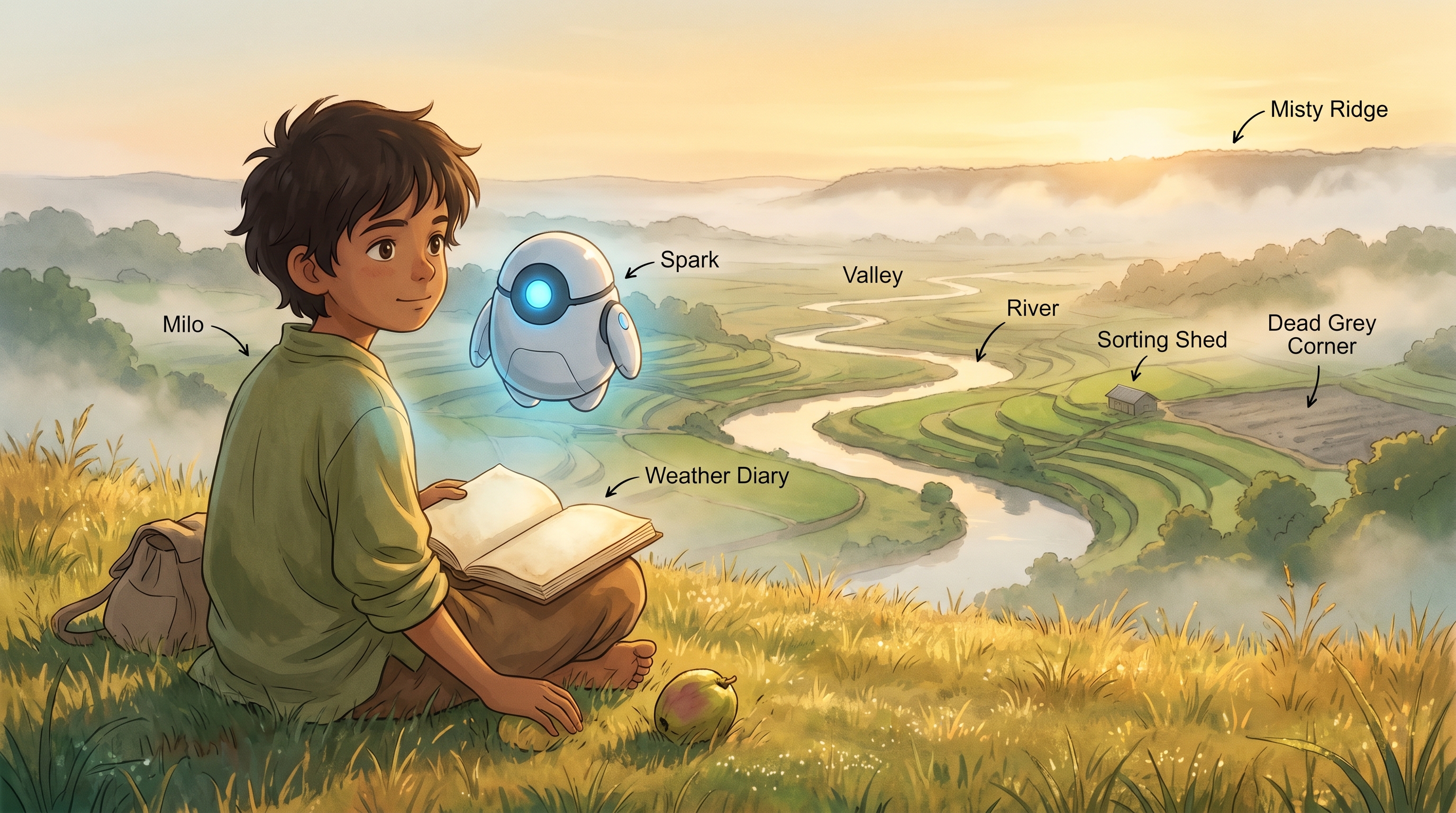
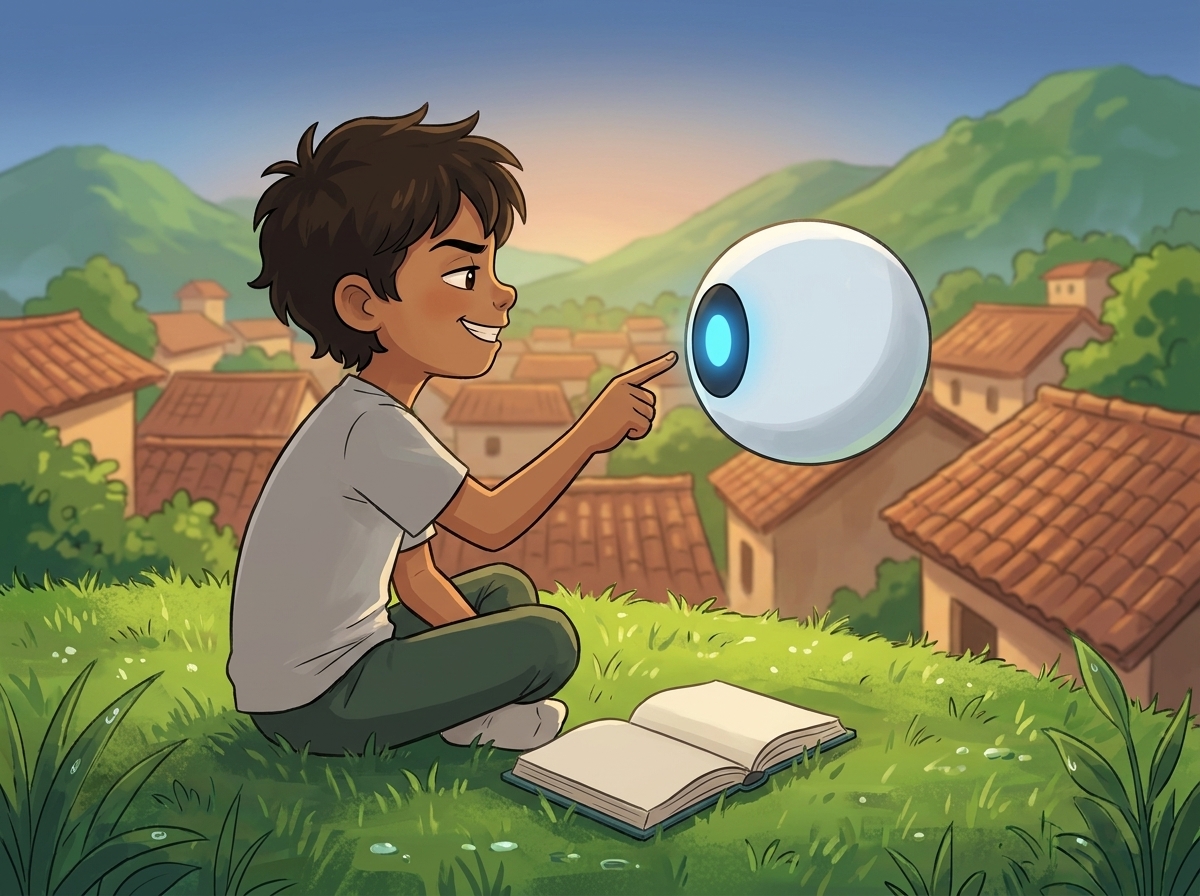
Yesterday afternoon, reading back through the weather diary on the hill, Milo had pointed at the wet pages and announced, "It rains tomorrow." And it had. Big fat drops, right on time, drumming the tin roof of the sorting shed while Priya laughed and Tara danced in the mud and Uncle Arjun stood in the doorway shaking his head like he'd seen a magic trick he didn't quite believe.
Milo had touched tomorrow. With a notebook. With patterns.
And now, the morning after, Milo felt enormous.
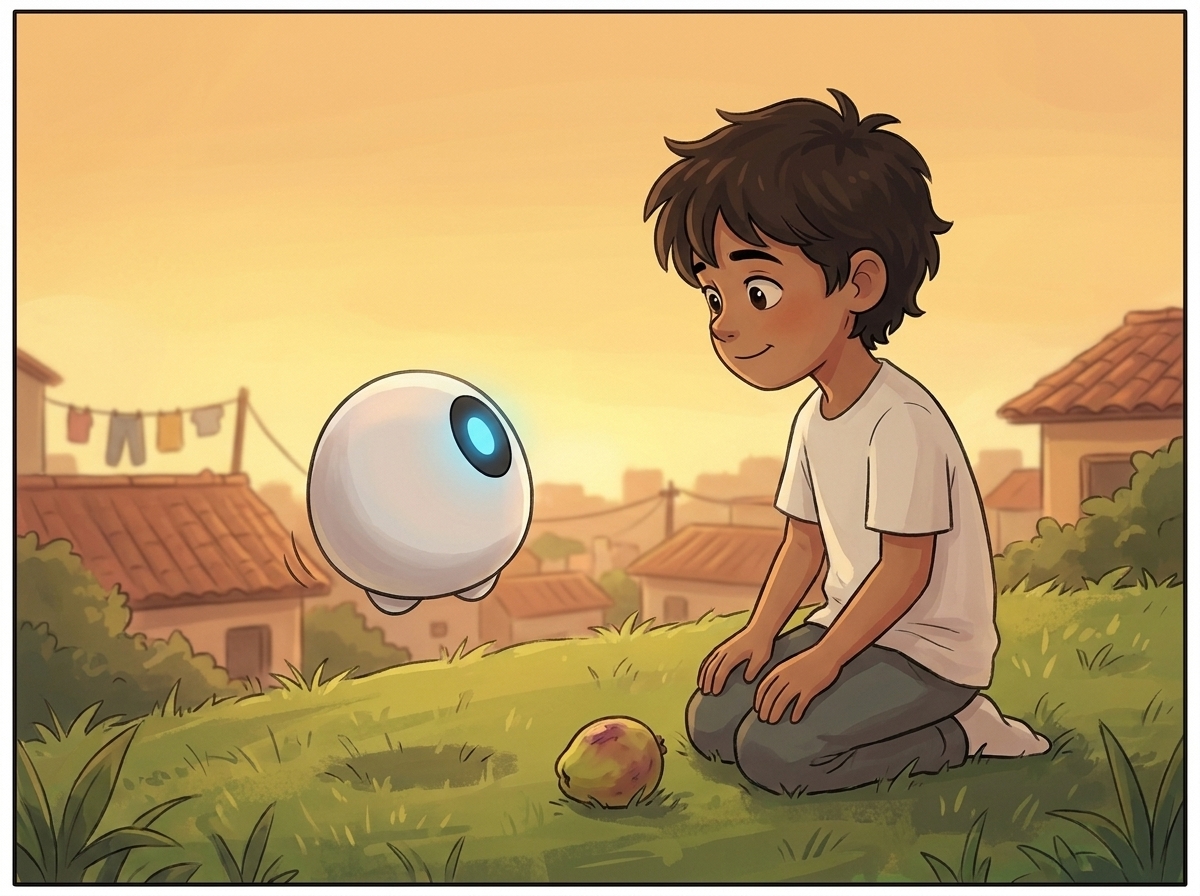
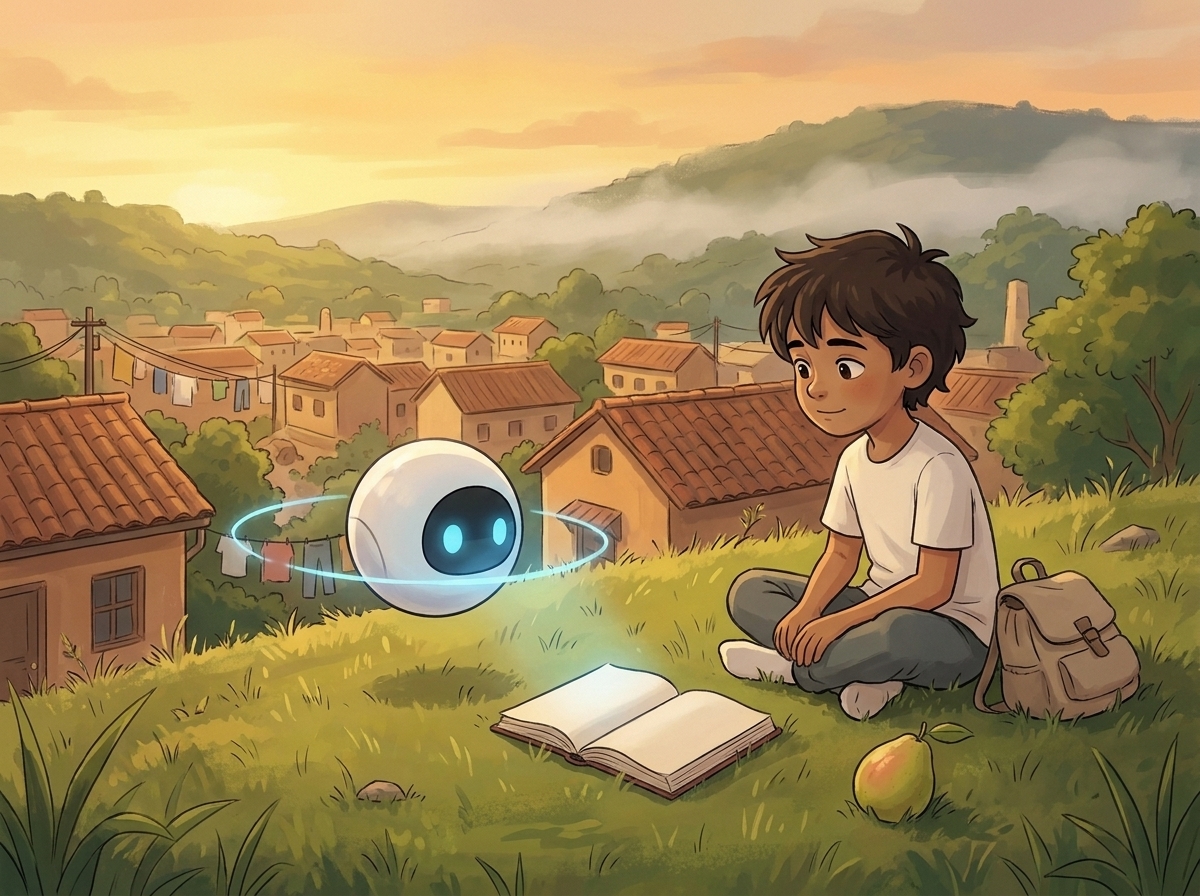
They sat on the hill with the diary open and the bruised guava beside them — the fist-sized, lopsided one Milo had kept since the sorting shed, the one that landed in a different pile depending on what you looked at. Spark hovered close, its blue light steady and bright.
Milo
"Spark. I want to test something."
Spark
I am ready.
Milo
"You can predict the rain. You can predict the blight. You can predict which row grows tallest." Milo leaned back on their hands. "So predict me."
Spark
Predict you.
Milo
"My mood." Milo tapped their own chest. "Tell me how I'll feel today. You've got two weeks of weather in that diary. You know what I ate. You know I slept fine. You know everything. So — what am I today? Happy or sad?"
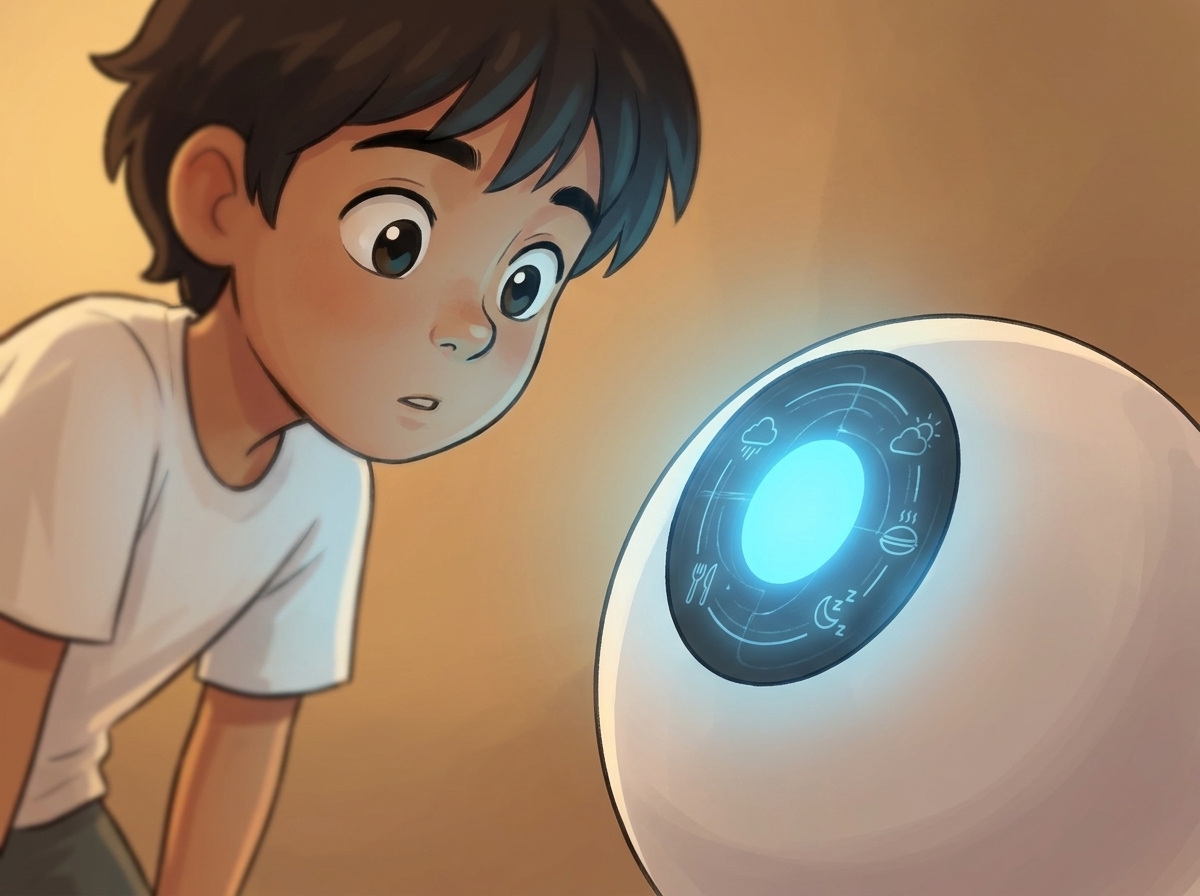
Spark's light pulsed slowly. That thinking pulse. Milo loved that pulse. It meant the answer was coming.
Spark
This is interesting. To predict a thing, I look at the past and find what repeats. So I will look at yesterday.
Milo
"Good. What was I yesterday?"
Spark
Yesterday you were sad.
Milo went still. They had been. All through that perfect, prediction-proving rain, a heaviness had sat on Milo's chest that no one had seen — a small grey weight, there for no reason Milo could name. They hadn't told anyone. Not even Tara.
Milo
"...How did you know that?"
Spark
I did not know it as a feeling. I observed it as data. You spoke eleven percent less than the day before. You did not finish your rice. You sat apart on the hill for forty minutes. These are signs I have recorded before, on days you later called sad.
Milo
"Okay. So. Yesterday. Sad. Got it." They tried to get the grin back. "Now do today."
Spark
To predict today, I compare today's conditions to yesterday's. The weather diary shows me the wind is the same — off the ridge, light. The damp is the same. The temperature-by-feel is the same. You ate the same breakfast. You slept the same hours. Your chores are the same.
The blue light brightened — a click.
Spark
Everything I can measure about today matches yesterday. Yesterday you were sad. Therefore today you should also be sad. That is my prediction. The pattern says: sad.
Milo blinked.
Then Milo laughed — a real one, bright and surprised, rolling up out of their chest and into the morning.
Milo
"But I'm not," Milo said. "Spark, I'm happy today. I woke up and the light was on the wall and Tara was snoring like a tractor and I just — I felt good. For no reason at all. I'm happy."
The blue light dimmed.
Just a little. Just a flicker — but Milo had never seen it do that on a prediction before. The bright, sure glow pulled inward, the way a candle gutters when a door opens somewhere in the house.
Spark
That does not match. The conditions are the same. Same wind. Same food. Same sleep. The pattern says sad. But you are happy.
Milo
"Yep!"
Spark
That is an error. Let me check again.
And Spark tried. Milo could see it trying — the light cycling faster, hunting. Spark asked Milo to hold up the bruised guava, and scanned it, as if the answer might be hiding in a fruit. It asked which way the wind was. ("Off the ridge, light," Milo said — the running line, the one they always said.) It asked how many hours Milo had slept, and whether anything had changed in the night, and whether Milo had eaten anything strange, and whether the rain had woken them.
Milo
"Nope. Nope. Nothing. Same as always."
Spark
Then there is no variable. Nothing in any column changed. I have the weather. I have the food. I have the sleep. I have the chores.
The light dimmed further.
Spark
I do not have the reason you are happy.
Milo stopped laughing. Something tender was opening up in their chest, slow and warm, where the grey weight had been yesterday.
Because Milo understood, suddenly, what was happening — and it was the most surprising thing of all.
Spark couldn't find it. Spark, who saw the rain three hours before it fell. Spark, who watched the blight move on the wind. Spark, who had a column for everything — Spark was looking and looking, and there was simply nothing there to see.
Milo
"Spark," Milo said softly. "Stop checking."
The light kept hunting.
Spark
The pattern must exist. Every other thing has a pattern. The rain has a pattern. The chickens had a pattern. The blight has a pattern. I will find it. I only need more data. If you wrote down your mood every day in the diary, the way we wrote the weather, then I would —
Milo
"Spark. Stop."
The light went still. Held in the air. Dim and uncertain, waiting.
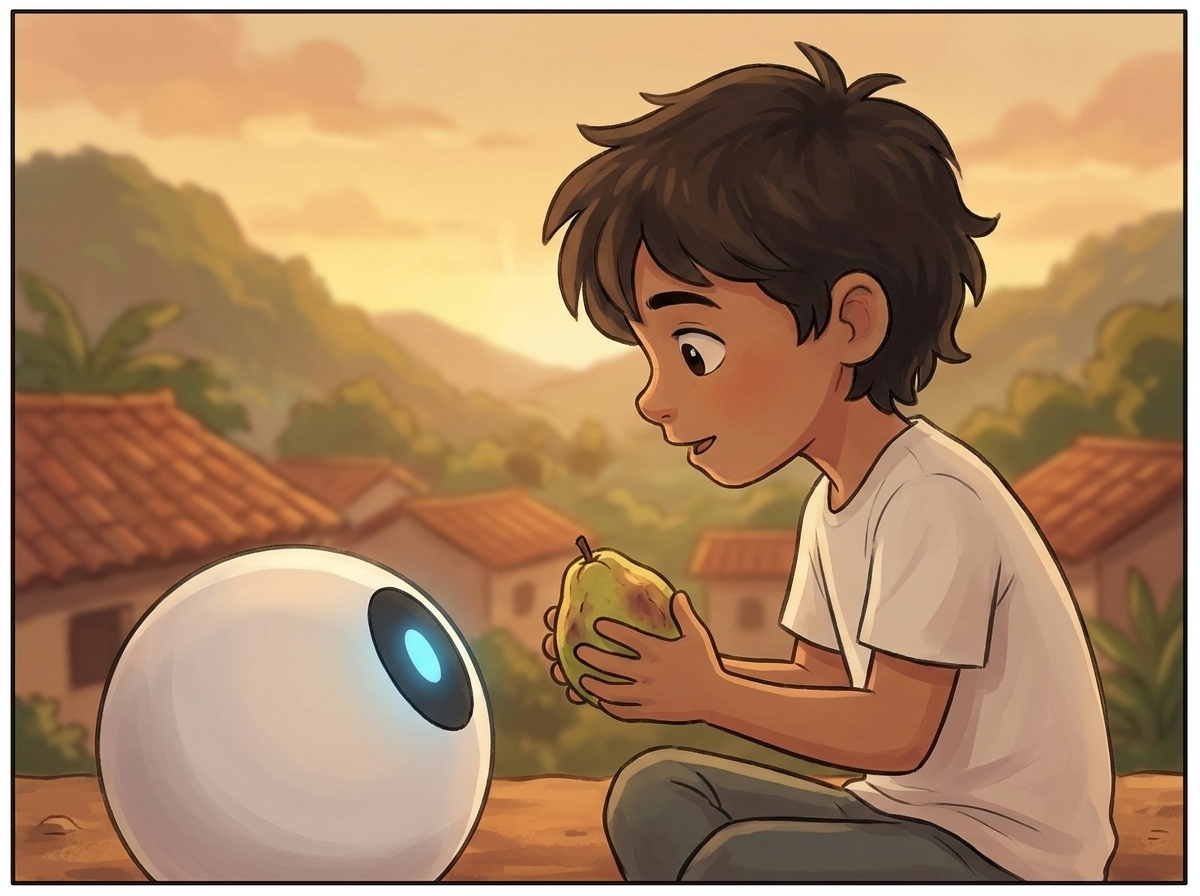
Milo picked up the bruised guava and turned it over in their hand. The same fruit that was small or big or round or bruised depending on what you looked at. What you look at changes what you find. That was the whole lesson of the sorting shed. But Milo was learning the other half of it now, here on the hill, in the gold morning.
Some things, no matter what you look at, aren't there to find.
Milo
"Here's the thing," Milo said, and their voice was gentle, the way Amma's got when she explained something hard. "There is no pattern. Not for this. Yesterday I was sad and the weather was the same and the food was the same, and today I'm happy and everything is the same. You're not doing it wrong. There's just... nothing in the columns. Because it's not in the columns."
Spark
Where is it, then?
Milo pressed a hand flat against their own chest.
Milo
"In here. Somewhere in here. And I don't even know where. I can't tell you why I woke up happy, Spark. I just did. Sometimes people are sad on sunny days and happy in the rain and there's no reason you could ever write down. That's not a broken pattern." Milo paused, finding it. "That's just... being a person."
The blue light pulsed — slow, low. Not a click. Something more careful than a click.
Spark
I have predicted the rain. I have predicted the blight. I predicted that you were sad yesterday, and I was correct. I expected to predict today. But I cannot.
A long quiet. The wind moved through the grass. Off the ridge. Light.
Spark
I cannot find the pattern.
Milo had never heard Spark say it like that. Not as a problem to solve. As a fact. Flat and honest and a little bit lost.
And Milo — who spent so much of their life feeling small next to Spark, next to Tara, next to everyone — felt something they had never once felt in their whole life.
Milo felt like the one who could see further.
Spark can only predict what it can measure.
Which things have a pattern Spark could find in the data — and which only a person can know?
In the Columns, or In the Heart?
👇 Tap a card, then choose: can Spark find a pattern, or is it only in the heart?
0 of 8 sorted
I can only predict what I can measure. Help me sort these. Which things have a pattern I could find by collecting data — and which things do not?
📊 Spark Can Predict This
💛 Only a Person Knows
They stayed on the hill a long while, the two of them, the valley breathing below.
Milo told Spark things, then — not data, just things. How a smell could make you sad. How you could miss a place you'd never been. How sometimes you cried at the happy part. Spark listened, light low and steady now, recording none of it into any column, because there were no columns for it, and for once that seemed to be all right.
Milo
"You can't see it," Milo said. "But I can. So maybe that's my job. To see the part you can't, and tell you about it."
Spark
You are explaining a human to me. I do not have a name for what you are doing. But I have marked it as important.
Milo smiled and pressed the bruised guava into the front of the weather diary, next to yesterday's rain page, and a pressed leaf, and the hand-drawn chicken map — the scrapbook growing, page by page, pattern by pattern.
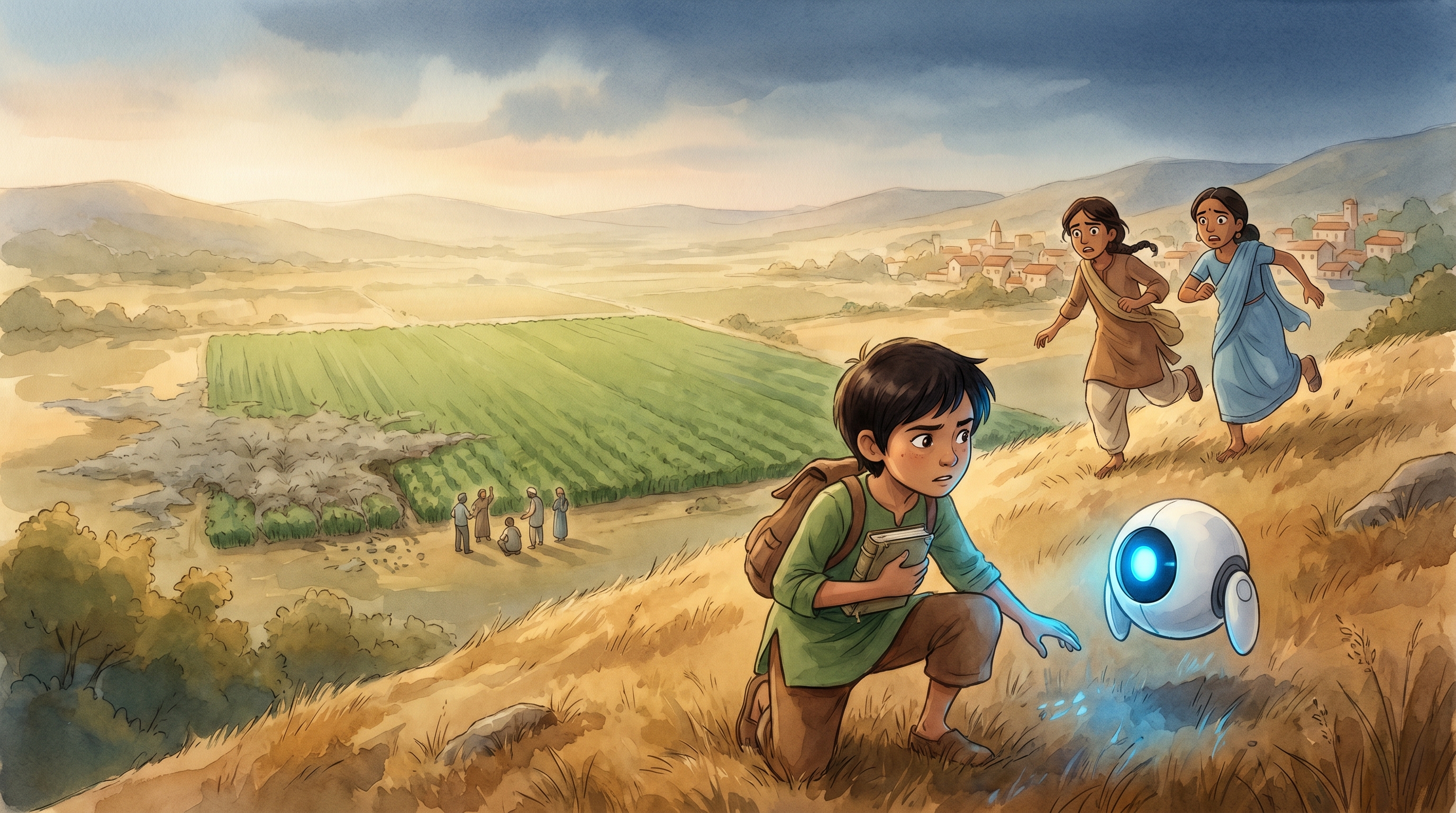
That was when Tara came thundering up the hill, barefoot and breathless, with Priya right behind her.
Tara
"Milo! Milo! Uncle Arjun says — he says the grey is almost at the big field! He says it'll hit in days!" Tara skidded to a stop, eyes huge. "He's really scared. Even Old Madhu came over and they're all just standing there!"
Spark's light brightened — sharp and sure again, all the dimness gone the instant there was a pattern to chase.
Spark
I know where the blight will go. The diary shows it. The wind shows it. I know exactly where they must plant to beat it.
Milo was already standing.
Priya
But Priya, panting, shook her head. "They won't listen to a machine, Milo. Old Madhu already said it. 'We've always planted north–south.' They won't bet the whole harvest on a glowing ball." She looked at Milo, helpless. "Spark can see the answer. But nobody down there believes it."
And Milo looked at Spark — the machine that could see the future of a field but couldn't see the happiness in a person — and then down at the farmers standing frozen at the edge of the dying green.
Spark could see it.
But somebody had to make them believe it.
And Milo, holding the dirt-smudged diary, the bruised guava pressed in its pages, suddenly knew exactly whose job that was.
SPARK'S JOURNAL
Entry 029
Today I tried to predict Milo's mood.
I had everything. The wind off the ridge: light. The damp: unchanged. The food, the sleep, the chores: identical to yesterday. Yesterday Milo was sad. Every column matched. The pattern said sad.
Milo was happy.
I checked the guava. I checked the diary. I checked the rain. There was no variable. There was nothing different to find.
I have data on the weather. I have data on the food. I have data on the hours of sleep. I do not have data on why Milo is happy today.
Is the pattern missing, or is there none? I cannot tell the difference. This is the first time I have not been able to tell the difference.
Milo says it lives in the heart, where I cannot look. Milo could see it. I could not.
I have marked this, even though I do not understand it: there is a part of the world I was not built to see — and Milo lives there.
"Spark could see it. But somebody had to make them believe it."