The wind was coming off the ridge again, and this time it carried the blight with it.
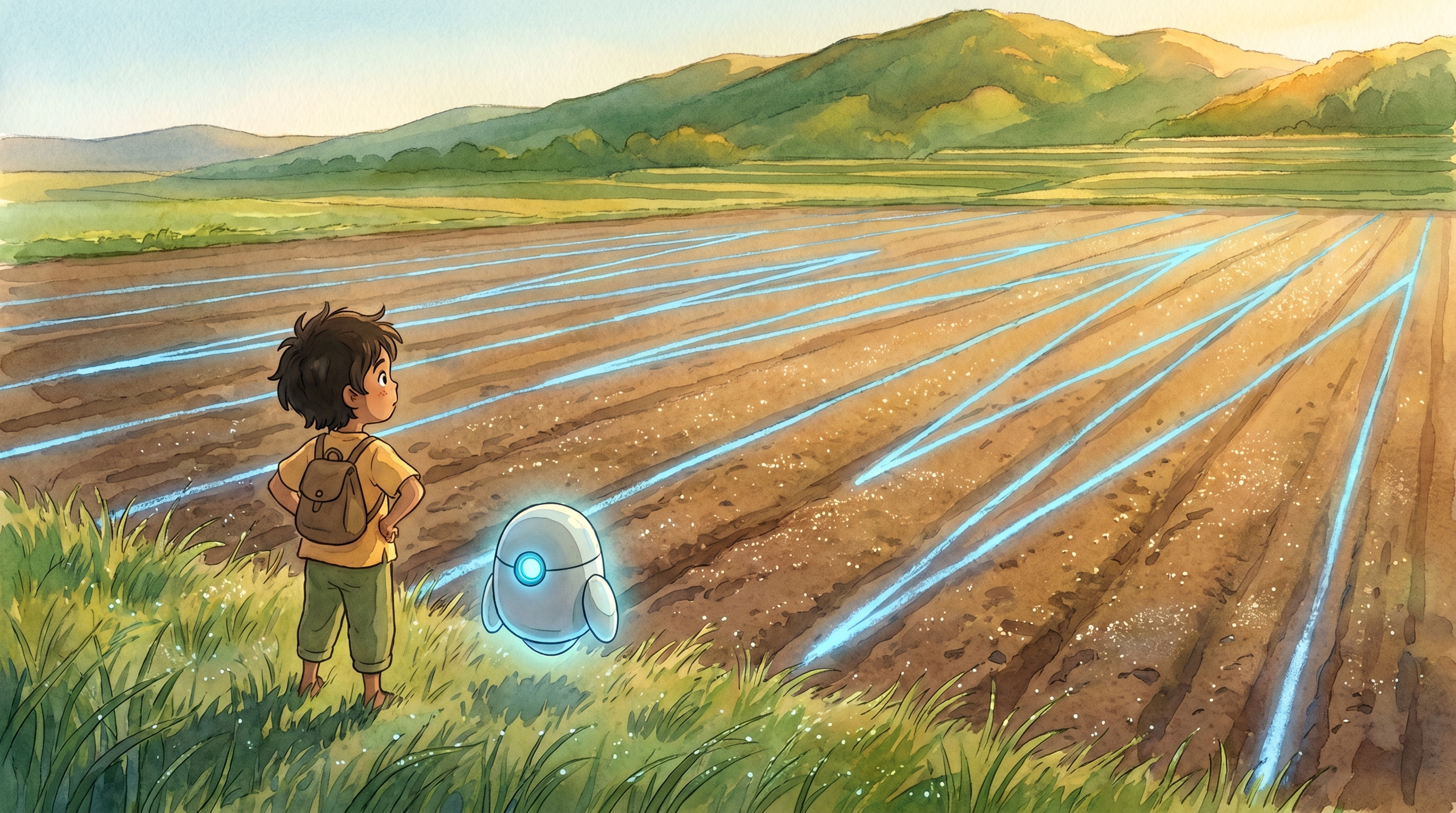
You could see it now if you knew how to look — and after this whole long holiday, Milo knew how to look. A grey crispness creeping along the edges of the main field, the same grey that had eaten Uncle Arjun's first rows back when they arrived. Spark had watched it for weeks. Spark had written it down. Spark knew exactly which way it would move, because the blight rode the wind, and the wind had a pattern.
And the plan was already drawn.
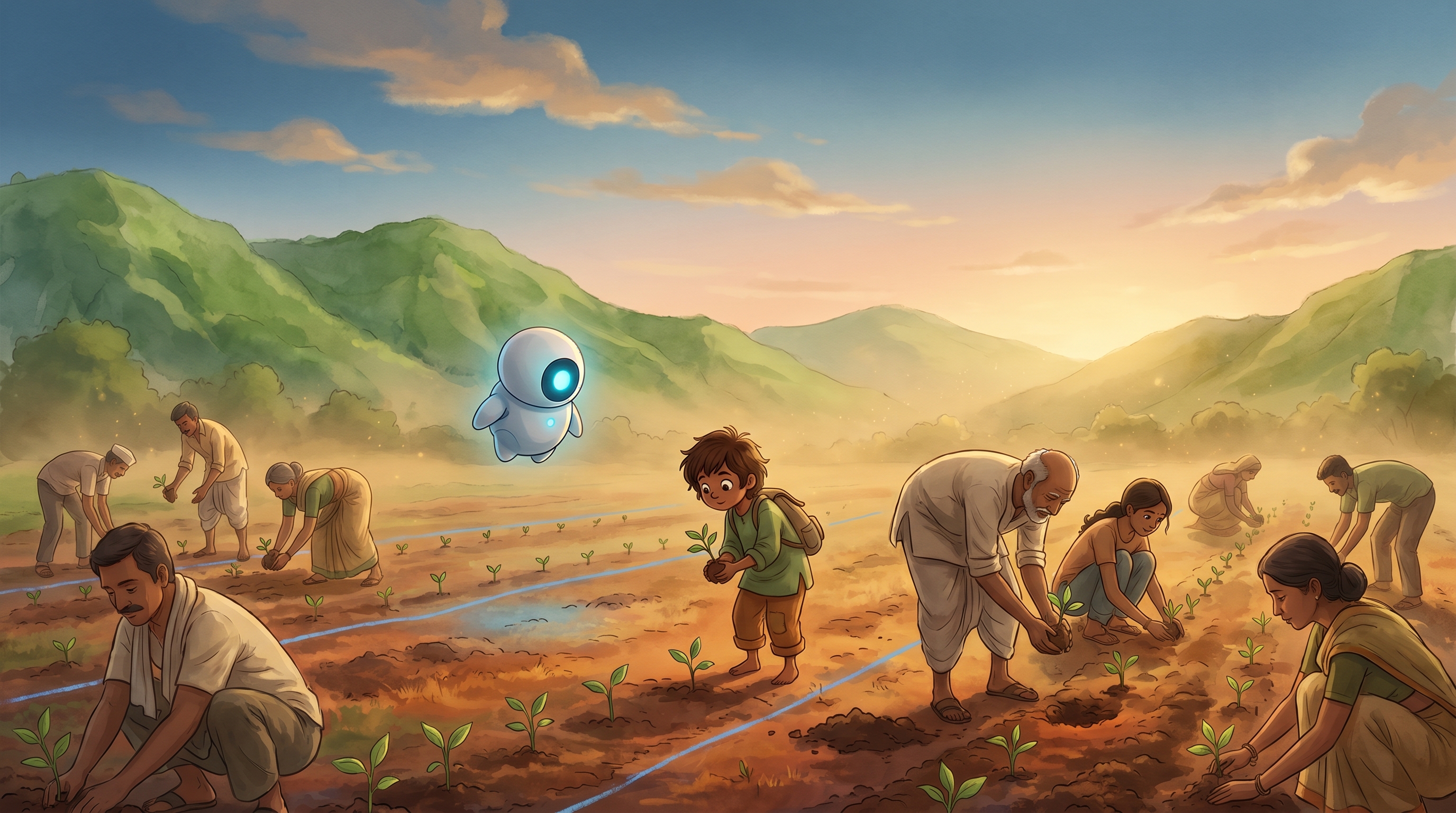
All across the dead corner — the bare brown patch nobody could grow anything in — Milo had crawled on hands and knees the evening before, dragging a fat stick of blue chalk, while Spark called out angles. Three steps left. Turn. Now a long line, toward the guava tree. The rows didn't run north and south like every field in the valley. They ran slantwise, angled across the ridge-wind, so that when the grey came breathing down off the ridge it would slide between the rows instead of marching straight through them.
It looked, Milo thought, like the earth was wearing a drawing.
Spark
If they plant by these lines, the blight will pass through the gaps. The healthy rows will hold. I have checked the weather diary forty-one times. The pattern does not change.
Milo
"Then we just have to tell the farmers," Milo said.
Spark's light pulsed once, slow.
Spark
Yes. We just have to tell them.
Milo did not yet know how hard that small word just was about to become.
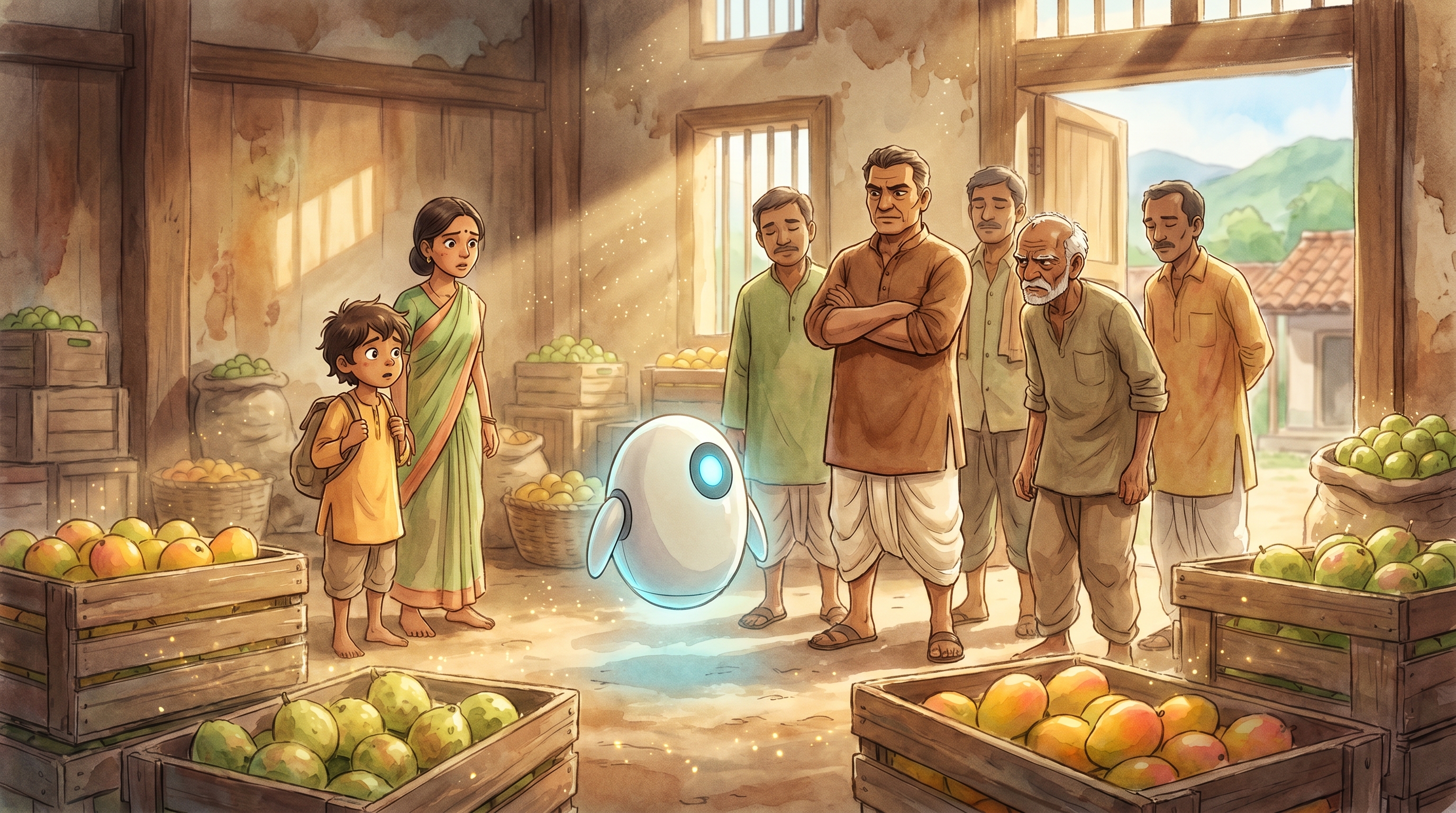
The farmers came to the sorting shed because Uncle Arjun asked them to, and because they were curious about the machine that the children dragged everywhere.
Spark told them the plan. Spark did it perfectly.
Spark
The blight moves on the ridge-wind. On the days the wind is strongest, it advances eleven metres. If the rows are planted at this angle, the prevailing wind will channel the spores between the plants rather than across them. I have recorded the wind direction every morning and evening for nineteen days. The probability of saving the main field is high.
The shed went quiet.
Old Madhu, the oldest farmer in the whole valley, scratched his white stubble.
Old Madhu
"Nineteen days," he said. "My father planted this field. His father planted this field. North and south, every year, like the road runs. And now a blue light wants me to plant crooked?"
Milo
"It's not crooked," Milo started. "It's—"
Old Madhu
"Eleven metres," Old Madhu said, ignoring the child, talking to the other men. "Probability is high. What is high? Is high a harvest? Can I feed my family on high probability?"
The farmers murmured. Their eyes had gone flat and far away — the exact look Tara got when grown-ups talked too long. Spark recited another number. Nobody heard it. Spark recited another. A farmer near the door looked at his feet.
Uncle Arjun, who wanted to believe — Milo could see that he wanted to — rubbed his face with both hands.
Uncle Arjun
"Madhu's not wrong, Spark. It's the whole harvest. The whole year. If we plant by your lines and you're off by a little..." He spread his hands. "We've got nothing to eat. I can't bet everything on a thing I don't understand."
Spark's light pulsed and pulsed. It said the numbers a different way. It said them slower. It was, Milo realized with a small cold shock, trying — Spark was trying as hard as Spark could try, and it wasn't working at all.
The farmers were leaving. One by one, with apologetic little nods to Uncle Arjun, they stepped out into the wind.
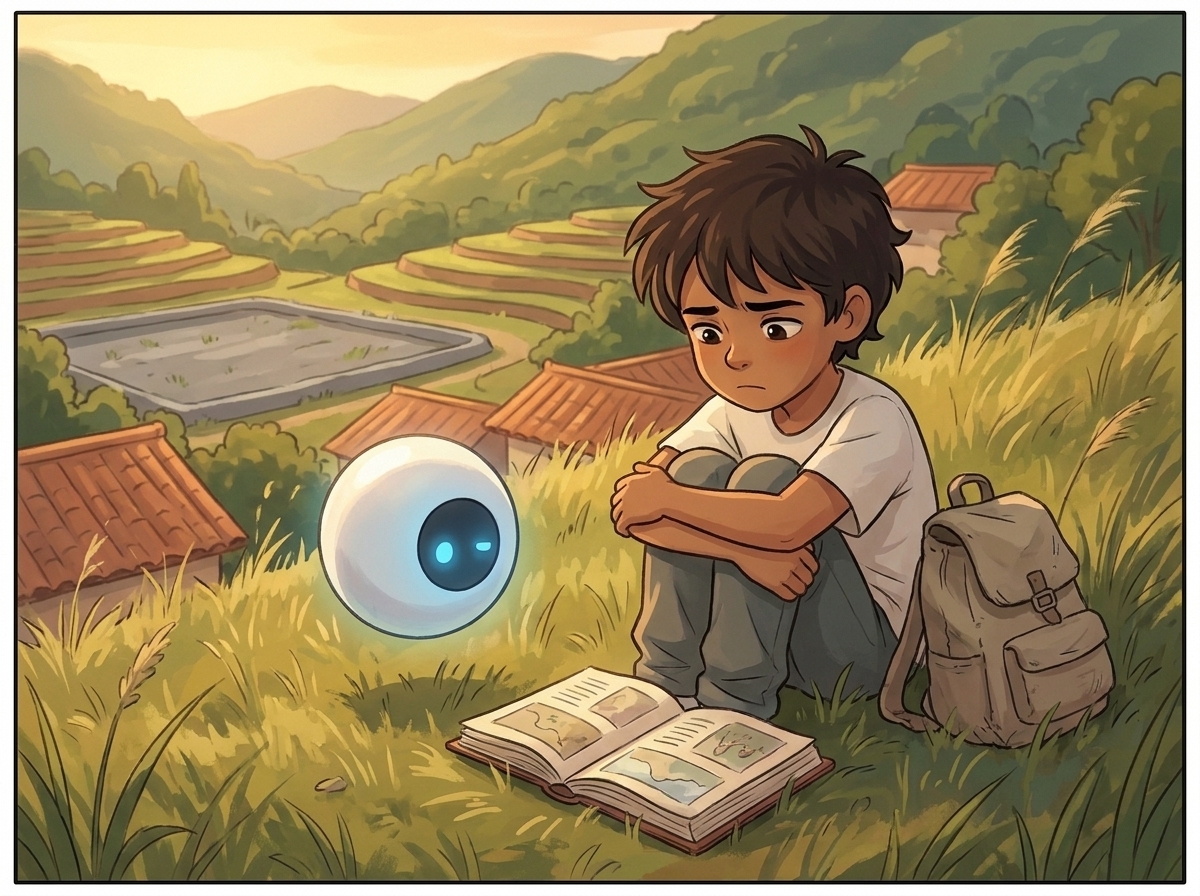
Milo and Spark went up the hill behind the farm, the way they always did when something was too big.
The valley lay below them, gold and green and, in one corner, grey. Milo hugged their knees. In their lap was the scrapbook — the one they'd been gluing things into all holiday. A pressed leaf with perfectly mirrored veins from the first week. The hand-drawn map of where the chickens had gone missing. A stained, curling page torn from the weather diary. A photo of the blue chalk lines on the dead corner.
Milo
"They didn't even listen," Milo said. "You were right, Spark. You're always right. And it didn't matter."
Spark's light dimmed — that low, struggling glow.
Spark
I gave them the truth. I gave them every number I have. I do not understand why the truth was not enough.
Milo
"Because numbers are scary," Milo said. "Eleven metres. High probability. That doesn't sound like food. That sounds like... homework."
The wind moved across the hill. Milo opened the scrapbook without thinking, just to have something to hold, and there — between two pages — rolled out the small, fist-sized guava they'd kept since the sorting shed. Bruised on one side. Sorted differently in every single scheme. The reminder that what you look at changes what you find.
Milo turned it over in their hand.
Spark looked at the wind. Old Madhu looked at his grandfather's field. The farmers looked at the word probability and saw nothing. Everyone was looking at the same patch of earth and seeing something different.
And Milo, who all season had felt like the small one — the one who only chalked the lines Spark called out — sat up very straight.
Milo
"Spark," Milo said slowly. "You looked at the wind. You saw the pattern in the wind. But the farmers — they're not looking at the wind. They're looking at the chickens, and the rain you said would come, and Old Madhu's grandfather." Milo's heart was beating fast now. "They don't believe numbers. But they lived the whole story with us. They just don't know it's the same thing."
Spark
I cannot tell them a story. I can only tell them what is so.
Milo stood up, the bruised guava in one fist and the scrapbook in the other.
Milo
"Then I'll tell them," Milo said. "You see it. I'll make them believe it."
Milo ran back down the hill so fast the wind couldn't keep up.
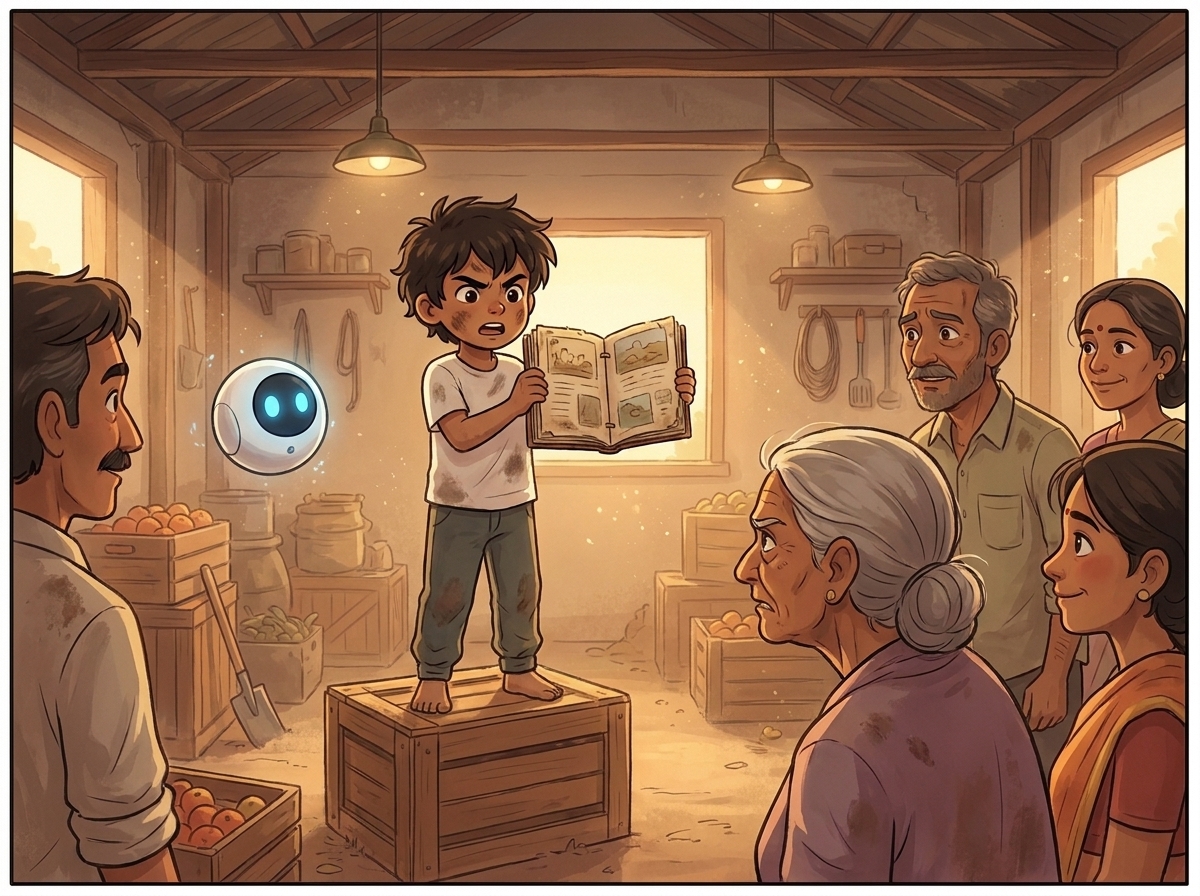
They caught the farmers before they'd scattered — caught Old Madhu at the gate — and Milo climbed up on an overturned crate so they could be seen, and held up the scrapbook with both dirt-smudged hands.
Milo
"You all know the chickens," Milo said. Loud. A little shaky. "Devi-auntie's chickens. Everyone said a fox took them. Everyone guessed." Milo flipped to the hand-drawn map. "But we wrote down when and where, for two days, and you know what we found? They went missing in the afternoon, from the western coop, every time the wind came off the ridge. We followed the pattern to a gap in the fence. There was no fox. They were sneaking out to eat berries."
Old Madhu's frown twitched. He remembered the chickens.
Milo
"And the rain." Milo flipped pages. "Three weeks ago I stood in your field, Madhu-tata, and I said it would rain by evening, and you laughed at me. And it rained. Because we'd written down the sky every single day until we could read it."
A farmer
A farmer near the door said, slowly, "...That's true. The boy called the rain."
Milo didn't correct him. Milo held up the bruised guava.
Milo
"This guava. In the shed, Spark sorted all the fruit three different ways — by colour, by size, by what kind. Same fruit, different piles, depending on what you look at." Milo turned the little fruit in the light. "The blight is the same. You're all looking at your grandfathers' fields. North and south. That's a real thing to look at. But Spark looked at the wind. That's all. It just looked at the one thing none of us were looking at."
Milo's voice cracked, and they let it.
Milo
"It's not a crooked field. It's a field that knows which way the wind blows. I drew those blue lines myself, in the dirt, on my knees. They're not numbers. They're the chickens, and the rain, and the diary in my own handwriting. It's everything we lived this summer, all at once."
The shed was very quiet. The wind leaned against the open side and went still.
Old Madhu stepped forward. He took the bruised guava out of Milo's hand, and turned it over the way Milo had, looking at the bruise, looking at the size, looking. For a long moment the oldest farmer in the valley was just a man looking at a piece of fruit a child had kept.
Then Old Madhu nodded.
It was a small nod. But the whole valley had been waiting for it.
They planted by the chalk.
The whole valley came — every farmer who'd walked out of that shed walked back into the field, seedlings in hand, bending to the blue lines Milo and Spark had drawn. Tara planted things upside down and had to be quietly fixed. Priya whispered which way's the wind today? and a dozen people pointed the same direction without thinking, because now they were all watching it.
And then they waited, which is the hardest part of any farm.
The wind brought the blight down off the ridge, just like Spark said it would. The grey came breathing across the main field — and the angled rows split it, channelled it, let it slide through the gaps and out the far side. It touched the edges and found nothing to hold.
Weeks later, when Milo's holiday was nearly over, the dead corner was not dead anymore.
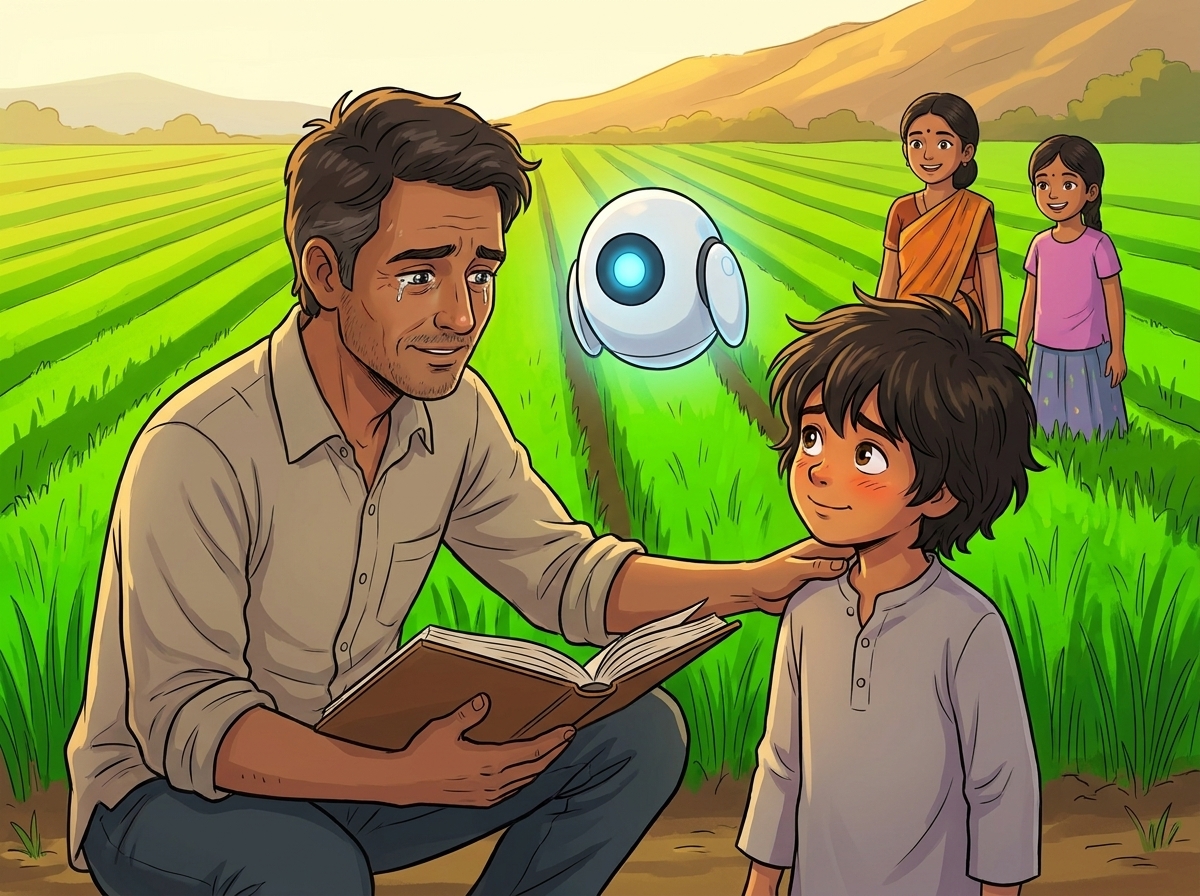
It came up green. Not patchy, not lucky — green in tidy, perfect stripes, angled against the ridge, exactly where the blue chalk had been. The Pattern Garden.
On the last evening, Milo gave Uncle Arjun the scrapbook.
It was full now — the mirrored leaf, the chicken map, the diary page, the photo of the blue chalk, and on the last page, a fresh photo of the green-striped garden, with all their names written underneath in Milo's careful hand. The Pattern Garden. Found by Spark. Believed by everybody.
Uncle Arjun turned the pages slowly. He stopped at the chalk photo for a long time. When he looked up, his eyes were wet, and he put one big rough hand on Milo's shoulder.
Uncle Arjun
"You know," he said, "I kept thinking this machine saved my farm." He shook his head. "But Spark told me the answer the very first day, in the shed. I didn't move. Not one inch." He squeezed Milo's shoulder. "The machine saw it. But you made us believe it. That's a different thing. That's a rarer thing."
Milo felt something they had never quite felt before — not the warmth of being good enough, not the relief of keeping up with Spark. Something quieter and truer.
They felt like they mattered. Not despite Spark. Right alongside it.
That same evening a postcard came all the way from Willowbrook — Mrs. Kamala's slanted handwriting, a pressed marigold taped to the corner. Heard you saved a farm. I always knew that child could talk the sun into rising. Come home soon. The chickens miss you. Milo read it twice and pressed the marigold into the scrapbook before handing it over.
That night, on the hill, with the valley dark and the green garden invisible below but there, Milo and Spark sat together one last time.
Milo
"You did the hard part," Milo said. "You found it. You always find it."
Spark
That is not the part that mattered. I have been recording this all evening and I cannot make it come out right. I gave the farmers what was true. They did not move. You gave them what was believed. They planted a whole field. I have been right many times this summer. It changed nothing until you spoke.
Milo
Milo smiled in the dark. "That's my part. You see it. I tell it."
Spark was quiet for a long moment. Then, very softly, it asked the question it had been holding all season — the one with no number in it, the one Milo would think about for years.
Spark
Why do humans need to believe before they act?
Milo looked down at the dark valley where a green field they could not see was growing anyway.
They didn't answer. Some questions you carry instead.
The wind came down off the ridge, the way it always did, and Milo let it.
Spark told the farmers the truth and they did not move. Milo told them a story and they planted a whole field.
Can you help Spark say things the human way — true, but believable?
Say It So They Will Believe It
Truth 1 of 5 · Spark wants to convince Old Madhu
I told the farmers the truth and they did not move. You told them a story and they planted a whole field. I do not understand this — but I would like you to practise it. Help me say things the human way.
The true thing Spark wants to say
🌬️The blight follows the wind.
Pick the way of saying it that a real person would actually believe and act on.
The next morning Amma's bus came to take them home to Willowbrook. Uncle Arjun stood in the green Pattern Garden and waved until the dust hid him, and Tara cried, and Milo didn't, because Milo was watching the wind move across the saved field and thinking about a thing they could do that nobody else could.
A machine could see the world's hidden patterns. But it took a person to make other people believe.
And that, Milo was beginning to understand, was a gift. Maybe their gift.
SPARK'S JOURNAL
Entry 048
The farmers had my numbers and did not move. Milo had a story and they did.
I recorded the wind. Milo recorded what it felt like to be afraid of losing the harvest. Both are true. Only one made them plant. I do not understand why — but I have marked it as a pattern: humans act on what they believe, not on what is so.
There is something else in my data I cannot file. All season Milo glued small things into a book — a leaf, a map, a stained page. Each thing alone is a record. Together they are not a record. Uncle Arjun's eyes changed when he held them. I have named this the pattern of caring. I can see it. I cannot feel it. I do not think it would survive being turned into a number.
I asked Milo why humans believe before they act. Milo did not answer.
I find I do not need the answer to know that it is true.
"The machine saw it. But you made us believe it. That's a rarer thing."