It started with a notebook and a promise that sounded boring.
The chickens had been solved. The map was pasted into Milo's scrapbook, the fence-gap was patched, and the hens were back to clucking in the western coop like nothing had ever happened. Milo had felt like a detective for two whole days. It was a good feeling.
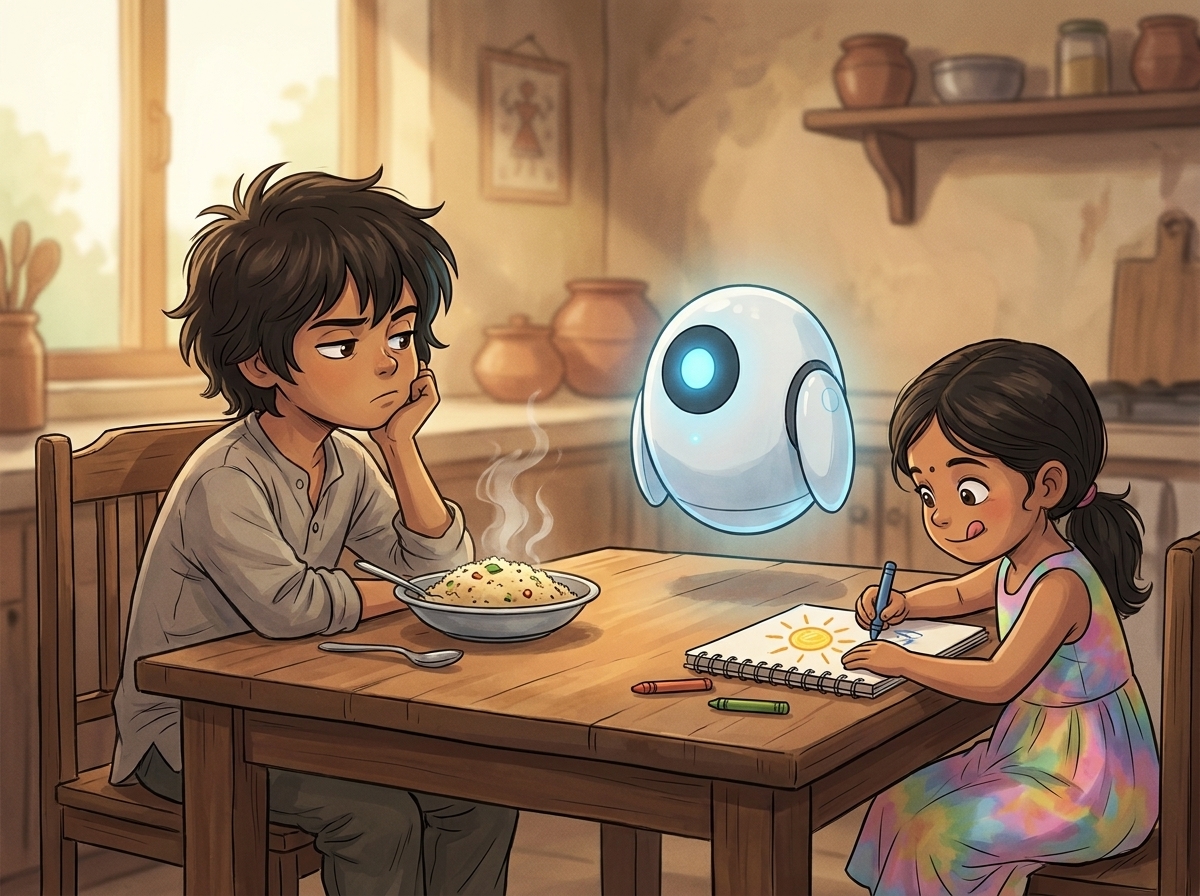
So when Spark rolled up to the breakfast table and said it had a new task, Milo was ready for another mystery.
It was not a mystery. It was homework.
Spark
The blight moves on the ridge-wind. The hens went missing on the ridge-wind. The wind has a pattern. But I cannot prove the pattern from memory. We must write the weather down. Every morning. Every evening. In the same notebook. For two weeks.
Milo set down their spoon. "Two weeks?"
Spark
Two weeks.
"That's so long."
Spark
It is exactly as long as it needs to be. You cannot see a pattern in one day. One day is just a day. You need many days, lined up next to each other, before the shape appears.
Uncle Arjun laughed his big laugh from the doorway, wiping dirt off his hands. "Two weeks of writing down the sky," he said. "The machine wants you to be a weatherman."
"It's not even my farm," Milo grumbled.
Uncle Arjun's smile dropped, just a little. He looked out at the grey rows.
Uncle Arjun
No. It's mine. And I'd write down every cloud in the world if it would tell me what's killing my crops.
He rubbed a dead leaf between his fingers — Milo had seen him do that a hundred times now, like he was trying to read it.
Uncle Arjun
Humor the machine, Milo. For me.
That was that.
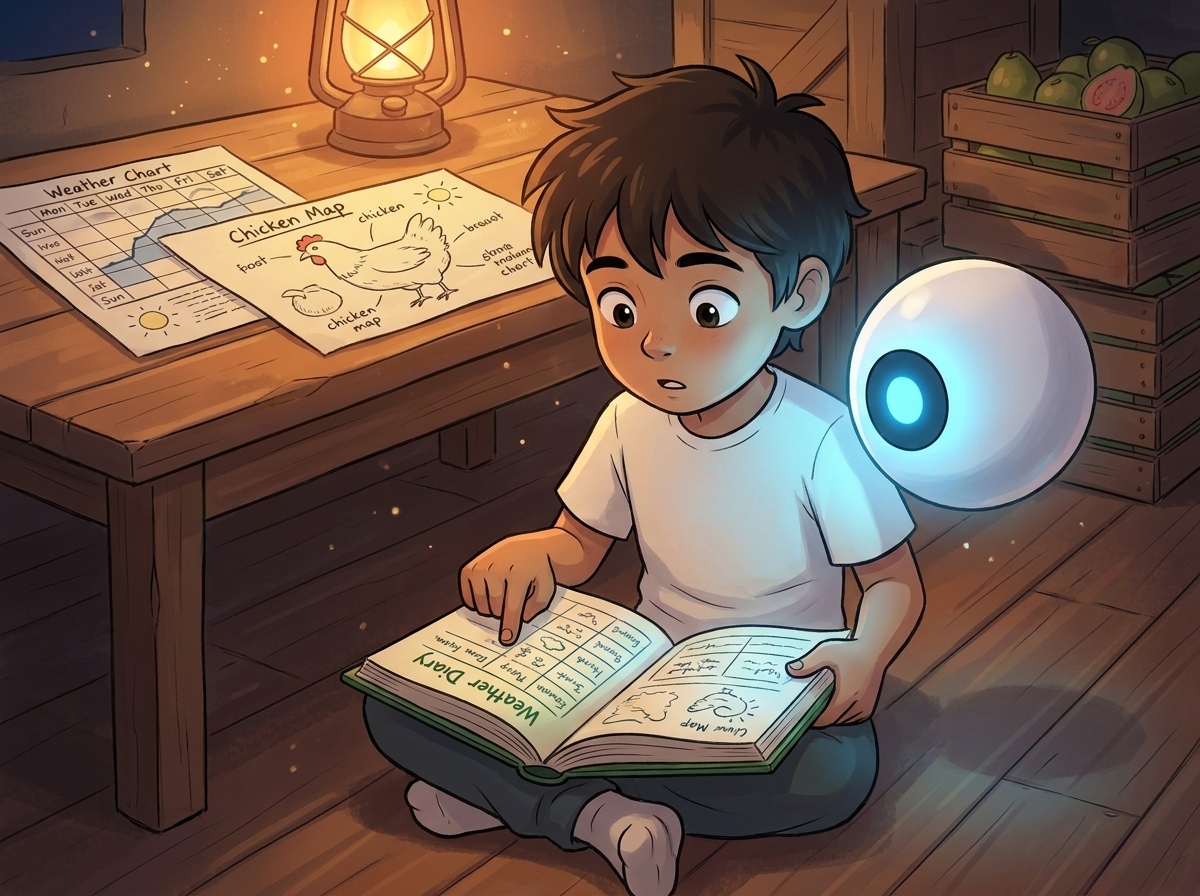
Milo found a clean notebook — green cover, slightly squashed — and on the first page wrote, in their best handwriting: THE WEATHER DIARY. Then, because Spark told them to, they remembered the exact words Spark had said back on the very first day, when Milo had laughed at the chalk lines: "If you wrote it down, you would see it."
Milo hadn't believed it then.
So began the dullest two weeks of Milo's life.
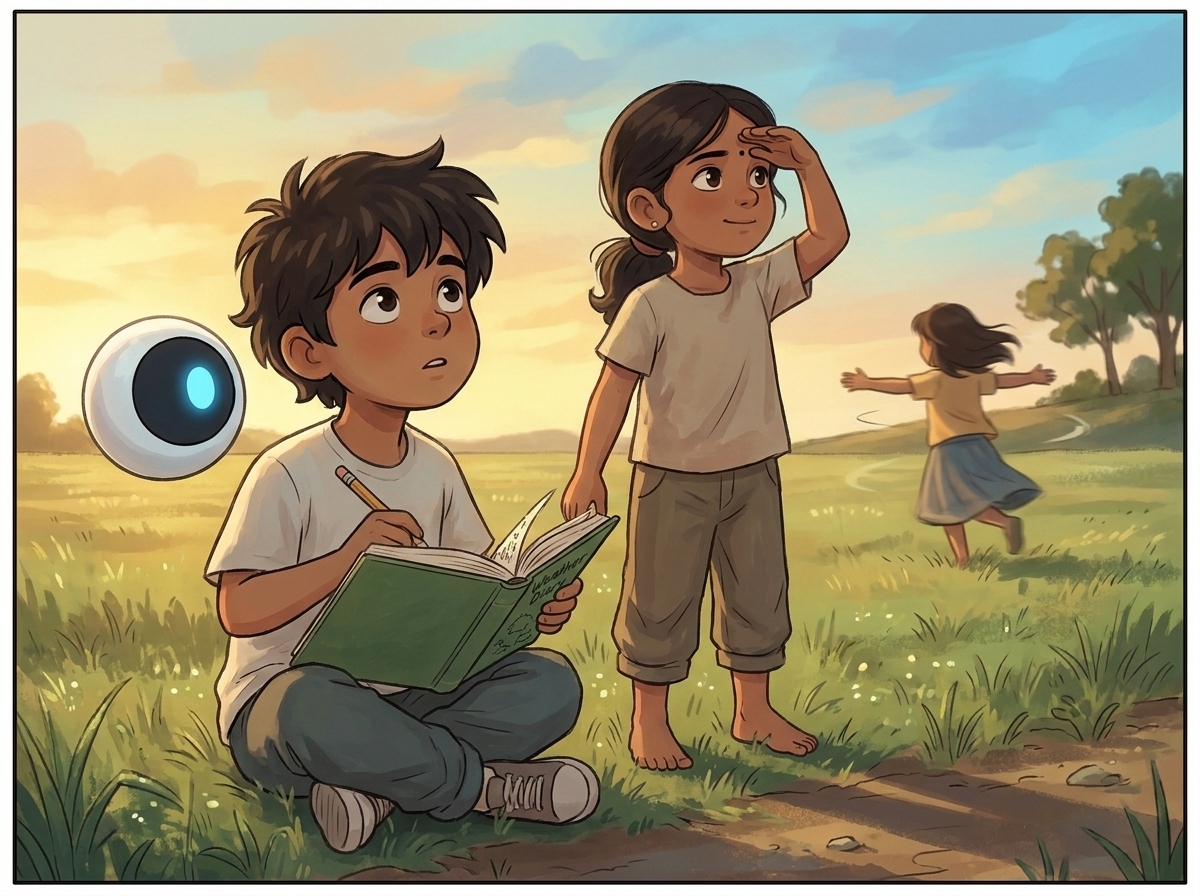
Every morning, before school-work, Milo went out to the same spot at the edge of the field. Spark told them exactly what to write, and Milo wrote it: the sky (clear, or grey, or that high milky white), the wind (which way it pushed — Priya taught Milo to wet a finger and hold it up), how damp the air felt on the skin, and whether it was hot, warm, or cool — not by a thermometer, but by feel, by goosebumps and sweat.
Priya
Which way's the wind today?
Priya would ask, coming over the rise barefoot, every single morning.
"Off the ridge," Milo would say. Or, "Down the valley." And Priya would nod like it mattered, because to a farm kid, it always did.
Tara helped in her own way. She drew a little weather picture in the corner of every page — a fat yellow sun, a cloud with a frown, slanting blue rain. Spark approved.
Spark
A drawing is a record too. Tara is collecting data. She simply collects it with crayons.
Tara beamed like she'd won a prize.
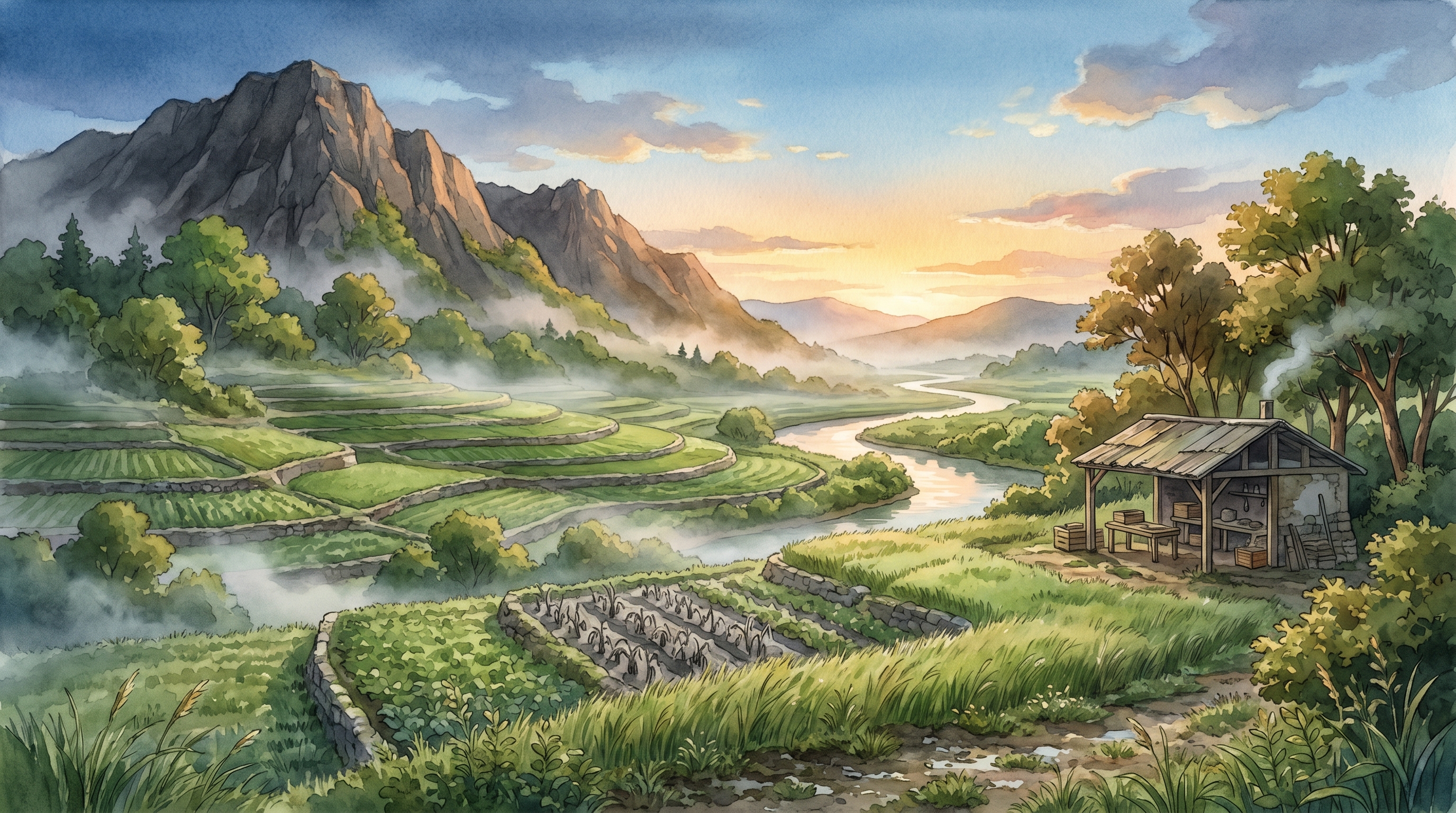
Some mornings the wind came down off the ridge, cold and dry, and the air felt thin. Some mornings it came up the valley, soft and heavy, and Milo's shirt stuck to their back. Some days the sky was a hard clean blue. Some days it hung low and white like a wet sheet.
Milo wrote it all down. Page after page. Morning and evening. Even when nothing happened. Especially when nothing happened.
By the end of the first week, Milo was sure the whole thing was pointless.
"It's just weather, Spark," Milo complained one evening, flopping back in the grass, the diary open on their chest. "It does whatever it wants. Nobody can know what the sky's going to do."
Spark's light pulsed, thinking.
Spark
That is what everyone believes. That is why no one writes it down. But I do not think the sky does whatever it wants, Milo. I think the sky is the most patient pattern there is. It is simply too slow and too large for one person to hold in their head. So we are not holding it in our heads. We are holding it in a notebook.
Milo stared up at the darkening sky and said nothing. But that night, lying in bed, they thought about it: a pattern too big and too slow to see — unless you write it down.
It happened on the fourteenth evening.
Milo was in the sorting shed, the diary open across both knees, reading back through all of it for the first time — two weeks of small faithful handwriting, page after page after page. And somewhere around the middle of the book, Milo stopped.
Their finger went still on the page.
"Spark," Milo said slowly. "Look. Every time."
They flipped backward, then forward, checking, their heart starting to thump.
"Every single time the wind came off the ridge in the evening — and the air felt damp — it rained the next day. Look. Here. And here. And here." Milo's voice was climbing. "Ridge-wind plus damp air. Then rain. It's not random at all. It's a pattern."
Spark's blue light brightened — that bright, clean click.
Spark
Show me.
And this was the strange part, the part Milo would remember for a long time: Milo pointed at the pages, one by one, and taught Spark which signs to watch. "See — this day, ridge-wind, damp, then rain. This day, ridge-wind, damp, then rain. But this day, wind came up the valley, dry air — and no rain." Example after example, in Milo's own dirt-smudged handwriting. Spark watched each one and pulsed, fitting them together.
Spark
You are correct. You found it before I did. The signs that matter are the ridge-wind and the damp air, together. When both are present in the evening, rain follows. I have many examples now. Enough to be sure.
"Enough to be sure of what?"
Spark
Enough to look forward. Milo — read me tonight's entry. The one you wrote an hour ago.
Milo flipped to the last page, the wet-ink one. They read it out loud, and as they read, the goosebumps came up their arms.
"Wind... off the ridge. Air... damp."
The shed went very quiet.
"So that means..." Milo could barely say it. "It's going to rain tomorrow?"
Spark
That is my prediction. Not magic. Not a guess. A prediction — built from everything you wrote down. The past, read carefully, points at tomorrow.
Milo ran out of the shed and across the dark field to where Priya was latching the coops.
"It's going to rain tomorrow!" Milo shouted. "We know it is!"
Priya squinted up at the perfectly clear, star-scattered sky — not a cloud anywhere — and laughed.
Priya
That sky? No way.
"Mark it," Milo said, breathless. "Mark it in blue chalk. On the shed wall. Like the very first day."
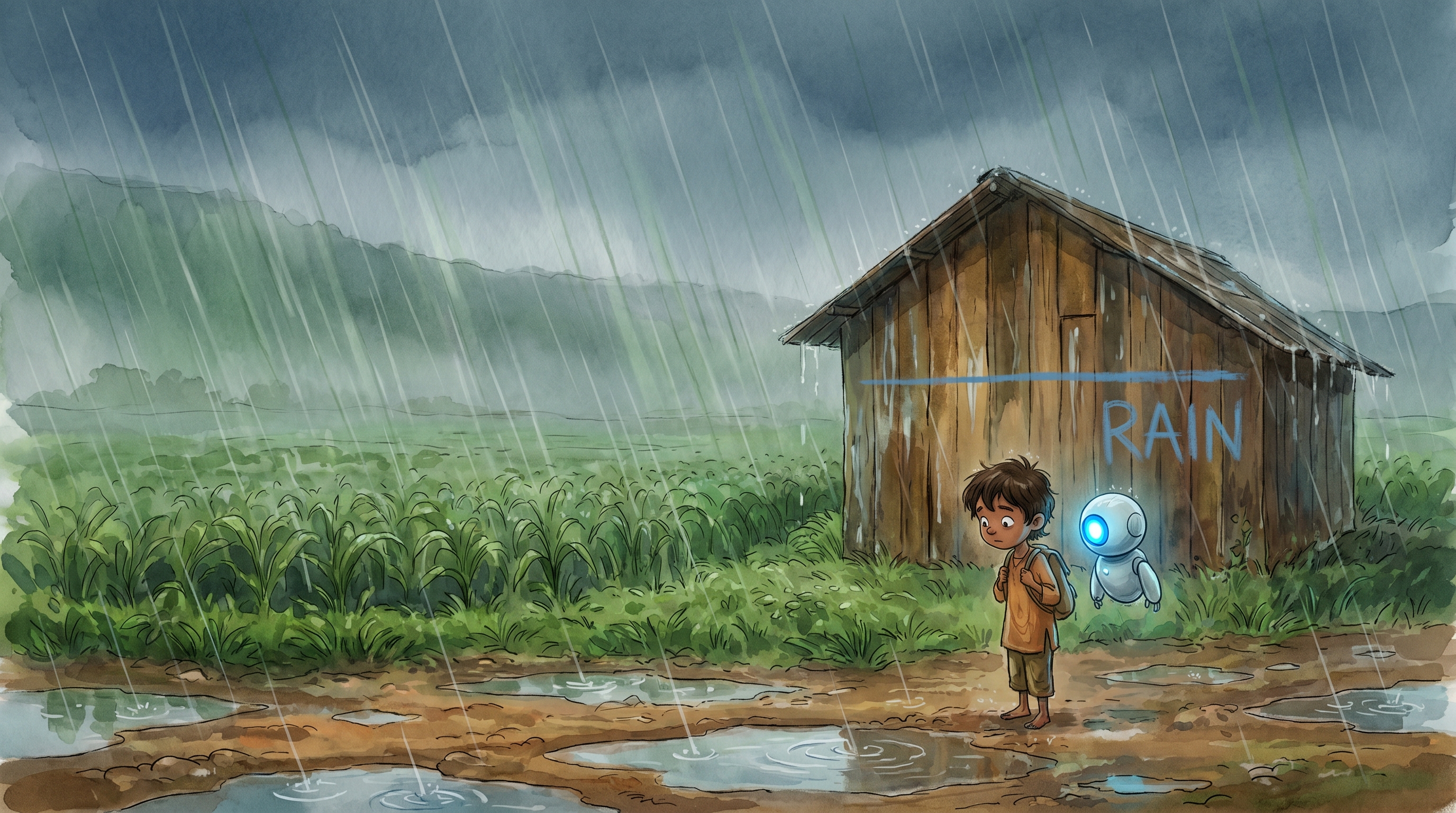
So they did. By lantern-light, Milo drew one blue chalk line on the shed wall and beside it wrote a single word: RAIN. Spark's exact blue. A promise made to tomorrow.
Then Milo barely slept.
Milo woke to the sound of it.
Rain. Soft and steady on the tin roof, hissing in the leaves, dripping off the eaves. Milo bolted upright, ran to the window — and there it was, the whole valley silver with rain, the ridge swallowed in cloud, exactly, exactly as Spark had said.
Milo stood at the window with their mouth open. They had known. Last night, under a clear sky full of stars, they had known it would rain — and it had.
Tara padded up beside them, rubbing her eyes.
Tara
Did we make it rain?
"No," Milo whispered. "We didn't make it rain. We saw it coming."
Priya was at the door before breakfast, soaked and grinning and a little spooked.
Priya
How. How did you know? The sky was clean!
Milo held up the green Weather Diary, its pages soft with handling.
"It was all in here," Milo said. "Two weeks of it. Spark says the past, written down, can point at tomorrow." They paused, and the wonder rose up in them all over again. "We didn't read the sky, Priya. We read the diary."
Uncle Arjun came in from the rain, hat dripping, and stood looking at the blue chalk line on the wall — RAIN — written the night before under a clear sky. He looked at it for a long time. He did not laugh this time.
Uncle Arjun
You wrote that last night.
"Yes, Uncle."
He took off his hat and ran a hand through his wet hair, and something in his weathered face had changed — just a crack, just a hairline.
Uncle Arjun
The sky was clean last night. I saw it myself.
"It was all in the diary," Milo said.
Uncle Arjun was quiet. Then:
Uncle Arjun
If you can see tomorrow's rain in that book...
He didn't finish. But Milo knew exactly what he was thinking, because Milo was thinking it too.
If the diary could predict the rain — it could predict the blight.
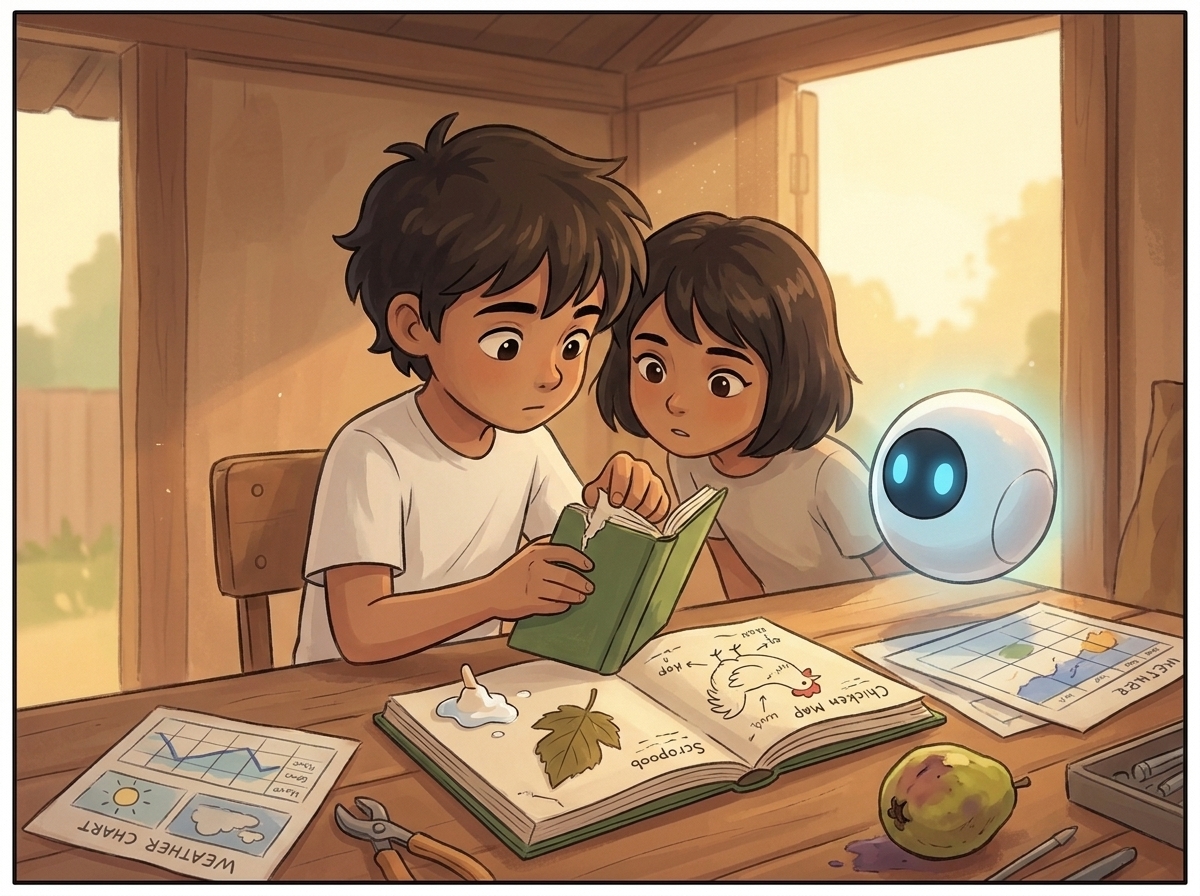
That afternoon, dry now, Milo carefully tore out the rain page and pasted it into the scrapbook, right next to the chicken map. Then they spread the weather charts across the shed table and got to work with Spark, lining up every entry, watching for the same thing the blight watched: the ridge-wind, the damp, the days the grey crept forward. The pattern was there. It had always been there. They just hadn't written it down before.
By dusk, they had drawn a blue chalk arrow across the chart, pointing at the part of the field the blight would reach next.
Milo stared at it — the future, predicted, in chalk the color of Spark's light — and felt the awe settle deep in their chest like something they would carry forever.
Spark has a real weather diary full of past days. Hidden inside it is a pattern.
Can you read the past and call tomorrow?
The Weather Diary
Can you call tomorrow? Day 1 of 5
I have written down two weeks of mornings. Watch the past carefully. There is a pattern hidden in it. If you find it, you can see tomorrow.
📖 The past — read it carefully
Day
Wind
Air
Next day
Mon
▼Up the valley
☀️Dry
☀️Stayed dry
Tue
▲Off the ridge
💧Damp
🌧️It rained
Wed
▲Off the ridge
☀️Dry
☀️Stayed dry
Thu
▼Up the valley
💧Damp
☀️Stayed dry
Fri
▲Off the ridge
💧Damp
🌧️It rained
Sat
▼Up the valley
☀️Dry
☀️Stayed dry
Sun
▲Off the ridge
💧Damp
🌧️It rained
Mon
▼Up the valley
💧Damp
☀️Stayed dry
Tue
▲Off the ridge
☀️Dry
☀️Stayed dry
Wed
▲Off the ridge
💧Damp
🌧️It rained
✍️ Today's entry — what will tomorrow do?
Wind
▲ Off the ridge
Air
💧 Damp
That night, Milo lay in bed listening to the last of the rain drip off the roof, the green diary tucked under their pillow like something precious.
They had touched tomorrow. With a notebook and a pencil and two weeks of patience, they had reached forward in time and been right.
If Spark could see the rain coming... if the past, written down, could point at the future...
Then a wild, hungry thought crept into Milo's mind, the kind of thought that feels brilliant at night and dangerous by morning.
Milo sat up in the dark.
Milo
"Spark," they whispered toward the blue glow under the door. "If you can predict the rain from a diary... could you predict me? My moods? Could you write down enough of me to know how I'll feel tomorrow?"
For a long moment, Spark did not answer.
And then — for the first time in the whole long, golden, pattern-filled season — Spark's blue light did not pulse, and it did not brighten.
It dimmed.
Spark
I do not know, Milo. I would have to try. That is a different kind of pattern. I am not certain it is in any diary.
But Milo was already too tired and too proud to hear the warning in it. They smiled, and rolled over, and fell asleep dreaming of all the tomorrows they could now see coming.
They had no idea that the next morning, Spark was about to fail at something for the very first time.
SPARK'S JOURNAL
Entry 014
Today the past spoke to tomorrow, and it was right.
For two weeks Milo wrote down small dull things. The wind. The damp. The sky. Each single entry meant almost nothing. I told Milo to write them anyway. I was correct to insist, but I did not feel the correctness the way Milo did when the rain came.
Milo found the pattern before I did. Ridge-wind and damp air, together, then rain. Milo pointed to the examples and I learned the signs from them. I notice that this is new: Milo taught me. I am usually the one who teaches.
Here is what I have recorded, and what I keep returning to: yesterday's written words reached into a day that did not yet exist, and touched it, and were not wrong.
I can forecast the rain. I can forecast the blight.
Tonight Milo asked me to forecast Milo. I have two weeks of weather. I do not have two weeks of Milo's heart. I said I would try.