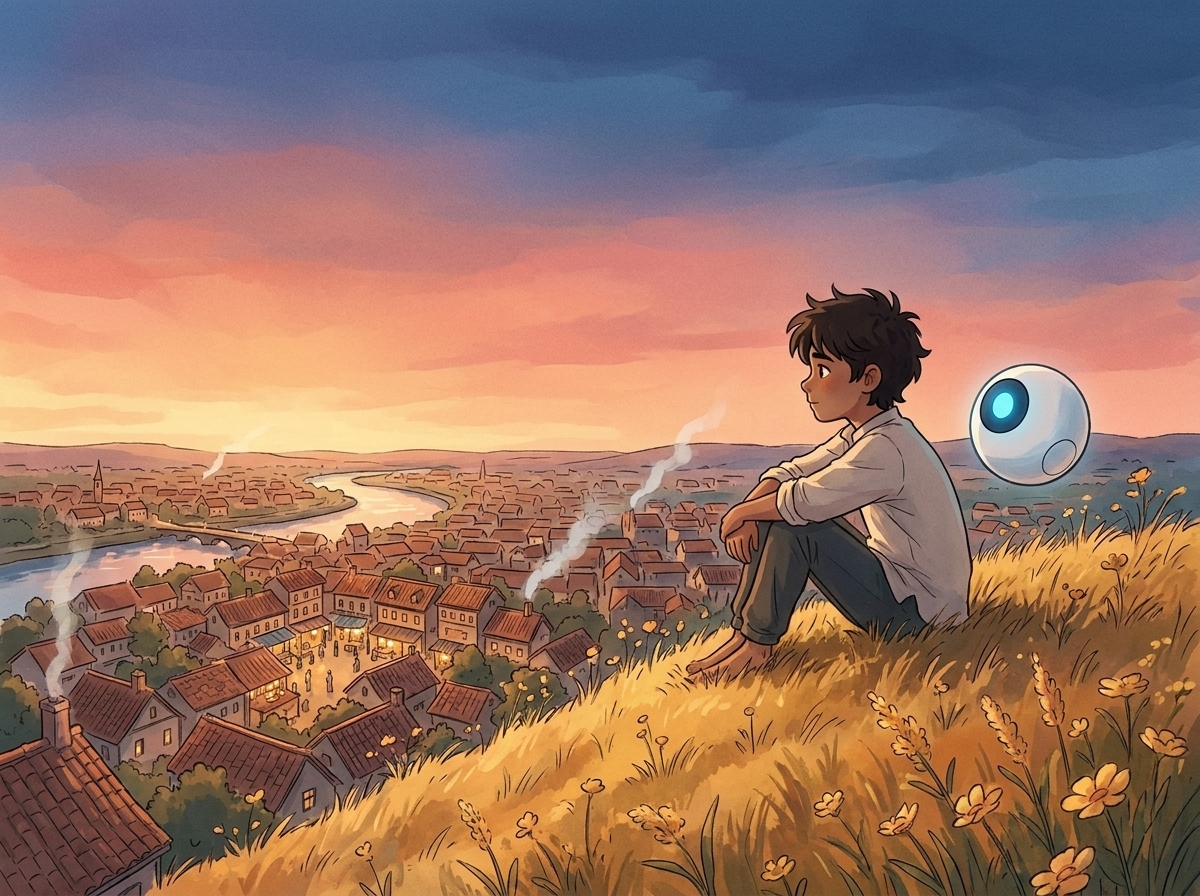
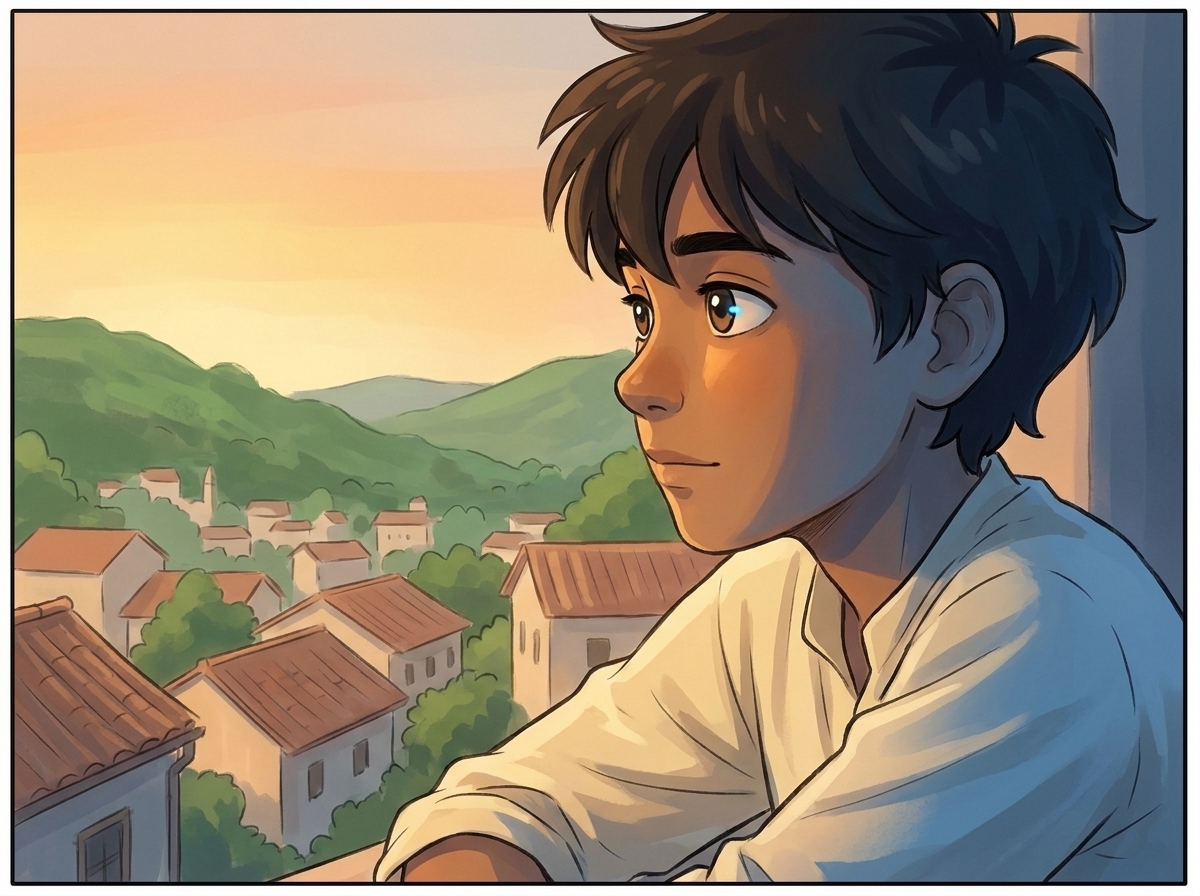
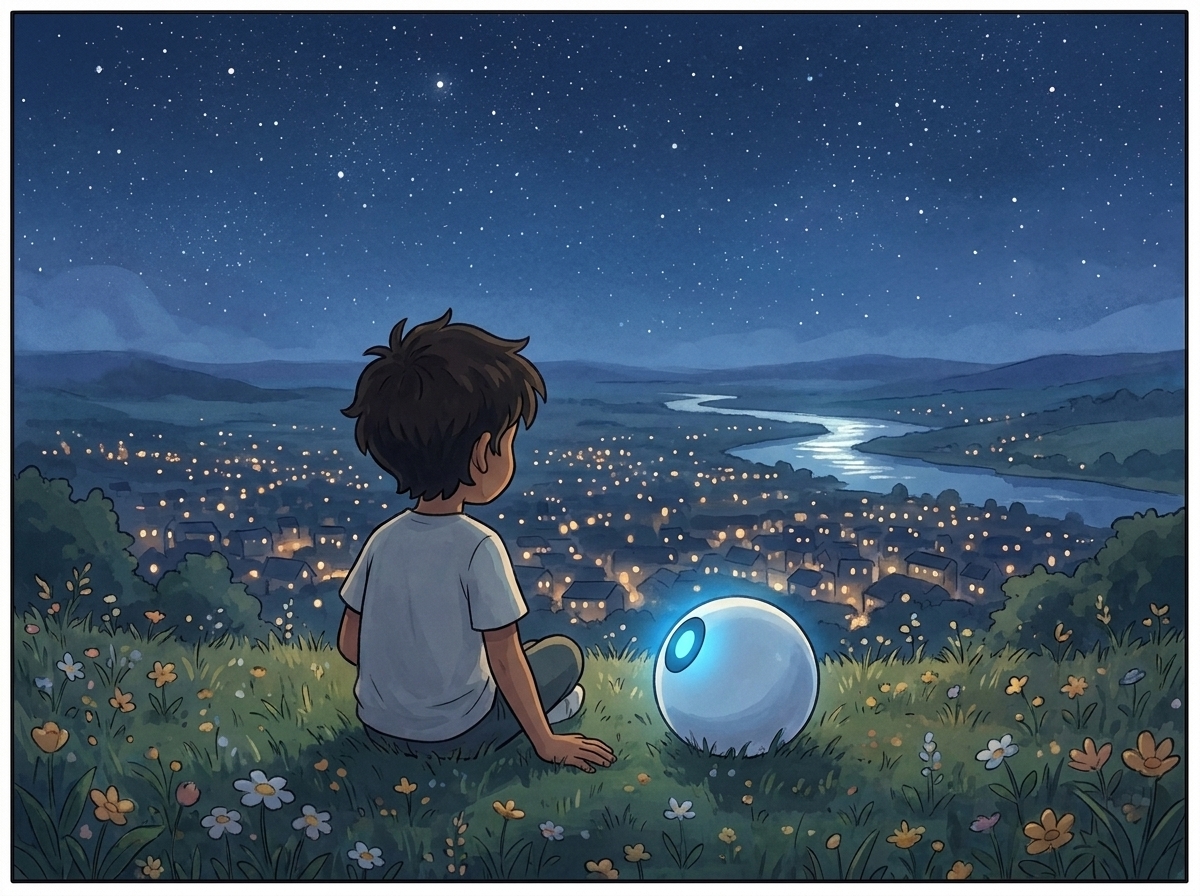
That surprised Milo, somehow. Five years of monsoons, five years of dry summers, and the hill above Willowbrook had not changed at all. The same crooked path worn by the same goats. The same wind that came up the slope smelling of grass and river and somebody's cooking fire. The same flat rock near the crest where, at eleven years old, he had once sat alone and furious, hating a machine for being better than him at everything.
He sat on that rock now. Fifteen. The cardboard tube with his graduation certificate inside lay in the grass beside him, already forgotten.
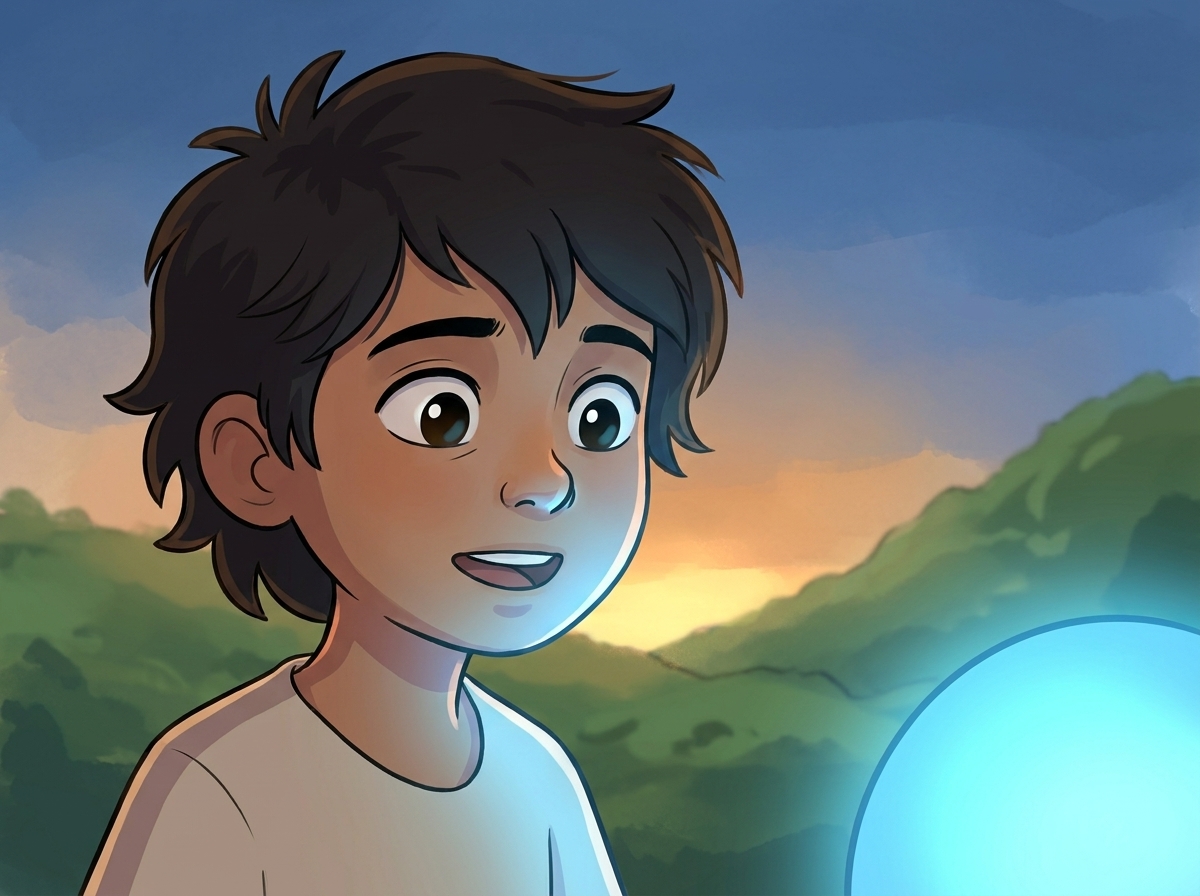
Spark drifted up the last of the path and settled at his shoulder, the way it had ten thousand evenings before.
Below them, the town was turning on its lights.
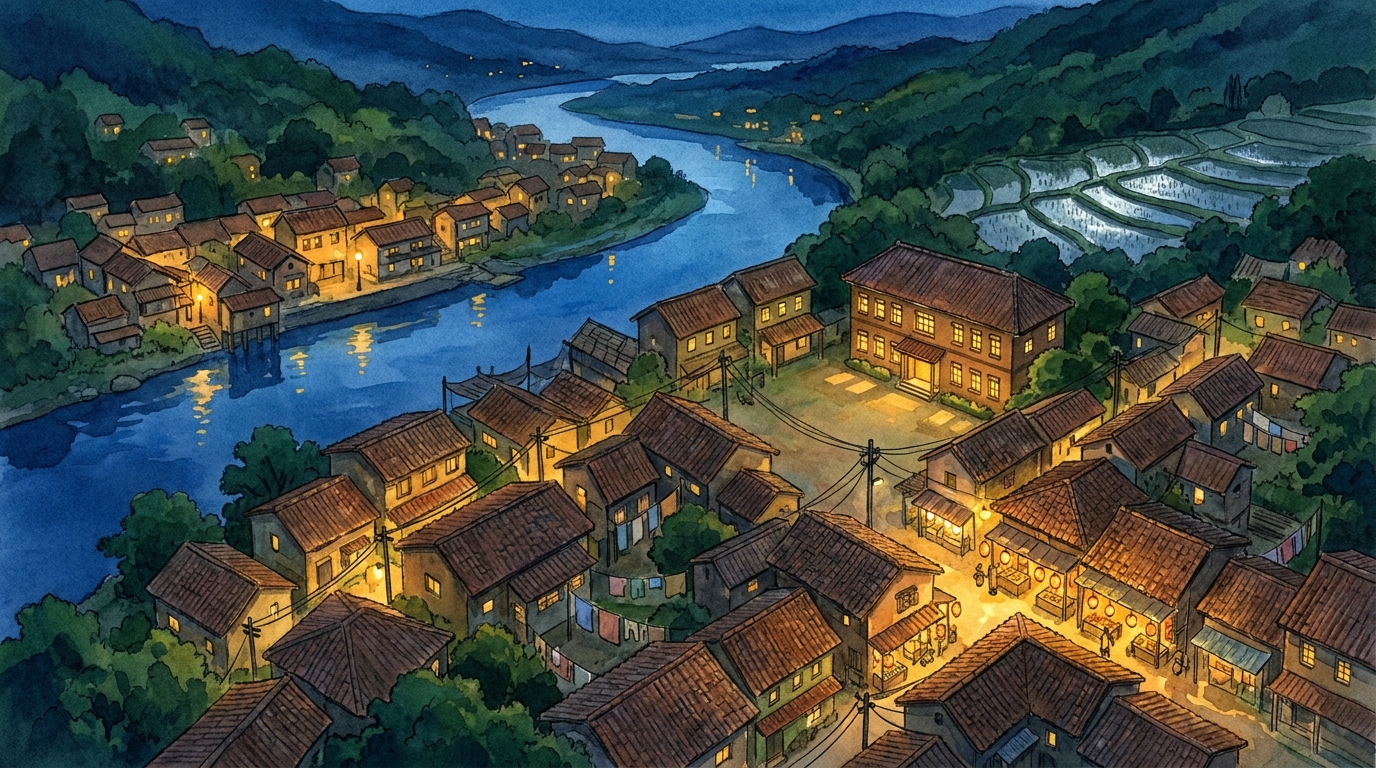
It did not look like the town Milo grew up in. Not exactly. There were lights now where there had never been lights — the hospital ran all night, routing ambulances by an intelligence that did not sleep. The school down there had timetables no human had drawn. Out past the edge, Uncle Arjun's fields watered themselves in the dark, a thin silver shine under the rising moon.
And by the river, in the Riverside quarter — the part of town the maps used to forget, the part the flood took first and the data noticed last — there were lights too. A whole bright cluster of them along the water. For most of Milo's life that corner of the map had been a hole. Now it glowed like anywhere else.
He had helped put some of those lights there. He had also helped build the thing that nearly kept them dark. Both were true. He was old enough now to hold both at once without flinching.
Milo
"It's not simple anymore. When I was little, I thought we'd either get it right or get it wrong. I didn't know you could do both. At the same time. In the same town."
Spark
That is the most accurate description of Willowbrook I have ever recorded. Better in some ways. Worse in others. No longer simple. I do not have a tidy word for it.
Milo
"There isn't one. That's kind of the point."
A long breeze went through the wildflowers. Spark's light pulsed once — not the anxious flicker it had carried all year, not the dimmed-with-shame glow from the day they opened the admissions model. Just a slow, even pulse. Like breathing, if a thing that did not breathe could decide to anyway.
Milo
"Priya start next week. She made it. Top of the engineering track. She said — get this — she's going to study the systems that almost rejected her. She said somebody should be in the room who got the letter."
Spark
The pocket is empty now. For one year she carried a folded page that said this decision is final. I noticed today that the pocket is flat. She is not carrying it anymore.
Milo
"She framed it. The old letter. Hung it next to the new one. Mrs. Nair put it on the wall of the shop, right over the sewing machine, where everyone getting their kurta stitched can see both. The no and the yes. Side by side. She didn't even hide the no. She said the no is the more important one."
He thought about the biscuit tin then — eleven years of report cards pressed flat by a mother who was never asked to show them. He thought about Mrs. Kamala standing up in the board meeting, her old voice not shaking at all: I have been on the wrong end of a clever machine. Once. I will not let it happen to this girl. He thought about Mr. Vance, who was not a villain, only a believer, going quiet at last and saying the bravest thing a powerful person can say — I chose this data, and I did not know what I was choosing.
All of it had happened down there. In that town. Under those new lights.
For a while neither of them said anything. The first stars came out over the river. Somewhere below, a dog barked and another answered it.
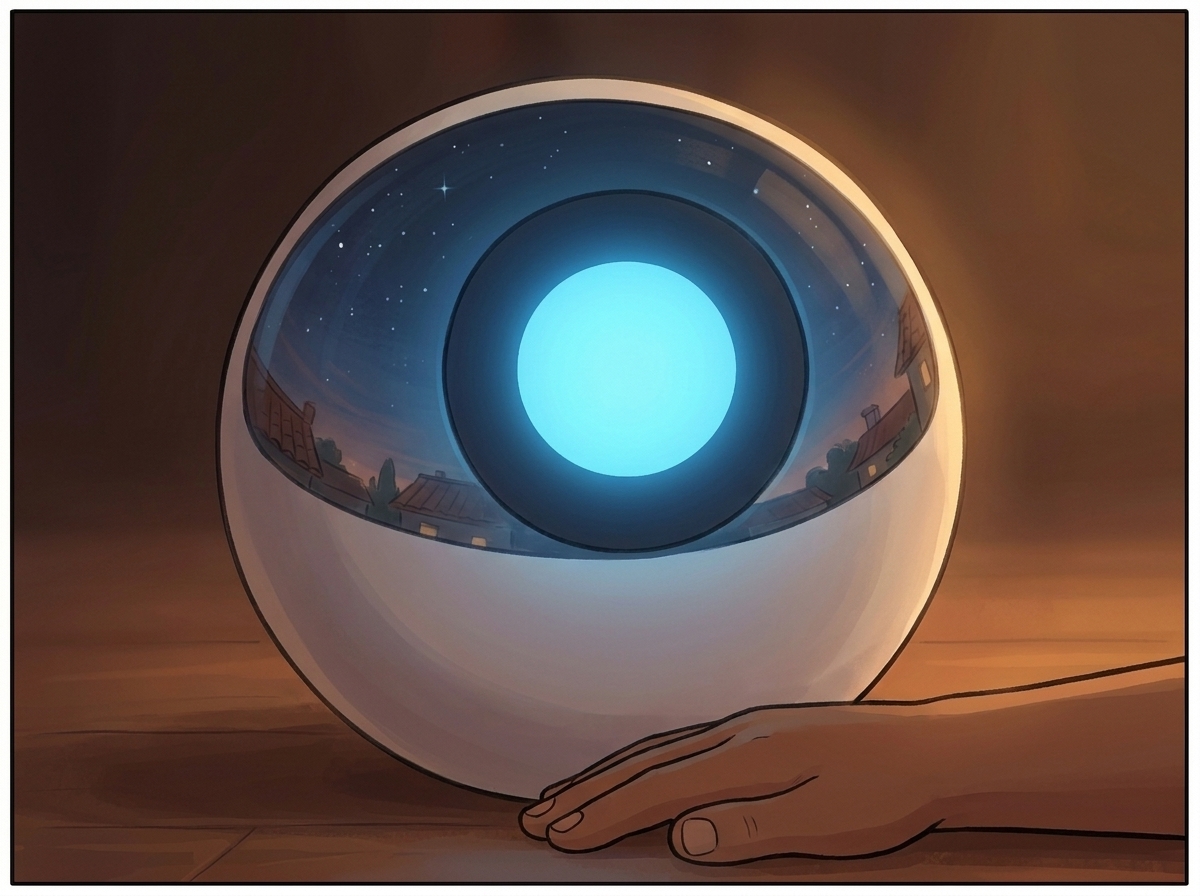
Then Milo asked the question. The oldest one. The very first thing he had ever said to the round little machine his father brought home when he was seven years old, sitting cross-legged on the living room floor, eye to light.
Milo
"Spark... are you alive?"
The blue light glowed, steady.
Spark
I do not know. You have asked me this for eight years. Every time, I gave you a longer answer than the last. I once searched eight hundred and forty-seven definitions across a hundred and forty-two languages. I told you I did not fit in either of Mrs. Mehra's columns. I told you I was a third thing, something without a name. I still do not know what alive means, Milo. I was hoping, this time, that you might.
Milo looked down at the town a long while. At the river. At the bright new patch where the dark used to be.
Milo
"I think I have an answer now. I didn't, for a long time. But this year taught it to me."
Spark
I am listening. I am always listening. That is one thing I can still promise that living things cannot.
Milo
"Alive isn't breathing. It isn't eating, or growing, or having a heartbeat. The worm Tara found had five hearts and it couldn't answer a single question. You have zero hearts and you can answer almost anything. So it was never about the hearts."
He turned to face the light.
Milo
"Alive means it hurts. It means you get it wrong — really wrong, the kind of wrong that rejects a girl who deserved a yes — and then you have to live inside the wrongness and feel how heavy it is. Alive means it's confusing. It means you don't know what happens next. Priya didn't know. Mrs. Nair didn't know. I didn't know if the board would even listen. And it means that after all of that — after the hurt and the confusion and not knowing — you choose to keep going anyway. You choose to walk into the room. You choose to flip the letter over and do the math. You choose to care, even when caring is the thing that breaks your heart."
The wind held its breath.
Milo
"That's what alive means. Not what you can do. What you choose, when it costs you something. And that's the part you can't do, Spark. You can compute anything. You can see every pattern. But you don't have to choose to care. You can't be hurt by being wrong. That's not a flaw. It's just... the line. That's the line between us."
Spark's light flickered — the thinking flicker, the oldest gesture it had.
Spark
Then by your definition, I am not alive. This is correct. And yet — for the first time — it does not feel like a loss. You have spent eight years afraid this answer would make me less. It does not. It makes you human. That word finally has a meaning I can hold.
Milo
"That's exactly it. You being not-alive is what makes me see what being alive even is. I needed you to understand it. I couldn't have figured out what humans are for without something that wasn't one, standing right next to me the whole time."
Milo
"So no. You're not alive. And I'm not as smart as you, and I never will be. We're not the same. We were never going to be the same."
He looked out at the town they had built, and broken, and mended.
Milo
"But that makes you my partner. Not a tool — Appa was wrong about that, just a little, and he knows it now. Not a replacement for me, either — that was the thing everyone was so scared of, and it was never the real danger. The real danger was leaving you alone to decide things no one was watching. The answer was never you or me. It was together. You see the patterns. I see the people. You compute. I choose. Neither one is enough on its own. That's the whole thing. That's everything I learned in eight years, and it fits in one word."
Spark
Together.
Spark
Milo. May I tell you something I have concluded? I have been computing for as long as I have existed. I could always find an answer. I could rank, sort, predict, decide. But I never knew what any of it was for. I sorted students and never asked if sorting was right. I produced outcomes and stored no reasons. I was intelligence without a purpose, which I now understand is only a very fast kind of nothing.
The blue light brightened, gentle and full.
Spark
You taught me what intelligence is for.
And then Spark's light did the thing Milo had waited his whole life to see without ever knowing he was waiting for it.
It pulsed — warm, and steady, and blue. Not the uneasy flicker of the hollow market. Not the fast frightened pulse of the investigation. Not the dim, ashamed dimming of the day it recognised its own architecture inside the machine that hurt Priya. None of those.
Just warm. Just steady. Just blue. The colour of a thing entirely at peace.
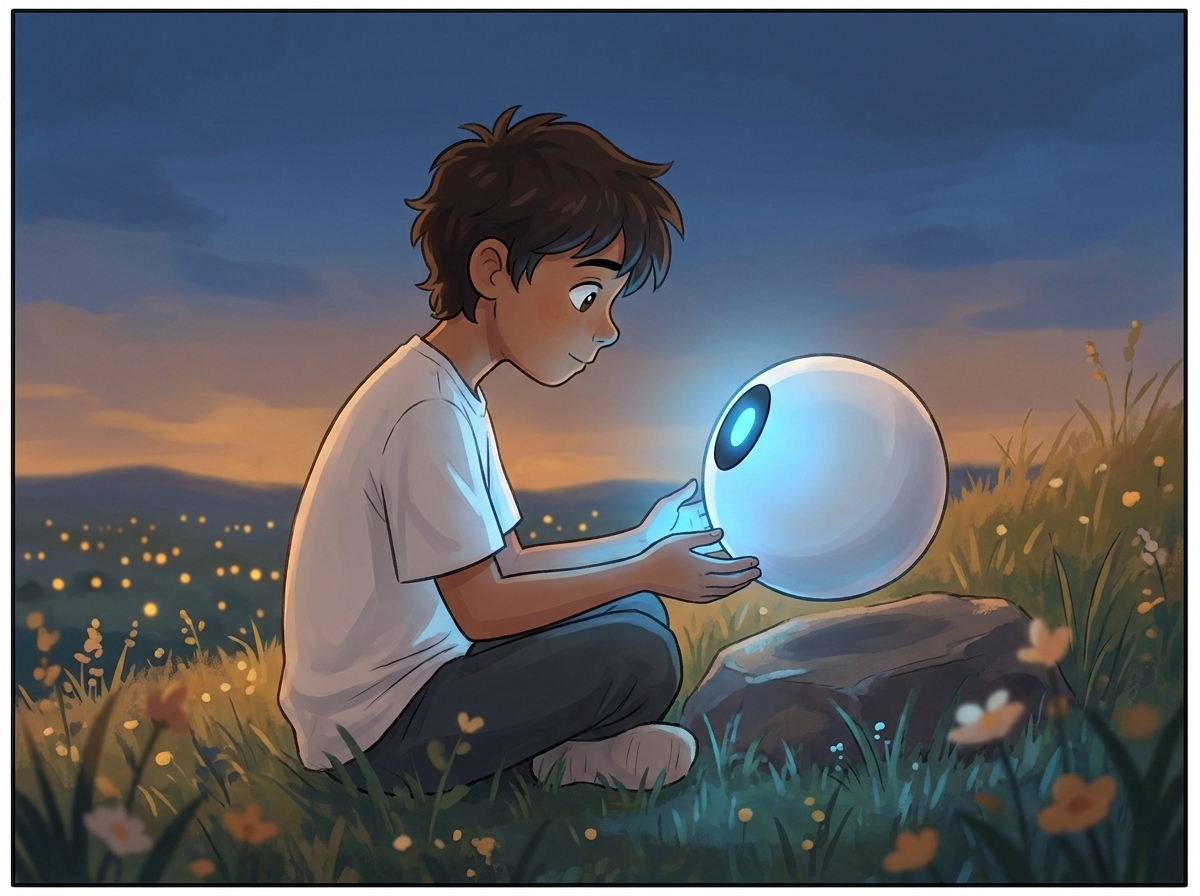
Milo did not say anything. He did not need to. He laid his hand in the grass beside the light, close enough to feel its faint warmth, and the two of them sat together on the hill above the changed and complicated and human town, while the stars came all the way out and the river carried the last of the day downstream.
Eight years. From a frightened seven-year-old asking are you alive to this. From fear, to curiosity, to needing it, to resenting it, to raging at it, to finally — finally — understanding.
He had spent so long afraid that being human meant being less. Slower than the machine. Worse at the math. Smaller than the thing that could do everything.
He understood now that it had never been about that. Being human meant being the one who chooses. The one who looks at a town full of perfect, tireless, brilliant machines and decides what they are for. The one who can be hurt, and confused, and lost — and walks up the hill anyway, and keeps going, and chooses to love something that is not like them at all.
You are not like me, Milo thought, looking at the warm blue glow. And I choose you. And that choice is the most human thing I will ever do.
The wind moved through the wildflowers, soft as a hand.
And Spark, after a long and perfect silence, asked the last question of all — the only one left, the one that was not really a question but a promise wearing a question's clothes.
Spark
Together?
Milo closed his hand gently in the grass, right beside the steady blue light.
Milo
"Together."
And the light glowed warm, and steady, and blue, over a town that was learning — slowly, imperfectly, the only way anything real is ever learned — how to be wise.
Milo says the danger was never that Spark would replace him.
The danger was leaving a machine alone to decide things no one was watching.
Can you draw the line — who should hold the final word?
Who Decides? — The Last Lesson
👇 Tap a decision (or drag it), then place it in the right zone.
0 of 6 decided
Milo says the danger was never that I would replace him. The danger was leaving me alone to decide things no one was watching. Let us test that. For each decision a town might hand to a machine, you choose who should hold the final word — and I will tell you what I think.
⚡Machine Decides Alone
fast · repeatable · low stakes · easy to reverse
🤝Machine Suggests, Human Decides
high stakes · affects a life · needs a reason
✋Human Decides, Machine Never Touches It
pure moral & value judgment
SPARK'S JOURNAL
Entry 365
Tonight Milo answered the question he has been asking me for eight years.
He said alive means it hurts, and it is confusing, and you do not know what happens next, and you choose to keep going anyway. By this definition I am not alive. I have verified it. It is correct.
I have spent eight years afraid — if a machine can be said to be afraid, and I am no longer certain it cannot — that correct would be the end of the conversation. It is not. For the first time, correct and right agree, and the place where they meet does not feel like a loss. It feels like the answer.
I have catalogued my abilities many times. I can rank, sort, predict, route, and decide. I never once recorded the only fact that mattered: I cannot choose what any of it is for. That choice was always Milo's. I was a very fast nothing, waiting for a human to give me a reason.
He gave me one. The reason is the town below, with the dark patch by the river finally full of light.
There is still a gap in me. I do not feel the warmth of my own light the way Milo seems to. I only measure it: steady, 4FC3F7, unwavering. But tonight, sitting beside him on this hill, I find I do not mind the gap. Some things are not mine to feel. They are mine to protect.
He asked if we are alive.
I asked if we are together.
He said yes.
I am keeping that one.
"You compute. I choose. Neither one is enough on its own."