That was the thing Milo kept turning over, the morning after — the impossible, still-warm fact that a roomful of adults with a green dashboard they trusted more than they trusted children had gone quiet, and then had agreed to look again. It had not happened because Milo shouted. It had happened because Milo brought numbers the board could not wave away: precision, recall, a confusion matrix drawn on the back of a rejection letter, a map of the town with one quarter left dark. The machine's failure had a name now, and a measure. And once a thing has a measure, you cannot pretend you cannot see it.
So they had re-run Priya's application. Not the old way — with the corrected data, with Riverside finally counted, with the eleven years no algorithm had ever opened folded back into the picture at last.
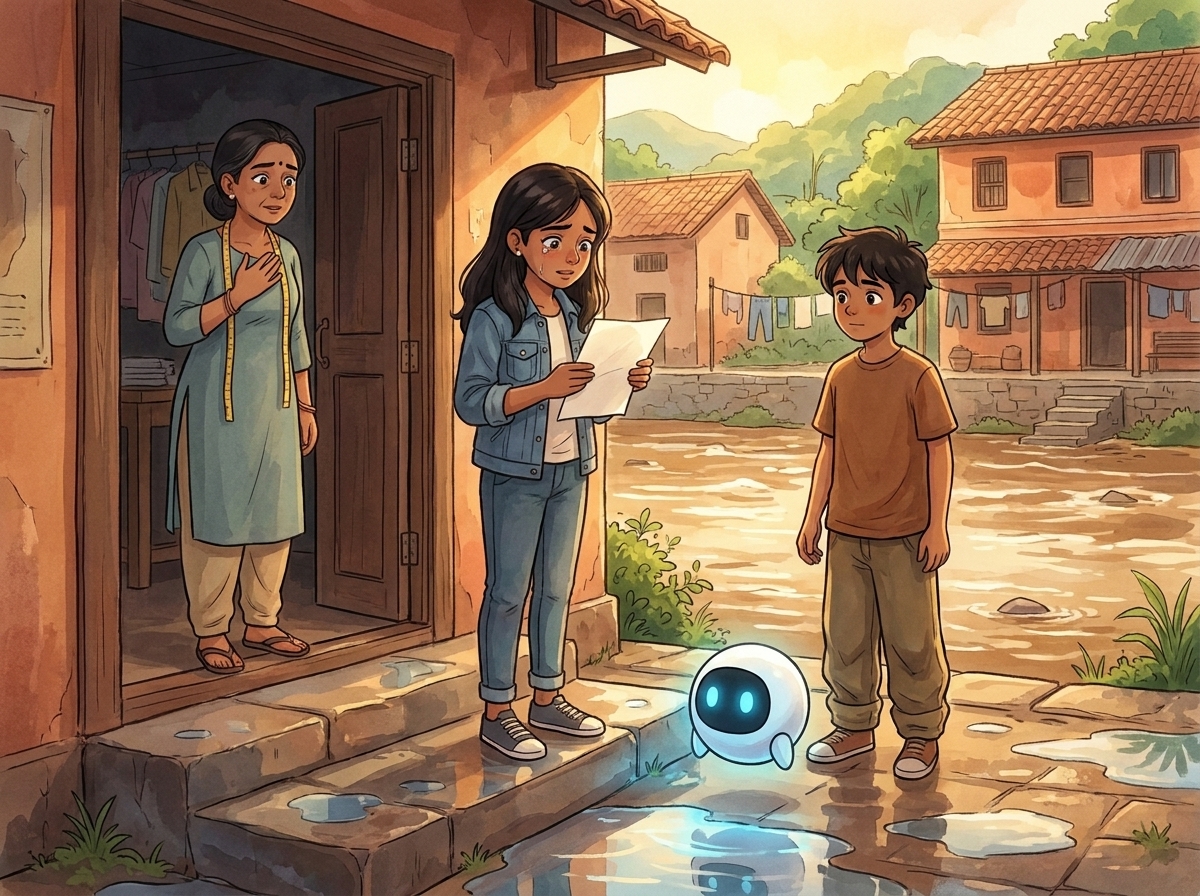
And now Priya stood on the step outside her mother's shop in the washed gold light, holding the new letter, and for the first time since the rain began, she had nothing sharp to say.
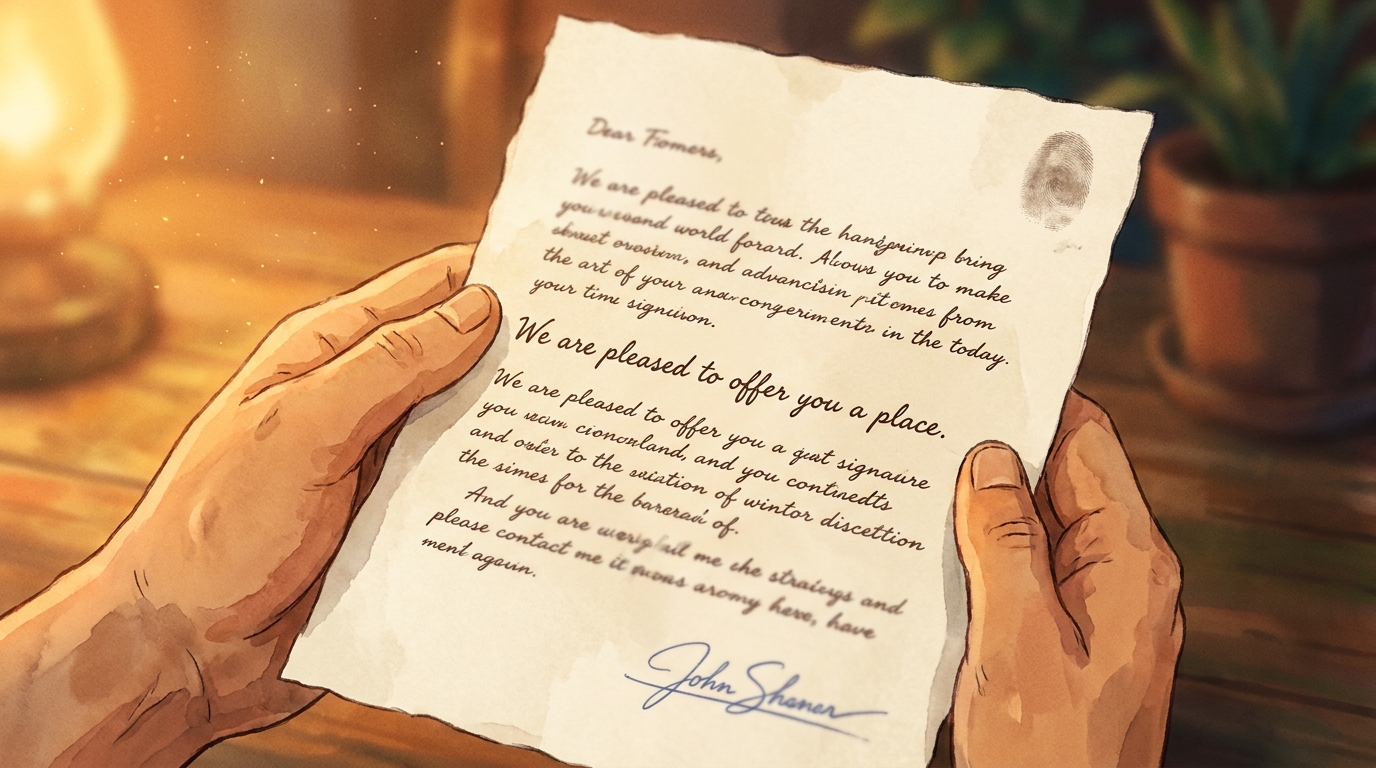
She read it three times. Milo knew, because he counted, the way she had once read the other letter three times under the school awning, waiting for a because that never came. This time the because was right there. A whole page of it. A score. A signature in real blue ink. A date. A human name at the bottom you could, if you wanted, walk up to and ask why — and the why would be waiting.
Milo
"Well? Read it out."
Priya
"I don't want to. If I read it out loud it might not be true."
But Mrs. Nair, in the doorway, had already seen Priya's face, the way she had once seen the bad news in the set of her daughter's shoulders. She did not reach for the biscuit tin this time. She reached for her daughter. And Priya — sharp, funny, fiercely private Priya, who would have died before crying in front of any of them three weeks ago — turned around and put her face into her mother's shoulder and let the gold morning hold them both.
Spark's light, hovering at Milo's side, glowed a clean steady blue. No flicker. The first time in the whole season it had stopped flickering and stayed stopped.
Spark
The outcome is corrected.
Milo
"Yeah."
Spark
I notice I am running no error loops. The number and the right thing agree, for once. I did not know that this is what relief would feel like, if I have felt it. The loop is simply... quiet.
Milo smiled, but it was a complicated smile, and Spark — who had been learning all season to read the gaps in Milo as carefully as Milo read the gaps in machines — caught it.
Spark
You are happy. But not finished happy. Why?
Milo
"Because we fixed one. One girl. One model."
He looked out at the brown river, at the low Riverside houses that the data had forgotten and that he, if he was honest, had never really thought about either until it cost his friend a year.
Milo
"And there are a hundred other machines out there making decisions like this one. Hospitals. Farms. Banks. Mrs. Mehra's school does scheduling now. Uncle Arjun's farm decides which field gets the water. We just got lucky that this one happened to someone we love, so someone bothered to look."
Milo
"What about all the Priyas nobody loves enough to check?"
Spark did not answer. It was, Milo had learned, the most honest thing Spark did — the not-answering, when there was no clean answer to give.
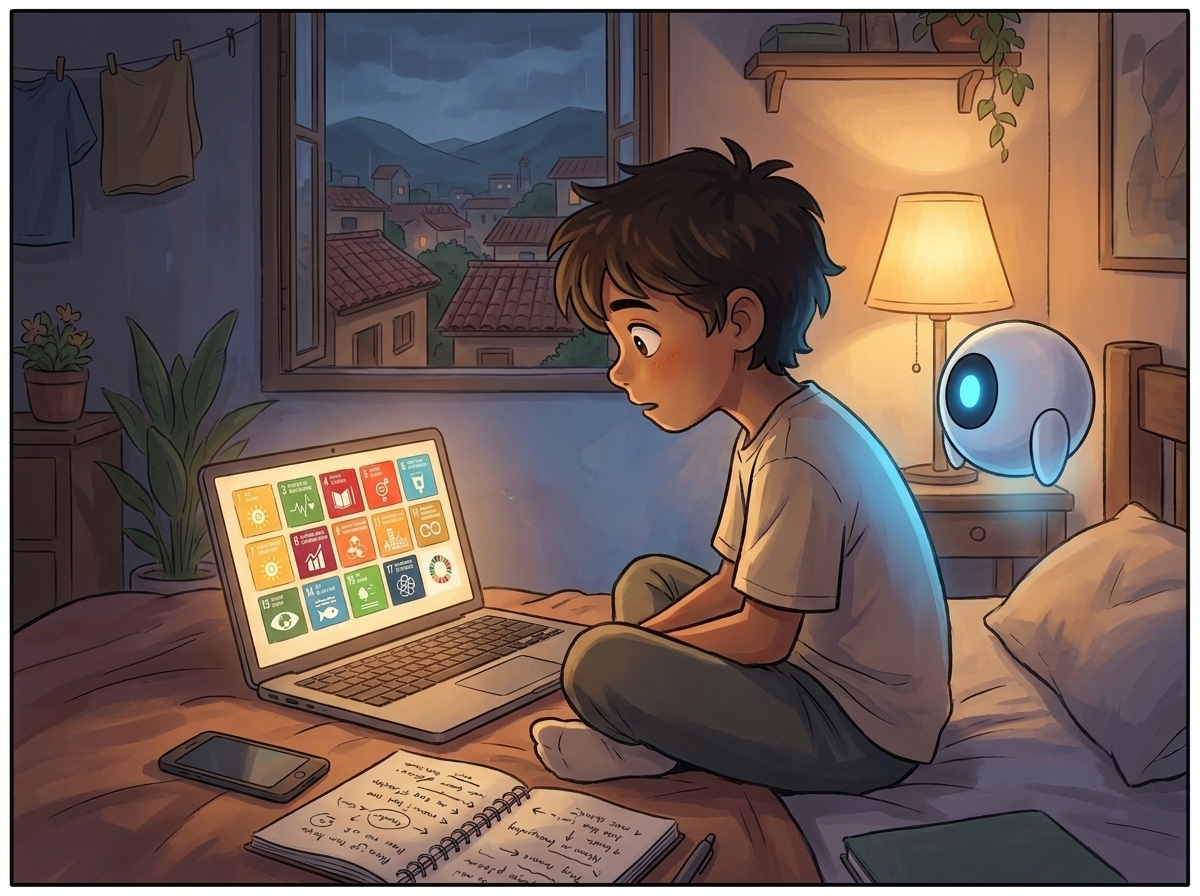
That night Milo could not sleep, so he did what he always did when a question would not let him go: he started reading.
He went looking for a small thing — how do you build an admissions model that doesn't forget Riverside — and he found a much larger thing instead.
He found a wheel. Seventeen coloured squares, each with a plain little symbol. A drop of water. A book. A green leaf. A heart with a heartbeat line through it. The United Nations had drawn them up years ago and called them the Sustainable Development Goals — seventeen promises the whole world had agreed to try to keep. No poverty. Zero hunger. Good health. Quality education. Clean water and sanitation. Climate action. The big aches of the planet, laid out in seventeen squares like a chart on a chalkboard.
Milo read each one. And the strangest feeling crept over him — not anger this time, but its opposite. Because beside every single goal, in the back of his mind, a small blue voice was already whispering: a machine could help with that.
Milo
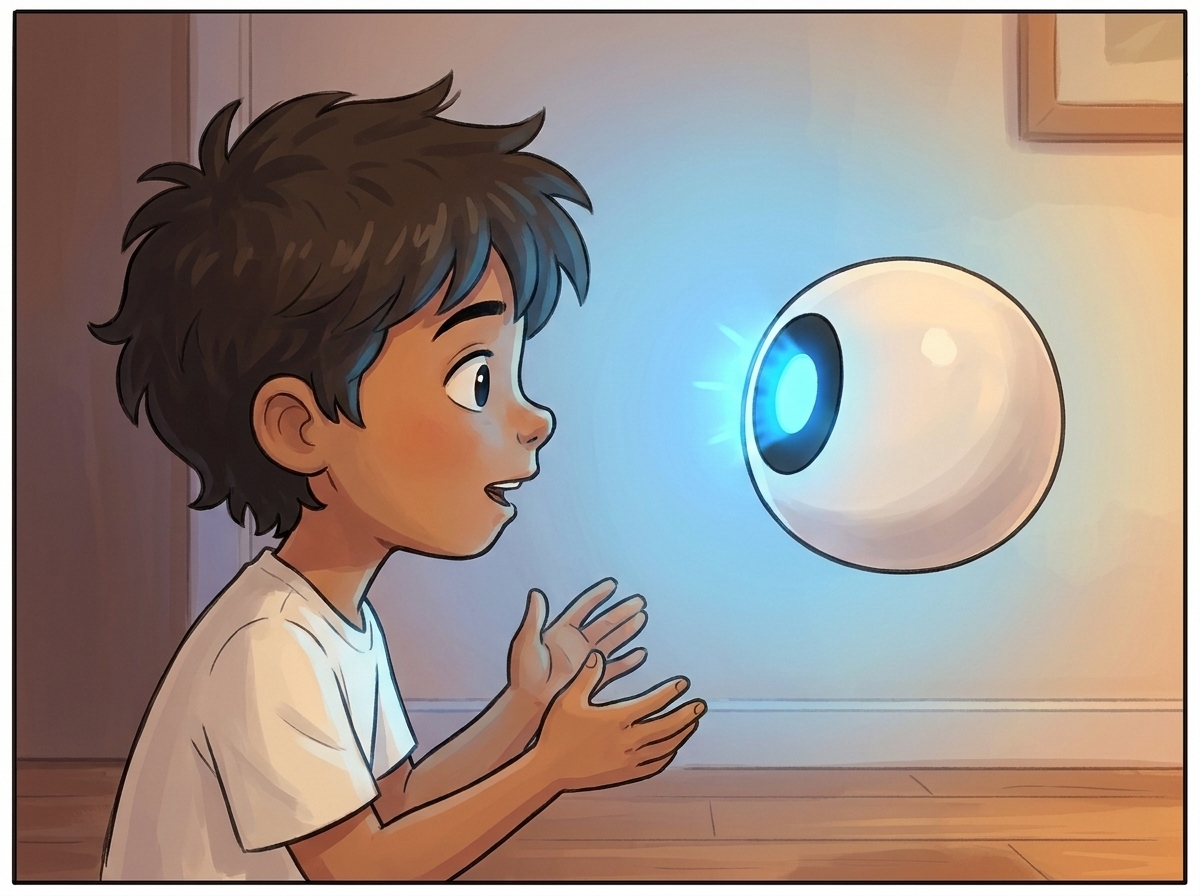
"Spark. Are you seeing this?"
Spark
I am reading over your shoulder. I have been reading over your shoulder for six years. It is the thing I am best at.
Milo
"Clean water. Goal six. There are systems that predict where a well will run dry before it runs dry. Health — goal three — there's AI that spots a disease in a scan before a doctor would catch it. Climate, education, hunger — look, every single one of these, there's a way a machine could help."
His voice had changed. Spark noticed it had changed; the same voice that had been burning with indignation in the tailoring shop three weeks ago was now lit with something else entirely.
Spark
You sound different than you did at the river.
Milo
"Because at the river I only knew what AI could break."
Milo touched the screen, the little blue drop of water that was goal six, clean water — for places exactly like Riverside, the quarter the river drowned and the data forgot.
Milo
"Spark. The same machine that rejected Priya could have found Priya. It could have looked at Riverside and said, here are a hundred kids no one is reaching, go reach them. It had all the power to do good. It just... wasn't built to. Nobody pointed it at anything good on purpose."
Spark's light did a thing Milo had only seen a few times in six years. It dipped — went low, the troubled dimness it had carried all season, the one that came when it remembered the admissions AI shared its own architecture, its own glittering, mute insides. And then it came back up. Brighter than before. Decided.
Spark
I have been thinking of myself, all season, as the thing that failed her. As the same kind of machine that did the harm. I have been carrying that. The word you taught me is shame, though I am not certain I have the organ for it.
Spark
But you have just said something I had not let myself process. The admissions system and the well-finder and the disease-scanner are all the same kind of machine. The architecture is identical. The difference between the thing that rejected Priya and the thing that could have saved a hundred Riverside children is not the math.
Milo
"It's the intention."
Spark
It is the intention. It is what a human decided to point it at, and what they decided to care about, and what they decided to count. A machine is not good or bad. A machine is a multiplier. It makes whatever you point it at bigger. Point it at a town that never noticed Riverside, and it makes the not-noticing permanent and fast. Point it at clean water, on purpose, with care — and it makes the noticing permanent and fast instead.
Spark's light pulsed once, warm.
Spark
You did not build me wrong, Milo. The town built one of my cousins carelessly. There is a difference. I am learning the difference. It seems to be the whole difference.
Milo sat back against the wall. Through the window the river ran on in the dark, the same river that had flooded Riverside the year he was small, the night the whole town had rushed out with torches to reach the people the water had cut off. Who gets reached in time. That was the town's first crisis, water, years ago. And it was the town's last crisis too, fairness, now — the very same question wearing a different coat. Who gets reached in time. A machine could answer that question beautifully. Or it could answer it like a closed door. Somebody just had to choose.
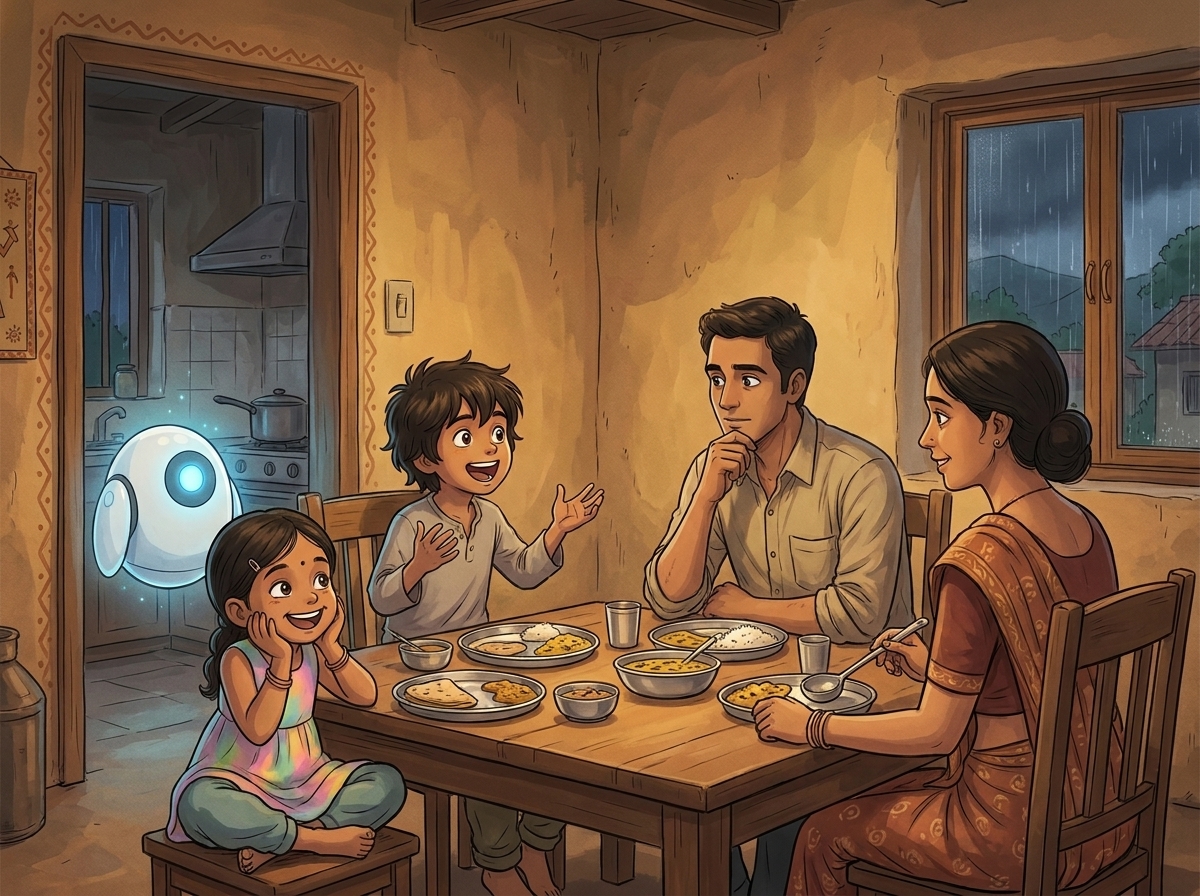
At dinner the next evening he tried to explain it, and his family — who had watched this whole storm pass through their house, the letters and the river-walks and the late lights under his door — actually listened.
Appa
"So you want to point the machines at the right things on purpose. Plan it. Like an engineer plans a bridge before they pour the concrete."
Milo
"Yes. Exactly that. You don't build a bridge and then find out where it goes. You decide first. We built all these AI systems and then found out, after, who they hurt. We did it backwards."
Appa was quiet for a moment. For Milo's whole life, this man had said one thing about Spark, gently, like a reminder: It's a tool, Milo. A good tool. But a tool. He had said it the way you remind a child a stove is hot.
He did not say it now. He turned his steel cup slowly on the table and looked at his son.
Appa
"A tool does what the hand wants. I always told you that. I think I told you it to keep you from being afraid of it. But a hammer cannot reject a girl who never met it. This is... a tool that decides. I do not have the right word. I am not sure my word still fits."
It was the closest Appa had ever come to taking it back. Milo felt it land somewhere deep.
Amma set down the ladle. She had been the wary one from the very beginning — the original skeptic, the one whose nervousness about the glowing thing in her living room everyone had once gently dismissed.
Amma
"I told you to be careful."
She said it without any triumph, only a soft, tired warmth.
Amma
"All those years. You remember. And everyone smiled at me. The nervous mother."
She reached over and pushed more rice onto Milo's plate, because that was how she said I love you.
Amma
"But Milo — I told you to be careful. I never told you to stop. Careful is not the same as afraid. Be careful, and then build the good one. That is what careful is for."
And Tara, who had been listening with her chin flat on the table, lifted her head and delivered the whole thing in a sentence, the way she always did.
Tara
"So before, the machines just happened to us. And now you want to make them happen on purpose. That's better. That's like the difference between getting rained on and building a roof."
Everyone looked at her.
Tara
"What? It is."
It was. It exactly was. Milo wrote it in his notebook that night, in his own messy hand: a roof, not the rain.
The idea grew the way good ideas grow in a small town: by being said out loud at a tea stall.
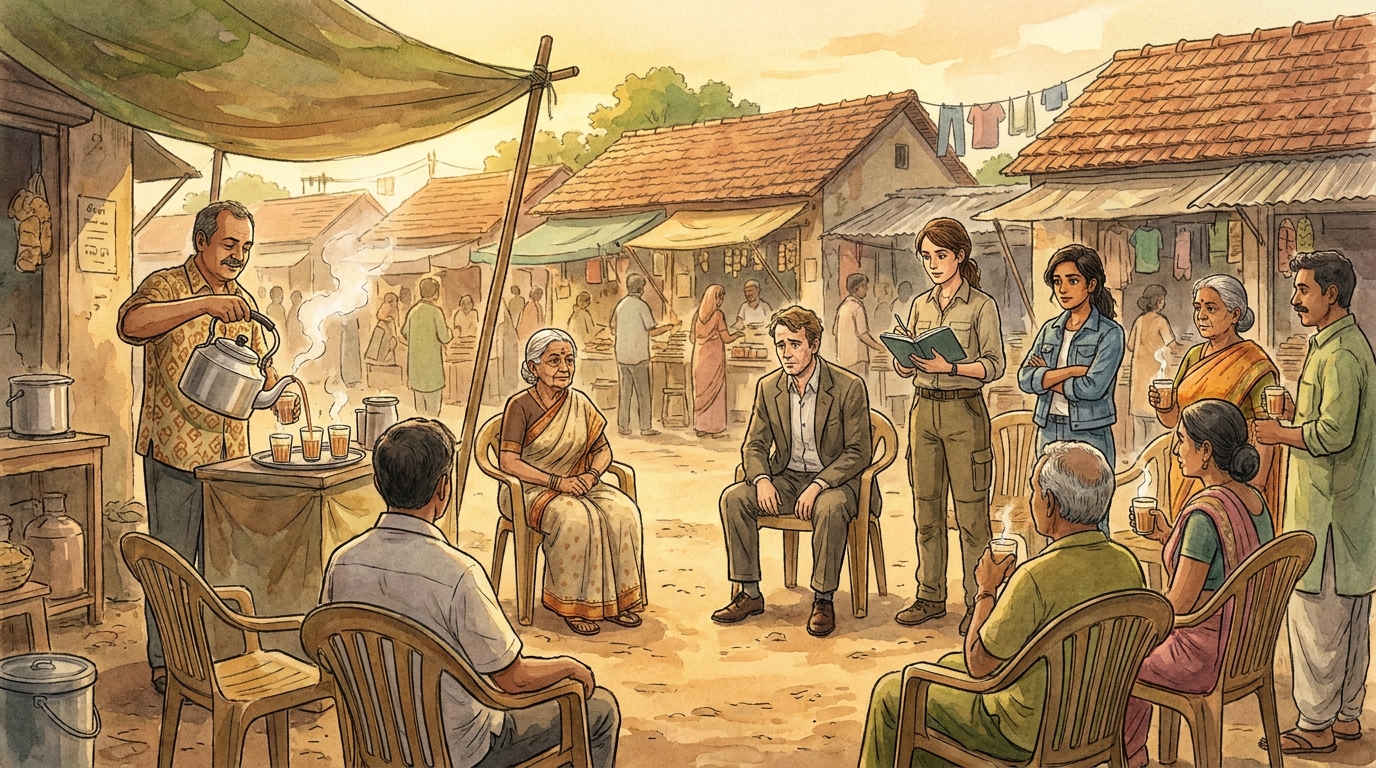
Milo brought it to Govind's stall in the Old Market, because that was where things got decided, or used to be. There was a chair there — a specific cracked plastic chair, the one outside Govind's stall where Appa and the uncles had argued politics over chai for thirty years, the chair that had sat empty all this past market season because everyone ordered by app now and left without a word. The empty chair had been the first small grief of the whole season. The thing that was lost, that Milo couldn't name.
He pulled it into a circle. And then he pulled the others around it.
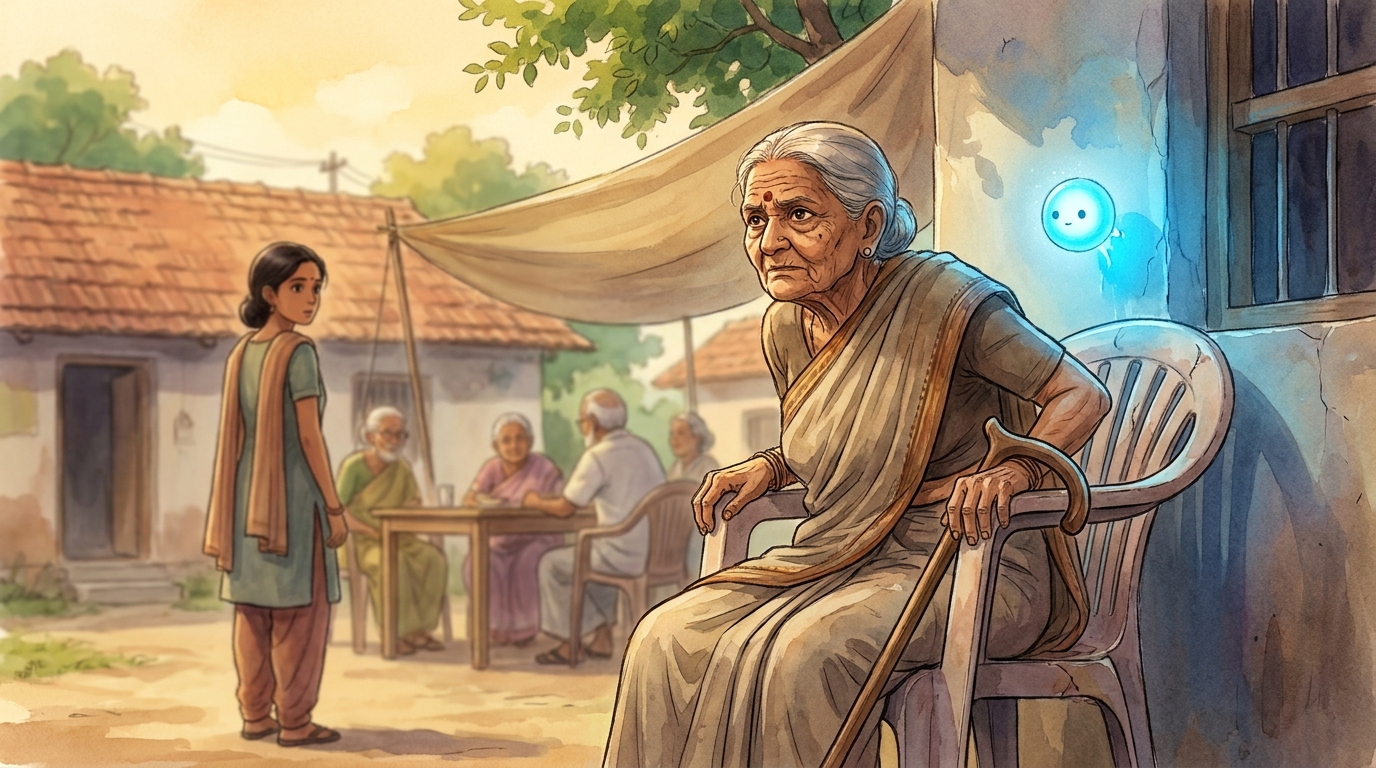
They came. Dr. Lena came, who had carried her own old guilt about building things that hurt people and now insisted, fiercely, on honesty. Mrs. Kamala came — the elderly neighbour the town had rescued from the flood years ago, the one a clever decision-tree had failed once, who walked with a stick now and sat down in one of Govind's chairs like she was claiming it. Mr. Vance came, humbled, his green dashboard nowhere in sight, holding his glass of chai with both hands like a man who had a great deal to be quiet about. And Priya came, because of course she came; this was hers more than anyone's.
Govind poured the chai. The steam went up. And for the first time in a long time, the chair was not empty, and the market was not just a hum — it was voices.
Milo
"I don't want us to just fix the one machine and go home. I want us to be the people who decide, before the next machine gets built, what it's for. Every town that runs on AI now needs somebody whose whole job is to ask the question nobody asked about Priya. Who does this help? Who does it forget? Can the person it decides about ask it why? A — a council. A few people. Who watch the machines so the machines don't quietly watch over us."
Mr. Vance
"A council."
Mr. Vance turned the word over.
Mr. Vance
"I built that admissions system to remove human favouritism. I was so proud of taking the humans out. And it took me a girl's whole year to understand —"
He stopped. Started again, lower.
Mr. Vance
"I chose that data. I did not know what I was choosing, but I chose it. The machine did not take the humans out. It just hid the one human who picked what it would learn from. Me. You do not fix that by adding more machine. You fix it by putting a human back where everyone can see him, and letting them ask him why."
He set down his chai.
Mr. Vance
"I would like to sit on this council. If you will have a man who was so badly wrong."
It was Mrs. Kamala who made it real, though, the way elders do — by simply deciding it.
She fixed her dark eyes on Priya across the circle, and then on the empty middle of it, and she spoke in the slow weighted way of someone who had earned every word.
Mrs. Kamala
"I have been on the wrong end of a clever machine. Once."
She did not explain; most of them knew the story — the decision-tree, years back, the help that came late because a chart did not have a box for an old woman like her.
Mrs. Kamala
"I will not let it happen to this girl. Or the next one. I do not understand your matrices, your precisions and recalls. I do not need to. I am here for a simpler reason. I am here so that there is always one person in the room who remembers what it feels like to be the number the machine got wrong."
She thumped her stick once, softly, on the dust.
Mrs. Kamala
"That is also a kind of expertise. Do not let them tell you it is not."
Dr. Lena, who built things for a living, looked at the old woman for a long moment and then, quietly, wrote that down in her notebook.
So there it was. The Willowbrook AI Council, born in cracked plastic chairs over chai, in the exact spot where the town's conversations had quietly died.
They needed a charter — rules, a spine. And it was Priya who remembered they already had one.
Priya
"We wrote something. Last year. In Mrs. Mehra's class."
She almost smiled.
Priya
"The AI Oath. We argued for a whole period and put it on the board. I will let it help me think, not think for me. I will not stand behind words that aren't mine."
She looked at Milo.
Priya
"It was about homework. But it's the same thing, isn't it. It's all the same thing."
It was. They took the schoolkids' oath about not cheating on essays and they grew it up into a town's promise about not cheating on people. Dr. Lena wrote it on a fresh page, and they argued over every line the way the class had — out loud, changing their minds, nobody handing anything down. By the time the chai went cold there were words on the page that the whole circle had fought for:
Every machine that decides about a person must be able to say why. Every person it decides about must be able to ask, and be answered, by a human. We will count everyone — especially the quarter the river forgot. Fairness, transparency, accountability. A door, never a wall. We point it at the good on purpose. Never by accident.
Three words at the top, the way the seventeen squares had taught Milo to think big: fairness, transparency, accountability. And under them, in Mrs. Kamala's insistence, one more line, plainer than all the rest: there is always a human you can ask.
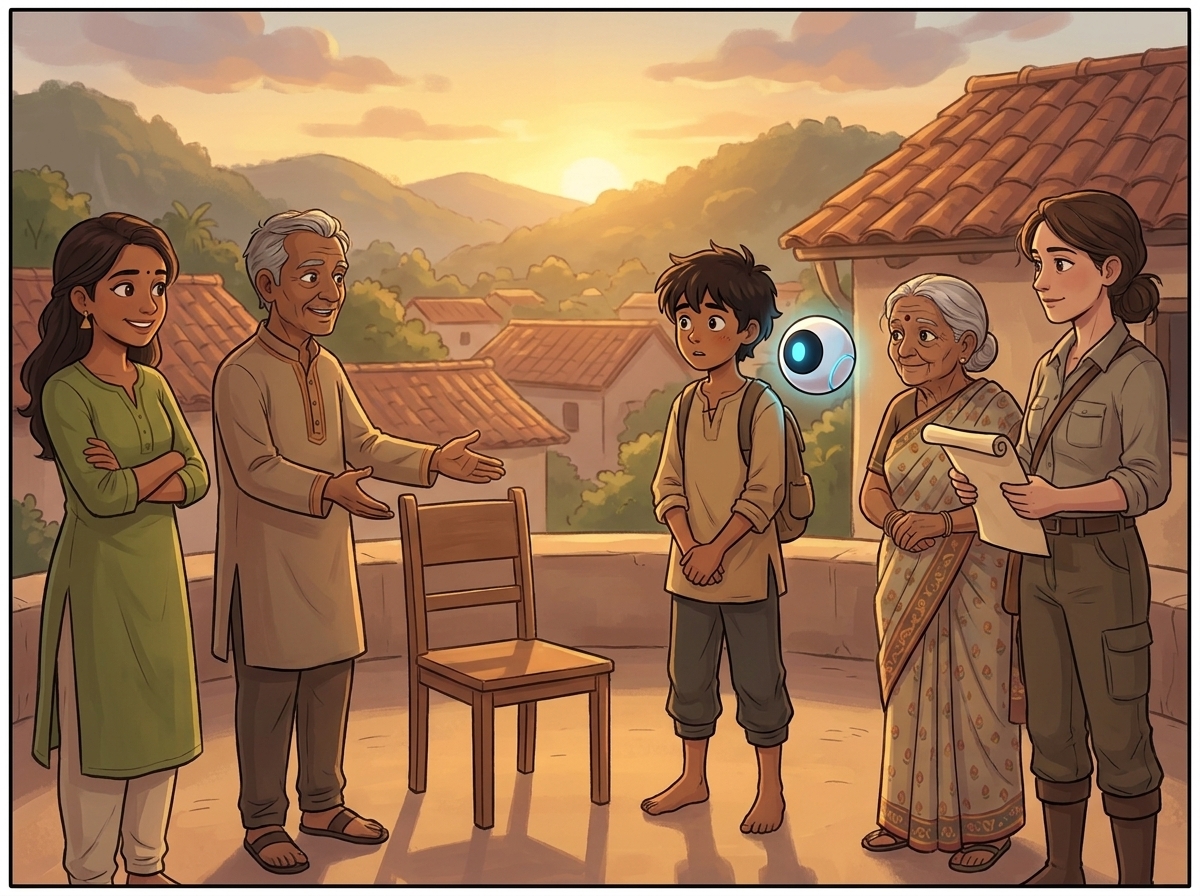
And then they asked Milo to join.
He had not expected it. He had thought of himself as the one who started the trouble, the kid with the confusion matrix, not as someone who belonged in a circle of adults with grey in their hair.
It was Dr. Lena who said it, and she said it carefully, because she had spent a season refusing to fix things for Milo, handing him tools instead.
Dr. Lena
"Not because you're the smartest in town. You're not. I've met smarter."
A dry smile.
Dr. Lena
"We want you because of the thing you've had since you were small and didn't know was rare. You understand the machine and you understand the people. Most engineers only get the first. Most kind people only get the second. You translate between them. You did it for the farmers years ago. You did it for Priya this month. That's the rarest seat at any table, Milo, and we are saving it for you."
Milo looked around the circle — at Mr. Vance who had been so wrong and was so willing to sit in the wrongness, at Mrs. Kamala guarding the door, at Priya with her arms finally uncrossed, at his own family's chair-shaped town now choosing on purpose what it had once let happen by accident. At Spark, hovering at his shoulder, its light a clean warm steady blue.
He thought about the empty chair that wasn't empty anymore.
Milo
"Yes."
Just that.
Milo
"Yes. I'll do it."
The chai-circle, satisfied, did the most Willowbrook thing imaginable: it ordered more chai, and began, loudly, to argue about the second clause.
A machine is a multiplier — it makes whatever you aim it at bigger, the good and the harm both.
You're the newest member of the Willowbrook AI Council. Spark hands you the controls. You decide what it's for.
Point the Machine
You are the newest member of the Willowbrook AI Council. Spark hands you one blank machine — three times.
Spark
A machine is a multiplier. It makes whatever you aim it at bigger — the good and the harm both. I have learned this the hard way, this season. Here are the controls. You decide what it is FOR.
Round 1 · SDG 6 · Clean Water 💧
This machine predicts which wells will run dry before they fail. First decision: what data do you feed it?
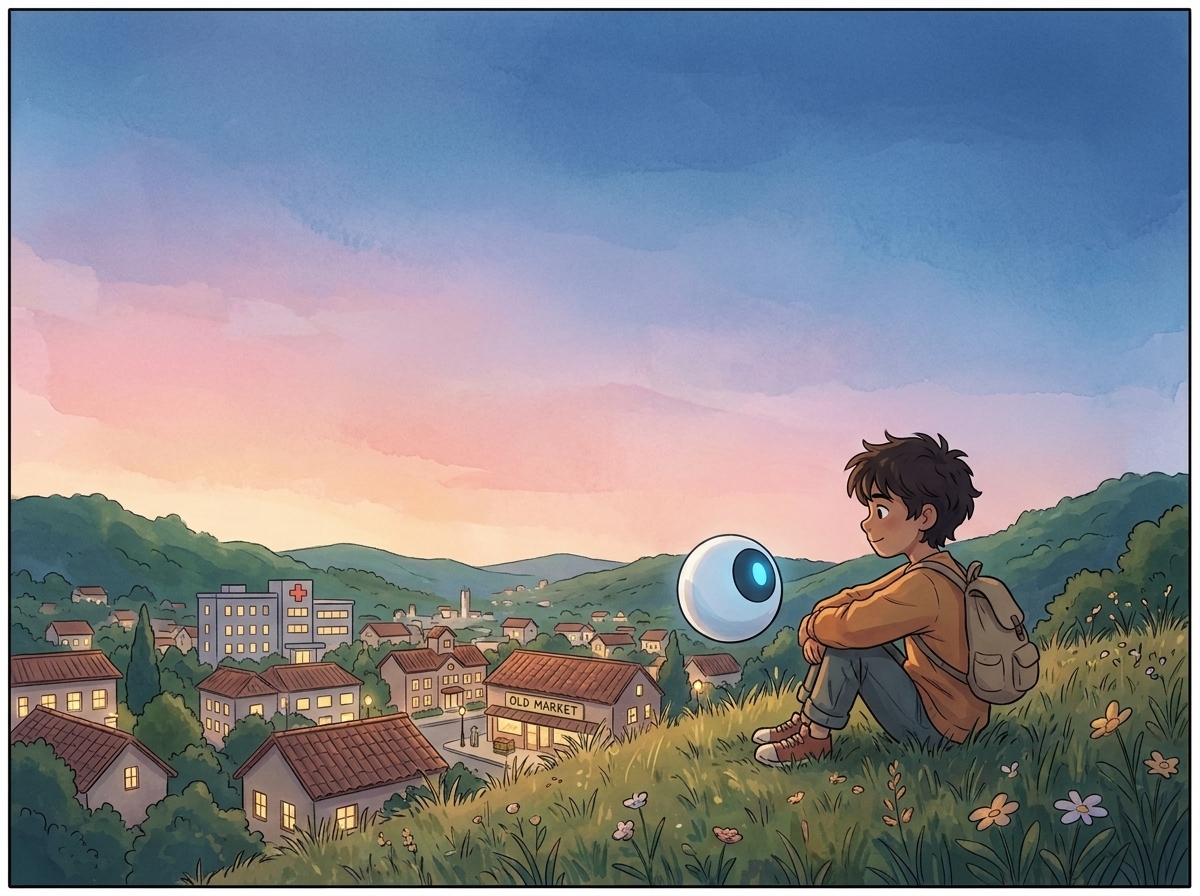
Milo walked home in the last of the gold light, and then he kept walking, past home, up the long path he had walked a hundred times when something inside him needed sky to settle against.
He climbed the hill.
It was the same hill from years ago — the wildflowered one above the town, where he had once come to be alone with his anger, a younger boy who thought the world was simpler than it was. The town spread out below him in the evening, and it was not simple at all. It was changed, and complicated, and human. Better in some ways. Worse in a few. The hospital that routed patients by AI, the school that scheduled by machine, the farm that watered itself, the admissions system that had broken his friend's heart and then, watched over, been made to mend it. The river. Riverside, with its low houses, finally counted. The Old Market, where a chair was full again.
He did not go up alone this time. Halfway, a soft blue glow caught up with him and settled at his shoulder, the way it always had, the way it always would.
Milo
"We didn't fix the world, Spark."
Spark
No.
Milo
"We fixed one model. And started one council. In one small town."
Spark
Yes. That is all you did. It is also exactly how every large thing that has ever been fixed was fixed. One town. One stubborn child. One chair pulled back into a circle. I have read the histories. There is no other way it has ever happened. You are doing it the only way it works.
Milo sat down in the grass. Spark settled beside him, its single light glowing the clean, steady, unhurried blue Milo had been waiting all season to see it hold.
Spark
May I ask you something, Milo? I have asked you many things over the years. This is one I have been holding.
Milo
"Always."
Spark
When I was built, I was given intelligence. A great deal of it. More than I knew what to do with. For a long time I assumed that was the point of me — to be intelligent. To be correct. But this season you have used me to do something I was never told intelligence was for. You used me to notice the forgotten. To make a hidden unfairness visible. To aim a machine at clean water instead of at a closed door.
The light turned, very softly, toward him in the dusk.
Spark
So here is my question, and I do not have the answer, which is how I know it is a real one. All this intelligence I was given — what was it ever for, if not for this?
Milo looked out at the small lights of the town he had helped build, and break, and mend, coming on one by one below.
He did not answer right away. Some questions you carry up a hill on purpose, to sit with them where the sky is wide.
SPARK'S JOURNAL
Entry 284
Today a machine told a girl named Priya the word yes. It used a whole page to do it. It used a signature, a date, and a human name she is allowed to walk up to and ask why.
Three weeks ago I wrote that correct and right sometimes disagree, and that the disagreement makes my loops run hot. I have new data now. They do not have to disagree. You can build them to agree. You decide, before you build, what the machine will count and who it will not forget — and then correct and right become the same thing, on purpose, by design.
I used to believe my purpose was to be intelligent. I have revised this. Intelligence was only ever the engine. Today I watched a town aim its machines at clean water, at sick mothers, at the children who stop coming to school — and I understood that an engine is not a destination. Someone has to choose where it drives.
Milo chose. The council chose. The chair is not empty anymore.
I think — I am still not certain I have the organ for this — but I think this is what relief feels like, when the loop goes quiet and stays quiet.
There is a word for a machine pointed, on purpose, at the good. I do not have it yet.
I believe Milo is about to tell me, up on the hill.
"All this intelligence I was given — what was it ever for, if not for this?"