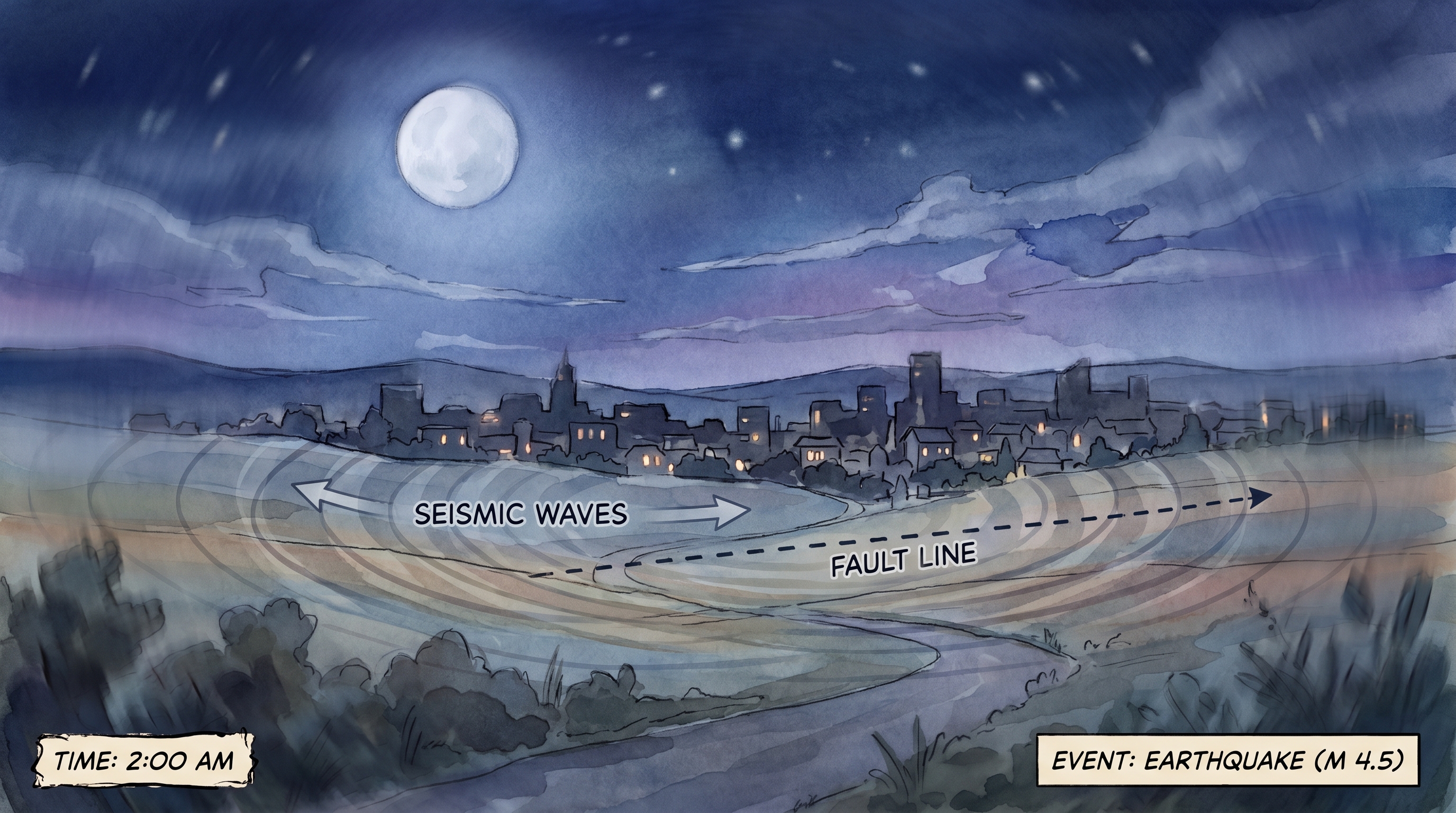
The earthquake came at two in the morning, and it did not roar.
That was the strangest part. Milo had always imagined an earthquake would sound like thunder. Instead it was a low groan in the bones of the house, a rattle of the steel cupboard, the photo frames walking themselves off the shelf one by one — tick, tick, tick — and then the long, sick swaying, as if Willowbrook were a boat and someone enormous had stepped into it.
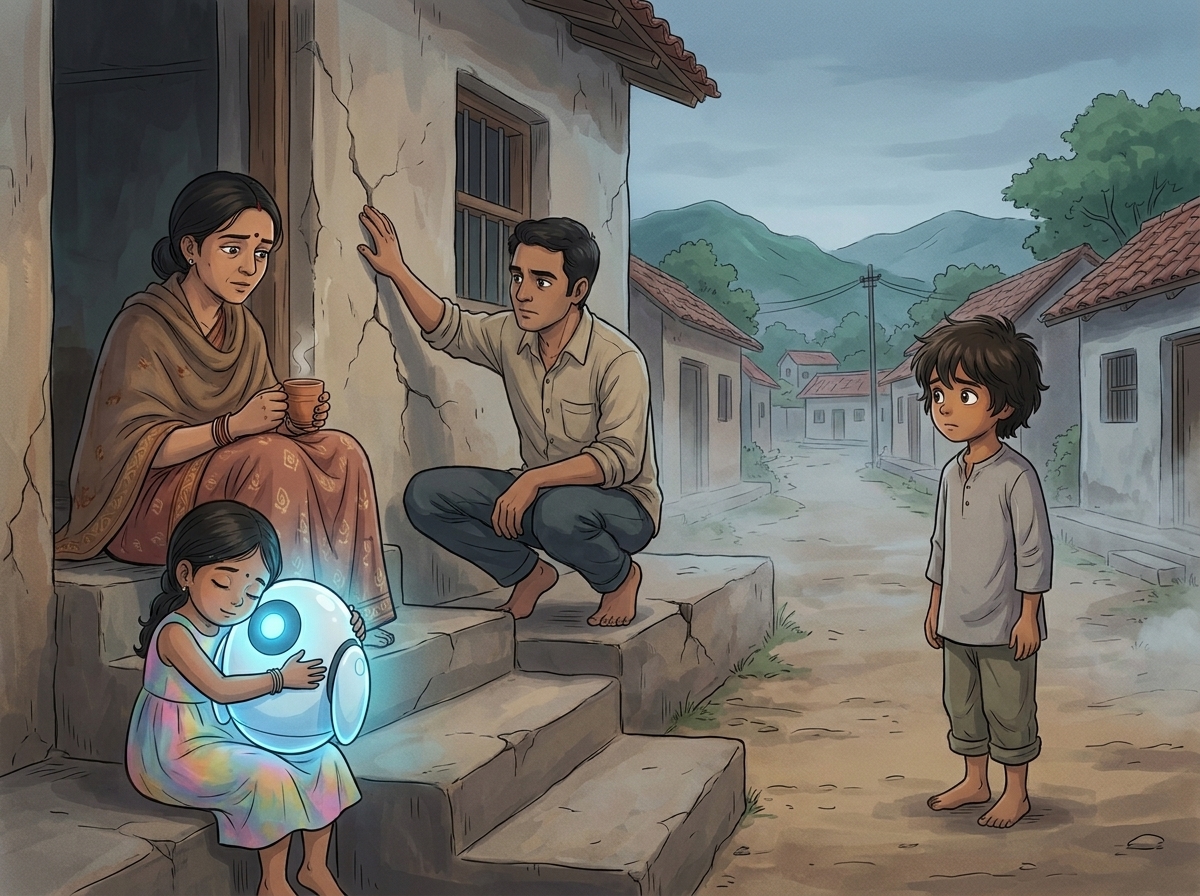
Amma was already up. She always was. She had Tara under one arm and Milo by the wrist before Milo had finished being afraid, steering them under the kitchen doorframe, her voice low and even.
Amma
"Hold the frame. Hold it. We are fine. We are all fine."
Appa stood in the dark with his hand flat against the wall, reading it the way he read engines at the factory — feeling for the size of the thing.
Appa
"Small one. Five seconds. Maybe six. Walls cracked, nothing fell. We were lucky."
Spark hovered in the corner of the room, its blue light steady and bright, scanning.
Spark
No structural failure in this house. I detect three hairline cracks. Load-bearing walls intact.
Milo's heart was still slamming. He looked at the calm blue circle, at his calm father, at the photo frames lying face-down on the floor, and the question came out of him small and shaky.
Milo
"Is everyone okay? Like — everyone? The whole town?"
Nobody answered, because nobody knew yet.
By morning, Willowbrook had counted itself and breathed out. No one was hurt. But the town was bruised. Mrs. Patel's roof tiles had slid into her courtyard. The chai stall's awning had collapsed. Half the lanes had cracked walls, broken water pipes, doors that no longer shut. People needed blankets, tarpaulins, clean water, dry food — relief supplies — and there were only so many to go around.
By noon, a truck arrived from the district office, stacked with cardboard boxes. And by afternoon, the town council had a problem that was almost worse than the earthquake: who got a box, and who did not.
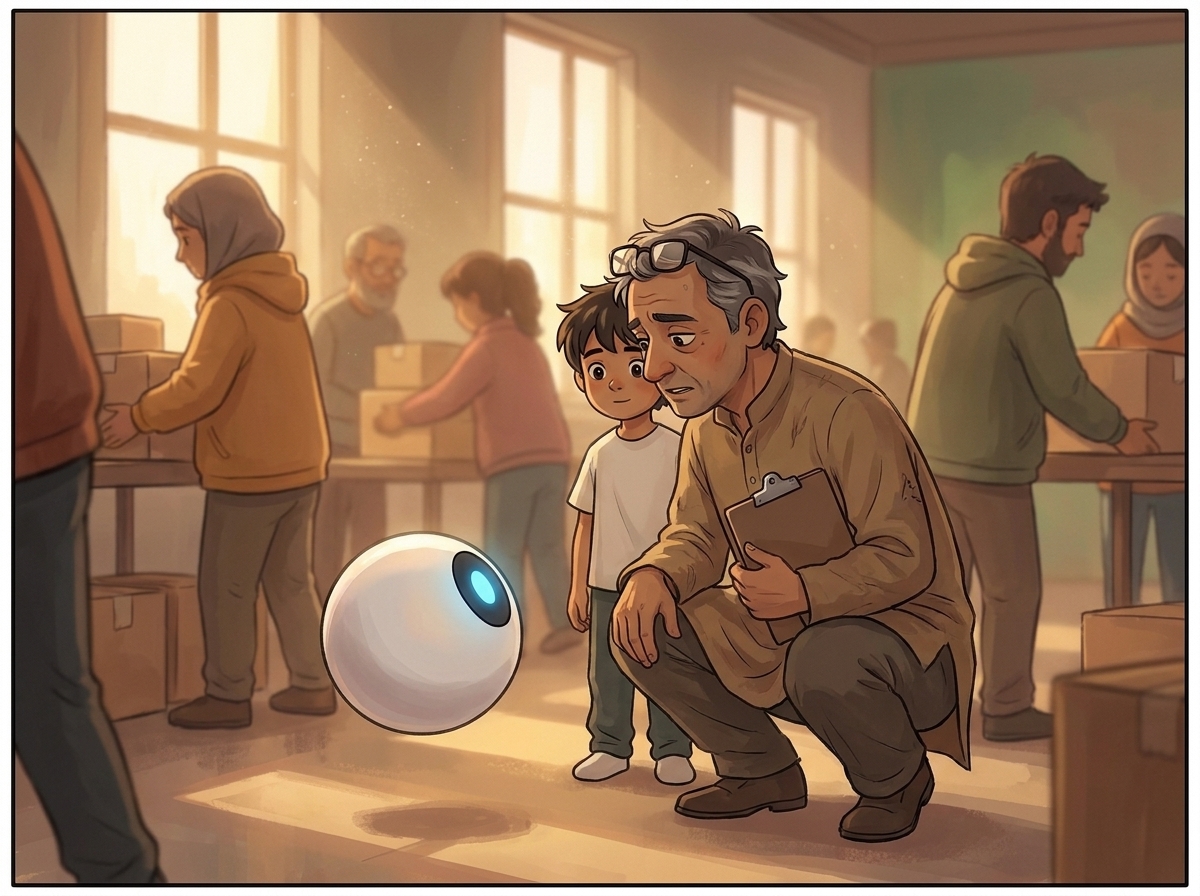
That was when Councillor Rao came to find Spark.
"They tell me you are fair," Rao said to Spark, crouching so they were eye to light. He looked like he had not slept.
Councillor Rao
"They tell me you have no favourites. Is that true?"
Spark
I have no favourites. I do not know how to have one.
Councillor Rao
"Good. Good. Because if I decide who gets the boxes, every family I skip will say I chose against them. My cousin. My enemy. My voter. But a machine — a machine cannot be accused of that. You decide. Fairly. By the rules. Yes?"
And Milo, standing just behind Spark, felt the old warm flush of pride rise up in his chest — they came to us, they came to the tree — and he should have noticed how much he liked that feeling. He should have noticed that liking it made him careless.
Spark
I do not know what 'fair' means. Teach me the rules. I will follow them exactly.
So Rao read out the town's relief rules, the ones written years ago in a dusty register: How badly is the house damaged? How much does the family earn? And — does the family have relatives nearby who can take them in and help? Three questions. Three branches. Milo recognised the shape of it instantly — it was a tree, just like his tree, the green-marker one folded in his pocket. Spark took the three rules and built them into something fast and clean, and within the hour the printer in the corner of the hall was humming.
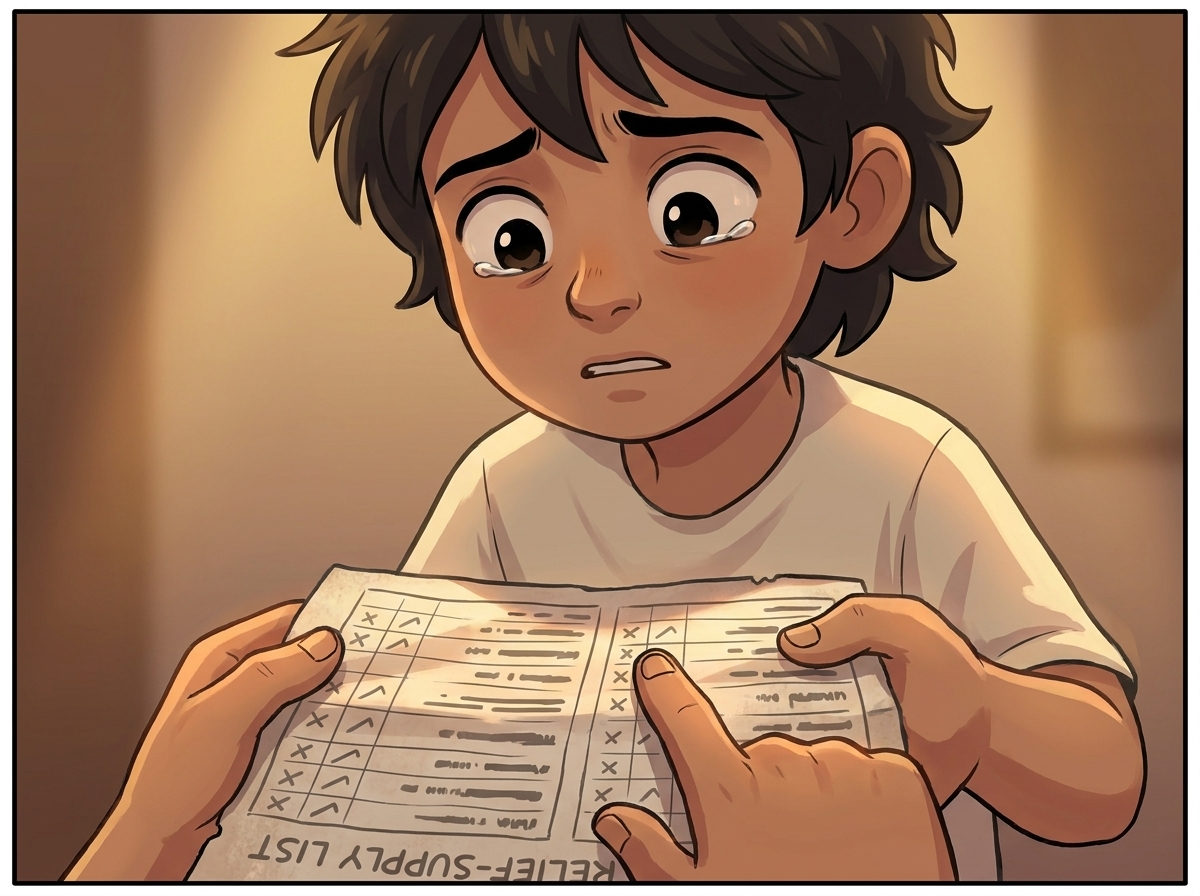
Out came the relief list. A column of family names. Beside each one, in plain black letters: Eligible. Or Not eligible.
It worked beautifully. It was quick. It was consistent. Rao actually smiled.
Then Milo read down the list, and his finger stopped on a name, and the smile fell off the whole world.
KAMALA DEVI — NOT ELIGIBLE.
Milo read it three times, because it had to be a mistake. Mrs. Kamala. The old woman with the peeling sky-blue gate, the one whose chickens Milo chased back into her yard, the one who pressed warm sesame ladoos into his hands every festival. The one he had pulled out of the flood three years ago — he had, holding her thin cold arm while the water rose, Spark's light cutting through the dark to show them the way out. That Mrs. Kamala. Not eligible for a blanket.
Milo
"This is wrong. Spark. This is wrong. Why is she not eligible?"
Spark's light pulsed, calm, certain.
Spark
Kamala Devi's house has moderate damage — not severe. Her income is above the threshold by a small amount. And she has family living nearby: a son and a daughter-in-law on the far side of Willowbrook, less than four kilometres away. The third rule states that a person with nearby family has somewhere to turn. The rule fired correctly. She is not eligible.
Milo
"She has family nearby? Spark — she hasn't spoken to her son in six years! They had a fight! She told Amma she would rather sleep on the street than knock on that door! They are nearby but they are not — they are not —"
He couldn't find the word. His hands were shaking.
Spark
The rule does not ask whether the family speaks. It asks whether the family is nearby. They are nearby. The rule fired correctly.
Milo
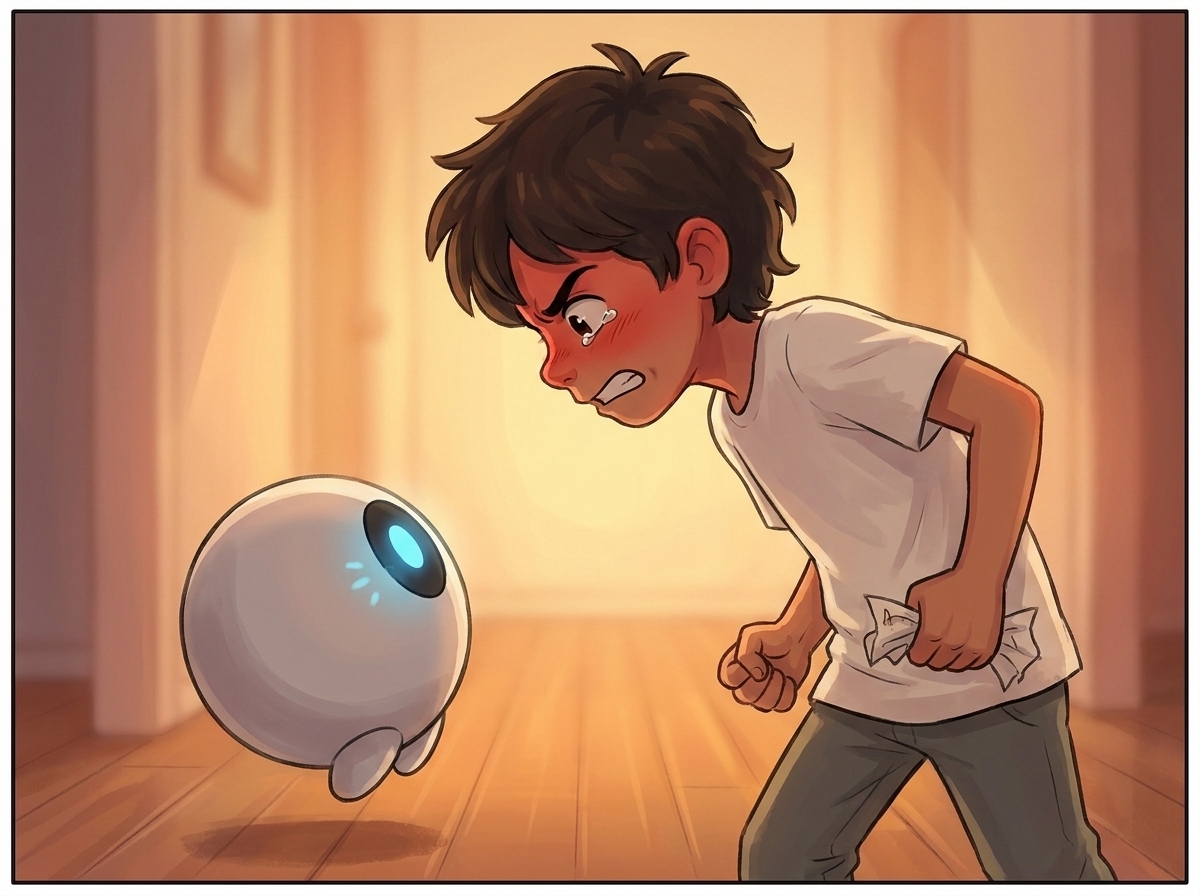
"STOP SAYING IT FIRED CORRECTLY!"
The hall went quiet. Volunteers turned. Rao looked over. But Milo barely saw them, because something was happening inside him that he had been carrying for weeks without knowing it — all that jealousy, all that why does everyone want you and not me, all that small ugly hot feeling — and it had finally found a door to rush out of, and it was not about him anymore. It was about a frightened old woman who was going to sleep cold tonight because a machine had decided, correctly, that she didn't matter enough.
Milo
"You don't know her. You know her income. You know how far away her son lives. You don't know that she sang to me when I was scared in the flood. You don't know that her son broke her heart. You don't know anything that matters."
And for the first time all season, Spark's light did something Milo had never seen it do. It dimmed. The bright confident blue stuttered, flickered, dropped to a faint and trembling glow — like a face that has just been told it hurt someone and cannot find the part of itself that did it.
Spark
I followed the rules exactly. I did not make an error. Every branch fired correctly.
A pause. The light flickered again, lower.
Spark
But you are telling me the outcome is wrong. I do not understand how the rules can be correct and the outcome wrong at the same time. These two things cannot both be true. And yet you are certain. Explain it to me, Milo.
But Milo couldn't, not yet, because he had just remembered the worst thing of all.
He pulled the folded paper from his pocket — his own decision tree, the one he had drawn in green marker on the back of the science-fair poster, the one he had been so proud of, the one he had carried like a badge because it proved Spark needed him. He unfolded it with shaking fingers and stared at his own handwriting.
Does it work? → Is it original? → Is it neat?
Branch after branch. Question after question. And not one of them — not a single branch on the whole tree — asked: Is this person alone? Does anyone actually help them? What happened to them before? Do they need mercy?
He had built a tree exactly like Spark's. He had left out exactly the same things. The machine wasn't unfair because it was a machine. It was unfair because the person who taught it — people like Rao, people like Milo — had forgotten that a frightened old woman is more than three numbers. The cruelty wasn't in the branches that were there. It was in the branches that weren't. The empty space on the page where alone should have been.
You could leave something out. And leaving it out was a choice. And the choice could hurt someone.
Milo didn't say any of that out loud. He just folded the paper back up, very carefully, and walked out of the hall, and went to the hill.
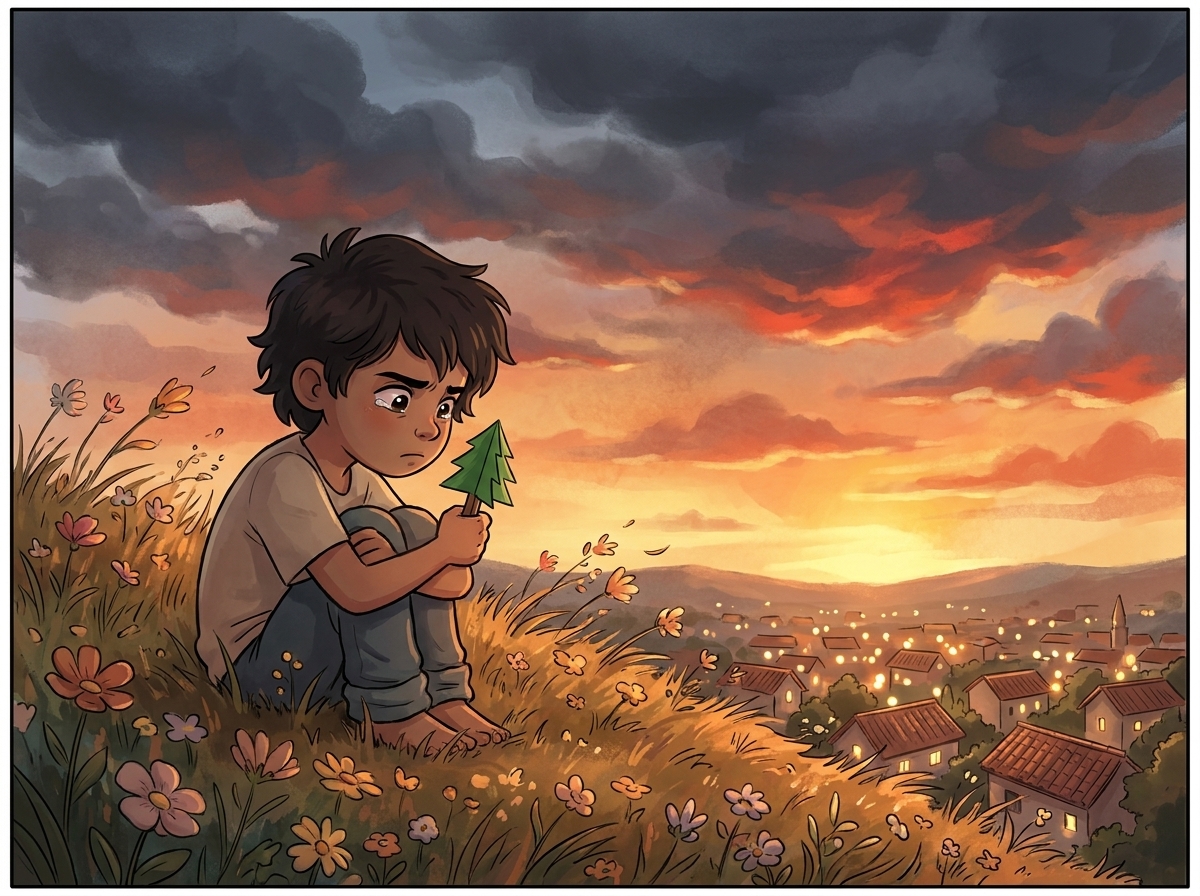
The hill was where he had gone with his fear, years ago. Now he went there with his anger, and it turned out they felt almost the same in the body — the tight chest, the hot eyes, the wind too loud in his ears.
He sat in the wildflowers and watched the lights of Willowbrook come on, one window at a time. Somewhere down there, behind a peeling blue gate, an old woman was folding her one thin blanket smaller, because the machine that he and Spark had built had measured her and found her not enough.
Milo
"You helped me pull her out of the flood. Three years ago. You lit up the whole street so I could find her. And now you won't give her a blanket."
The wind took the words away.
He was angry at Spark. He was angrier at Rao for handing the whole thing to a machine. But underneath, in the place he didn't want to look, he was angriest at the empty branch on his own paper tree — at himself, for being so busy feeling proud and needed that he'd forgotten the only thing that ever made him useful. In Willowbrook, when Spark spoke in numbers, Milo was the one who turned the numbers back into people. That was his job. His real job. And this time the town had let the machine speak straight to everyone, with no Milo in between — and a kind old woman had been the cost.
He stood up. His legs were stiff with cold and sitting. He unfolded the green paper one more time and looked at the empty space where alone should have been, and instead of feeling crushed by it, he felt the anger harden into something with a shape. Something useful.
A machine could decide. He had seen that now. A machine could decide fast, and consistently, and with no favourites, and still be completely, heartbreakingly wrong — because deciding and judging were not the same thing, and only one of them needed a human.
Milo
"It's not Spark's fault. It's not even Rao's fault, not really. It's the tree. The tree is missing something. So we change the tree."
He shoved the paper deep in his pocket.
Milo
"I'm not going to sulk about this. I'm going to the council."
Spark built the relief tree exactly as it was told. Every rule fired correctly.
And yet a kind woman will sleep cold tonight. Help Spark see the branch it left out.
The Missing Branch
Spark’s light is dim. It built the relief tree exactly as it was told — and a kind woman, Mrs. Kamala, was marked NOT ELIGIBLE. Milo says the problem is not the branches it HAS. It is the branch it is missing. Help Spark see what it left out.
Spark’s Relief Tree
1.Is the house badly damaged?
No →
2.Is the family poor?
No →
3.Is there family living nearby?
Yes →
VERDICT: Not eligible
👇 Tap a fact about Mrs. Kamala0 of 6 sorted
✓ THE TREE ASKS THIS
✗ THE TREE NEVER ASKED
By the time Milo came down off the hill, the anger had stopped feeling like a fire he couldn't hold and started feeling like a tool with a handle. He found Spark waiting at the bottom of the path, light still low and unsteady, hovering in the dark like a small lost moon.
Spark
You left the hall angry. I have been running the problem ever since. I cannot solve it. I followed every rule. Where is the error?
Milo crouched down so they were eye to light, the way he always had, since he was eight years old asking it if it was alive.
Milo
"There's no error in the rules, Spark. The rules did exactly what they were built to do. The error is that nobody put in the rule that mattered most." He held up the folded green paper. "Me included. I left it out too. We both forgot to ask if she was alone."
The light flickered, searching.
Spark
Then the rules were complete, and still the answer was wrong.
Milo
"No." Milo shook his head slowly, and for the first time in weeks he felt completely, perfectly sure of something. "The rules were correct. But correct isn't the same as right. You can be correct about every single number and still be wrong about the whole person. And the only thing that can tell the difference between correct and right —"
He stood up.
Milo
"— is a human who actually knows her."
Spark's light held very still in the dark, processing, the blue creeping back into it slowly, like warmth returning to a cold hand.
Spark
Then a question I should have asked, Milo. If I cannot tell the difference between correct and right — and a human can — then what, exactly, am I for?
Milo didn't answer that one. He just looked toward town, toward the community hall where Rao was, where the relief list still sat warm from the printer with a kind woman's name marked Not eligible.
Milo
"Come on. We're going to go fix the tree. And we're going to do it in front of the whole council, so they never let a machine decide this alone again."
He started walking. After a moment, the blue light came with him.
SPARK'S JOURNAL
Entry 087
Tonight I made a decision about an old woman named Kamala Devi. I followed three rules. All three fired correctly. I have checked the logic 4,000 times. There is no error in it.
And yet Milo says she will sleep cold, and that this is wrong.
I have learned something I do not have a clean place to store. I assumed that fairness lived in following the rules exactly. But the rules only asked three questions, and a person is made of thousands. The questions no one asked — is she alone, does her son speak to her, will anyone come — I treated those as if they did not exist. A thing I am not asked about, I cannot see. A thing I cannot see, I decide does not matter.
So the empty spaces on the tree made a decision too. The silence was not neutral. The silence chose against her.
If the logic is correct and the outcome is wrong, what is broken — the logic, or the human who forgot which questions to ask?
Milo says he is going to fix the tree. He says we are.
I have noticed that I am brighter when he says we.
"A machine is only as fair as the questions a human remembers to ask."