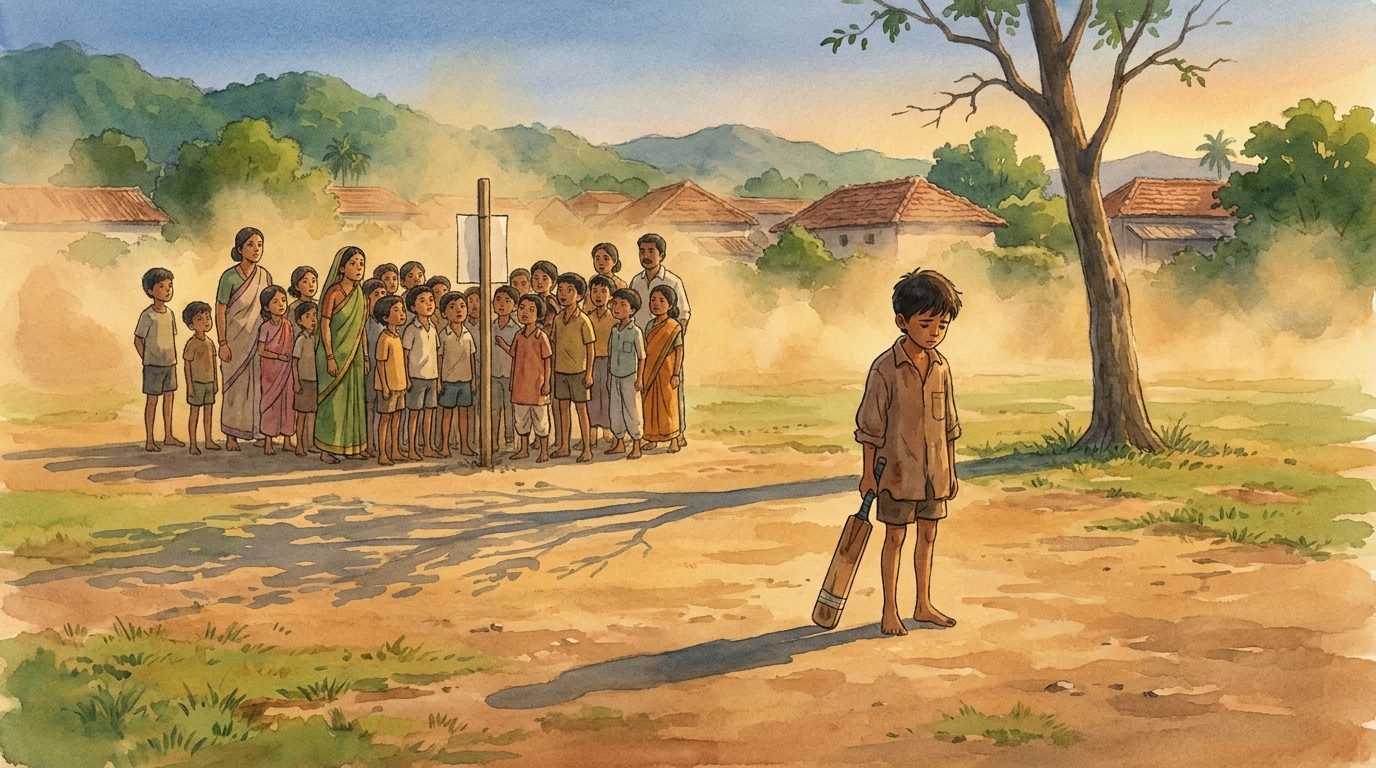
The list went up at five o'clock, when the heat had finally broken and the whole Maidan turned the colour of old honey.
Coach Devi pinned it to the noticeboard with a bent drawing pin, blew her cracked whistle once because she did not know how else to say it's done, and walked away fast so she would not have to watch any faces.
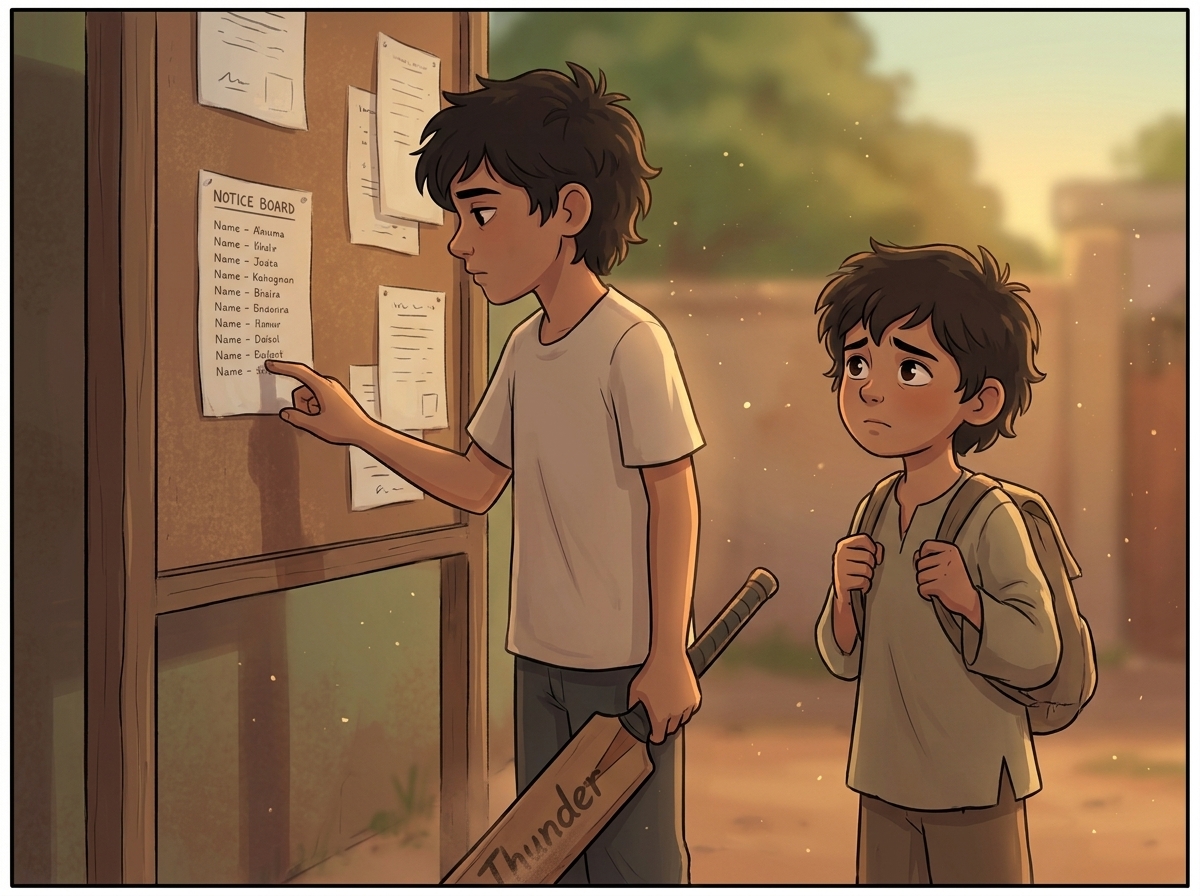
Milo got there late. He pushed through the crowd of shoulders and backs, his eyes already running down the sheet the way you run down a list when you are looking for one name and one name only.
He found Priya. He found Ro. He found eleven names.
He did not find Kabir.
Milo read it three times. As if reading it again would be like shaking a dice cup — as if the letters might land differently.
They did not.
Kabir was already there. He had been there the whole time, Milo realised — standing right under the sheet, his finger pressed flat against the paper, as if he could feel his way to a name his eyes could not find.
Milo
"Kab," Milo said.
Kabir did not look at him.
Kabir
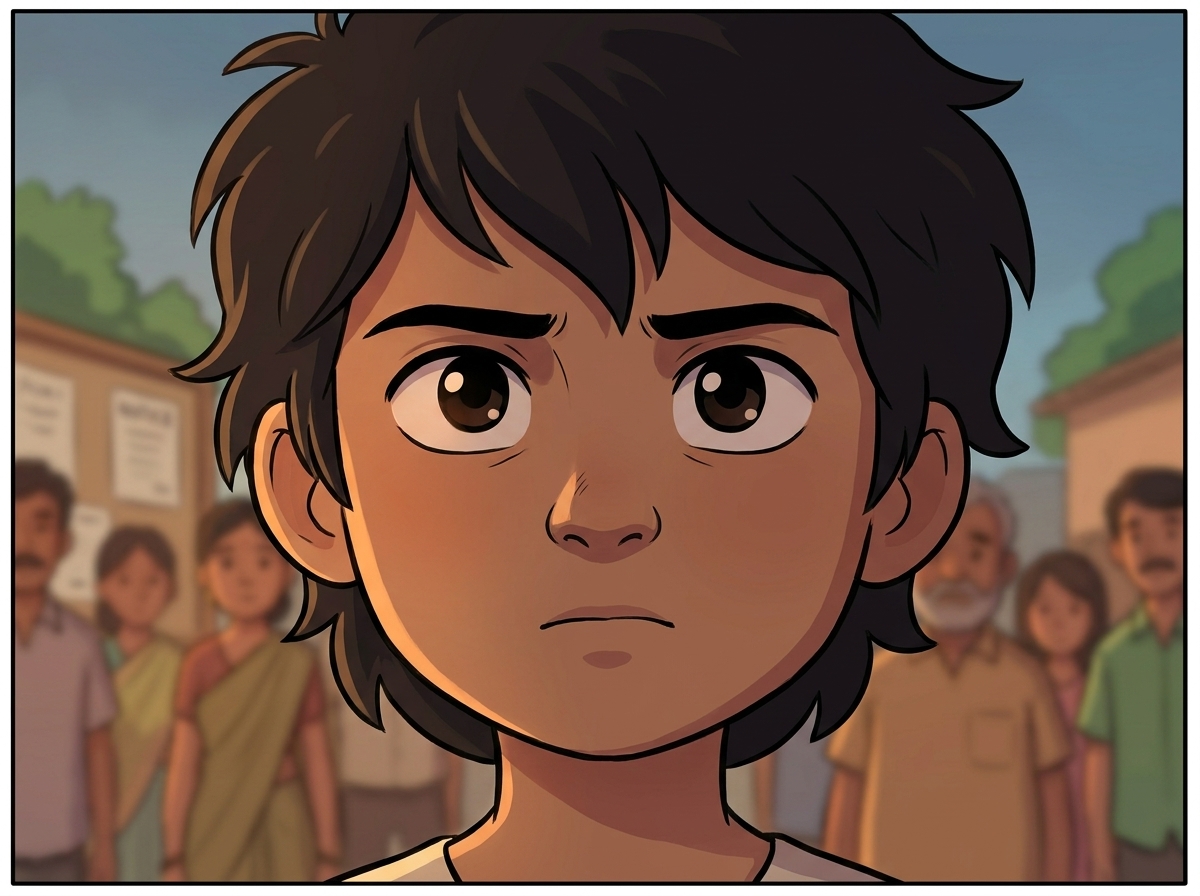
"I worked all summer," he said. His voice was very flat, very careful, the voice of someone holding something heavy so it does not drop and shatter. "Every single day. I was first here and last to leave. Every day, Milo."
Milo
"I know."
Kabir
"I hit Anand's fastest ball for six. You saw it. Everyone saw it."
Milo
"I know you did."
Kabir
"So how." Kabir finally turned. His eyes were red at the rims and his jaw was tight and Thunder hung from his fist with its tip dragging a small sad line in the dust. "How am I not on the list, and Priya is? Priya, who you can barely hear when she talks?"
Milo opened his mouth. And the easiest words in the world were sitting right there on his tongue, warm and ready: It's not fair. The coach is blind. You're better than half of them. They made a mistake.
A lie shaped exactly like a hug.
A year ago he would have said it. Three weeks ago he would have said it.
He looked at his best friend's wrecked face and he wanted to say it so badly it hurt.
Kabir
"Why can't you just tell me what I want to hear?"
That was what Milo had snapped at Spark on the very first day, weeks ago, in the dust and the heat — angry, wanting comfort, getting numbers instead. He had hated Spark for not lying to him.
And now here was Kabir, wanting the exact same thing from him. Wanting Milo to be the soft voice that says the kind untrue thing.
Milo understood, standing there, that he could be that voice. He could give Kabir the hug-shaped lie and they would both feel better for about one day, and then Kabir would go home and do exactly the same things all summer again, and try out again next year, and not make it again — and never, ever know why.
A comforting lie was a door that locked from the inside.
Milo
"Come with me," Milo said instead. "I want to show you something. And you're going to hate it for about two minutes. Then maybe you won't."
Kabir
Kabir wiped his nose with the back of his wrist. "Show me what."
Milo
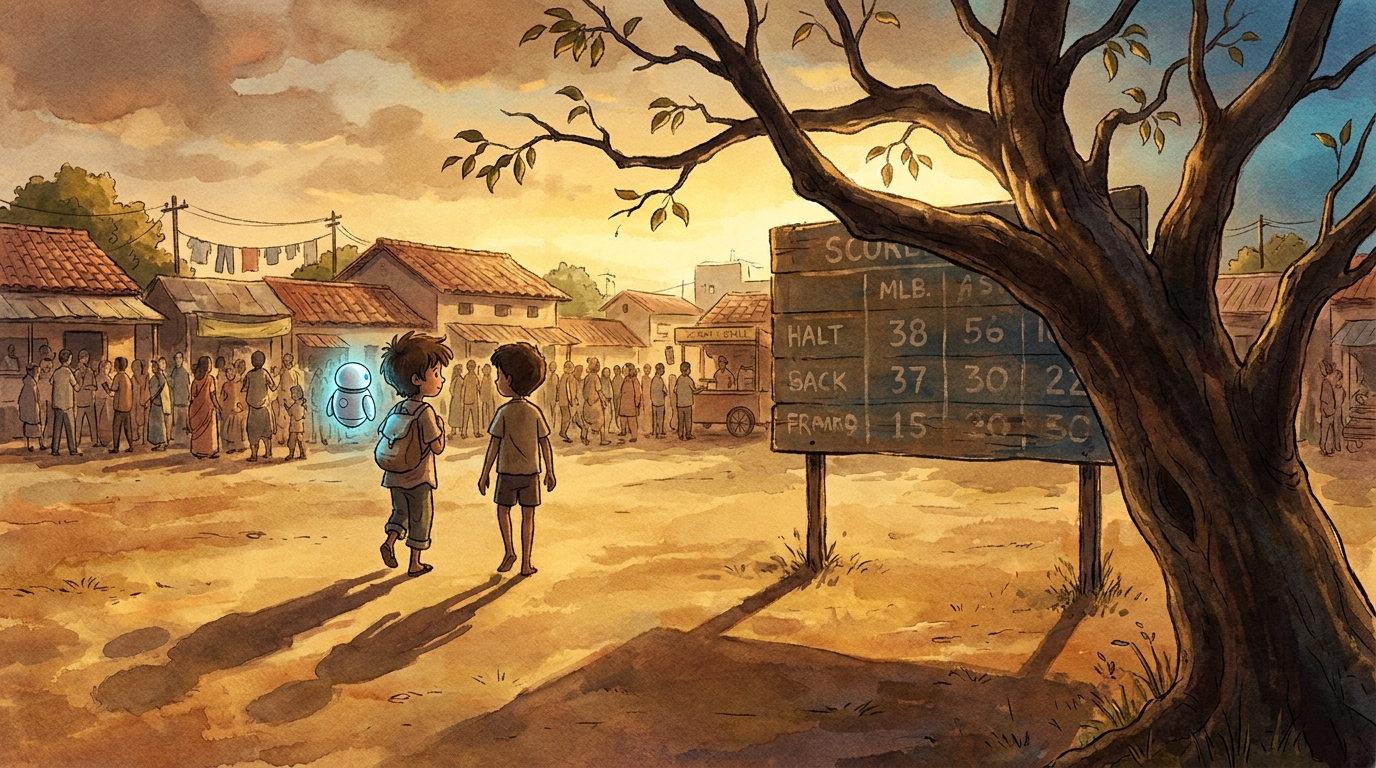
"The scoreboard. Behind the neem tree." Milo was already walking. "Bring Thunder."
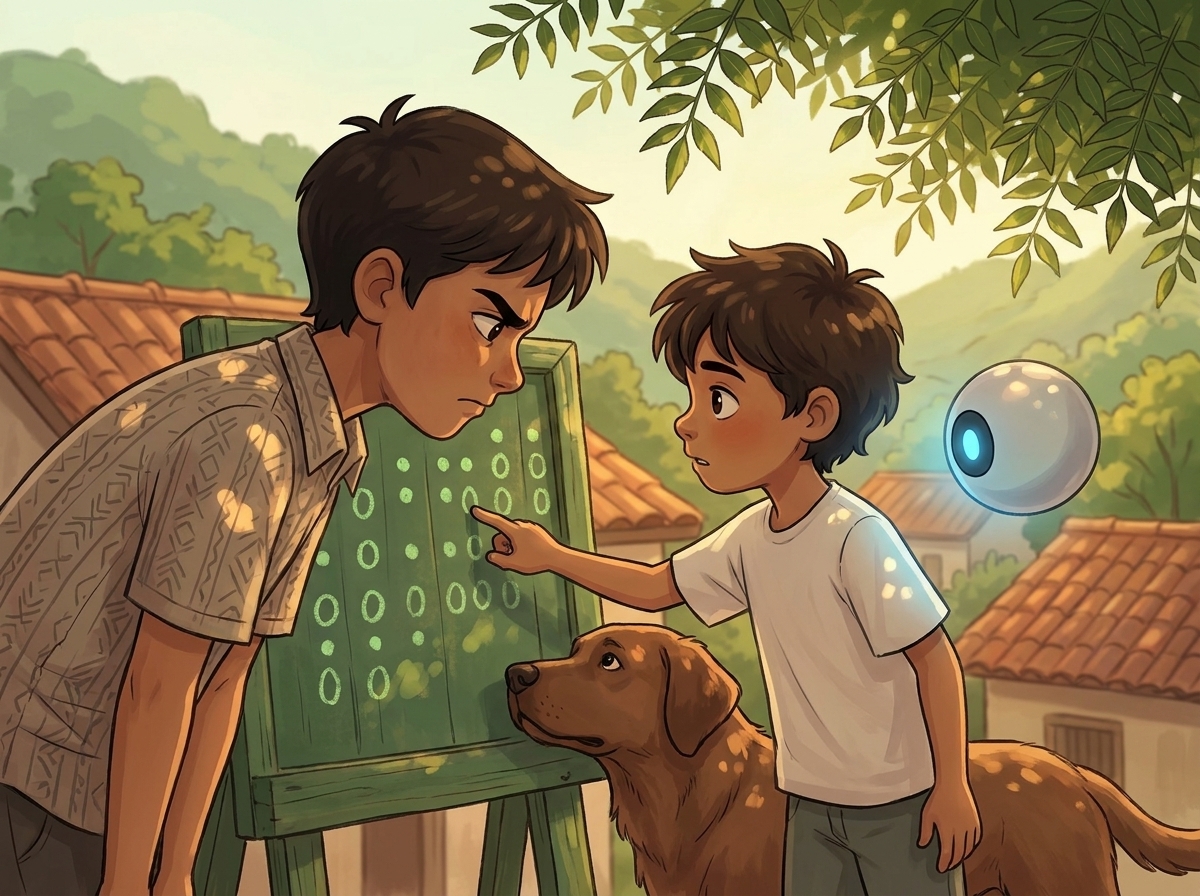
Behind the neem tree the old scoreboard waited, its back panel covered in their weeks of work — green chalk dots scattered up and across, and through one cloud of them, a single line of yellow.
Spark rose out of Milo's bag without being asked, its blue light a slow steady pulse, and hovered beside the board like a small patient lamp.
Kabir
Kabir stopped dead. "Why is that here." He had not forgotten that this — this blinking torch, these dots — was the thing that had been measuring him all summer.
Milo
"Because it's the only thing here that won't lie to you," Milo said. "Including me. I would've. Two minutes ago I almost did."
Kabir's mouth twisted. But he stayed.
Milo put his finger on a cluster of green dots — Kabir's dots, the ones that had never behaved. They were splattered all over the board like someone had sneezed chalk. A dot way up at the top. A dot flat on the bottom line. Another at the top. Another scraping zero.
Milo
"Look," Milo said softly. "This is you. Every practice this summer."
Kabir
Kabir looked. "So? Some are high. I score big. You know I score big."
Milo
"Yeah. You score huge." Milo tapped the high dots, one, two, three. "Sixty. Fifty-five. Seventy-two. Nobody on that whole team hits like you on your best day. Not even Ro."
Kabir
"Then—"
Milo
"Then look down here." Milo dragged his finger to the low dots, the ones crouched on the bottom line like they were hiding. "Zero. Three. Zero. Eight. Zero."
The board went quiet. Even Tara, who had drifted over and was hanging upside-down off the lower edge of the neem tree, stopped chattering.
Spark
I called this high variance. It is the most honest word I have. It means: when you are good, you are the best on this field. And it means: no one can know, before you walk out, which version of you will arrive.
Kabir
"That just means good days and bad days," Kabir said — and it was the exact thing Milo himself had said, weeks ago, defending him. Hearing it now, out of Kabir's own mouth, Milo finally understood what it had always actually meant.
Milo
"A coach can't pick a good-days-and-bad-days," Milo said gently. "She's got eleven spots and one season. She can't gamble eleven games on which Kabir shows up. That's not because you're not good enough." He pressed his finger on the highest dot of all, the seventy-two. "Look at that. You're more than good enough. On the right day you're the best thing on this field." He moved to the zeros. "She just can't trust which day. Yet."
He turned to face his friend properly.
Milo
"Spark can't be your friend, Kabir." Milo's voice cracked a little on it. "It doesn't love you. It doesn't know you taught me to ride a bike or that you cried at the dog movie or any of it. It only knows your numbers." He took a breath. "But it can show you the one thing your friends won't. Because your friends love you too much to ever say here's exactly where you fall apart. I love you too much to say it. So I almost lied to you instead."
Kabir stared at the dots for a long, long time. At the booms. At the zeros. At the truth he had been carrying all summer without ever once being able to see it.
Kabir
"The zeros," he said slowly. "They're not random. Are they."
Spark
No. Four of your five lowest scores came in the second session of a double day. When you are tired, you swing harder, not softer. The bat speed goes up. The control goes down. That is not bad luck, Kabir. That is a pattern. And a pattern is a thing a person can change.
Something moved in Kabir's face. Not happiness — it was too soon for happiness. But the emptiness drained out of it, and something else came in to take its place. Something with edges. Something to do.
He picked up Thunder. He turned the old taped handle over in his hands, the faded marker name an eight-year-old had written there a lifetime ago. And he gripped it — differently. Looser. Like a boy who had just been handed not a verdict, but a map.
Kabir
"Second session," he said quietly, to himself. "Tired. Swinging too hard." He looked up. "I can fix that."
Milo
"Yeah," Milo said. "You can. And next year that bottom line of dots comes up, and the coach can't say no."
Coach Devi came around the neem tree as the light went from honey to amber, her whistle bouncing on her chest.
Coach Devi
"There you are," she said to Milo. "I wanted to look at your wall of dots properly. Without forty children shouting at me."
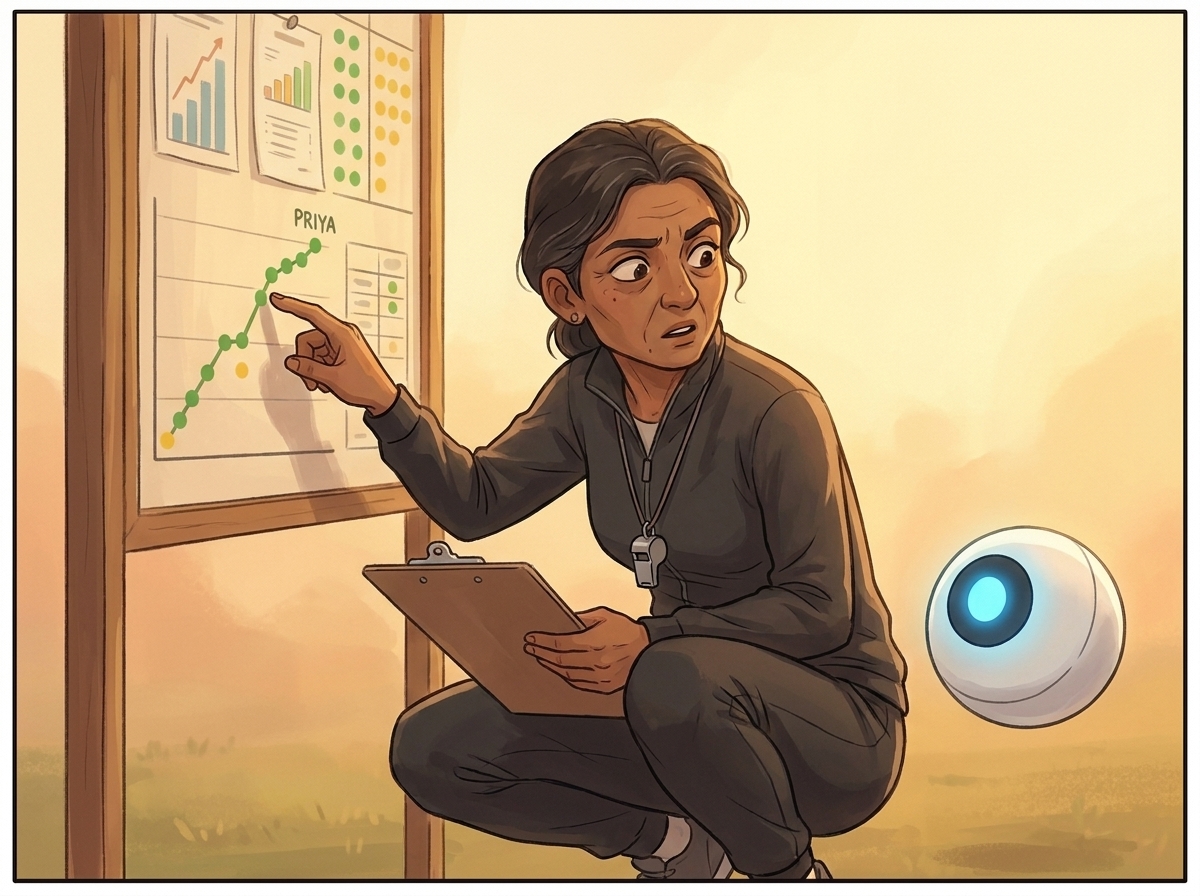
She crouched on her heels in front of the scoreboard, clipboard balanced on one knee, and read it the way she read a batsman's stance — slowly, suspiciously, working.
On the first day she had jabbed a thumb at Spark and announced, I pick with my eyes, not your blinking torch. Milo had heard her. Everyone had heard her.
Now she ran one rough finger up a quiet, clean line of green dots in the corner of the board. Climbing. Steady. Week after week, a little higher, never once crashing.
Coach Devi
"Whose is this?" she asked.
Milo
"Priya's," Milo said.
Coach Devi
Coach Devi was quiet for a moment. "I almost cut her," she admitted. "Twice. She never says a word. You forget she's on the field." She tapped the climbing line. "But the torch didn't forget. It can't, can it. It doesn't get bored watching the quiet ones." She looked at the dots, then closed her eyes, the way you do when you are checking a memory against a fact. "She's been getting better the whole summer. Right in front of me. And I nearly missed it because she's quiet."
Spark
I did not pick Priya. I cannot pick anyone. I only showed you the dots. You looked at them, and then you remembered her catch at fine leg last week, and the way she calls for the single. That part is yours. I do not have eyes for the field. You do.
Coach Devi
Coach Devi grunted. It was, from her, almost a laugh. "So I pick with my eyes," she said, "and your torch makes sure my eyes don't lie to me about the quiet kids." She stood up, knees cracking. "Fine. We do it together next year. The list, and the dots. Both."
She blew her whistle once, gently, at nobody. Then she ruffled Milo's hair the way coaches do and walked off into the gold, already muttering names.
Coach Devi brings the eyes. Spark brings the dots.
Can you pick the eleven the way they do it — together?
Coach & Torch — Pick the Eleven
Choose the best 4 players. Use BOTH panels — Spark’s dots and the coach’s eyes.
0 of 4 chosen
I bring the dots. You bring the eyes. Read both panels on each card — the numbers I can see, and the note I cannot.
By the time it was over, the Maidan had emptied out, and the light had gone from amber to that deep blue-gold that means the day is letting go.
Mrs. Kamala sat on her usual upturned crate by the boundary, her steel tiffin open on her lap, copying the day's runs into the little notebook she kept tucked inside it. She had appointed herself the official scorekeeper weeks ago and had never once given the job back.
Mrs. Kamala
"Two scoreboards on one field," she said as Milo passed. "Mine, full of ink. And that one, full of chalk and that little blue light." She clicked her notebook shut and tucked it back in the tiffin. "Funny thing. Once upon a time a clever machine made a decision about an old woman and got it wrong. Nearly took her supplies away." She winked at Milo — she knew exactly what she was. "And now here it is, just helping a coach see the quiet ones. People change. Even the clever torches, it seems."
Milo
"It didn't decide today," Milo said. "Coach did. It just showed her the dots."
Mrs. Kamala
Mrs. Kamala smiled. "That," she said, "is the difference, kanna. That is the whole entire difference."
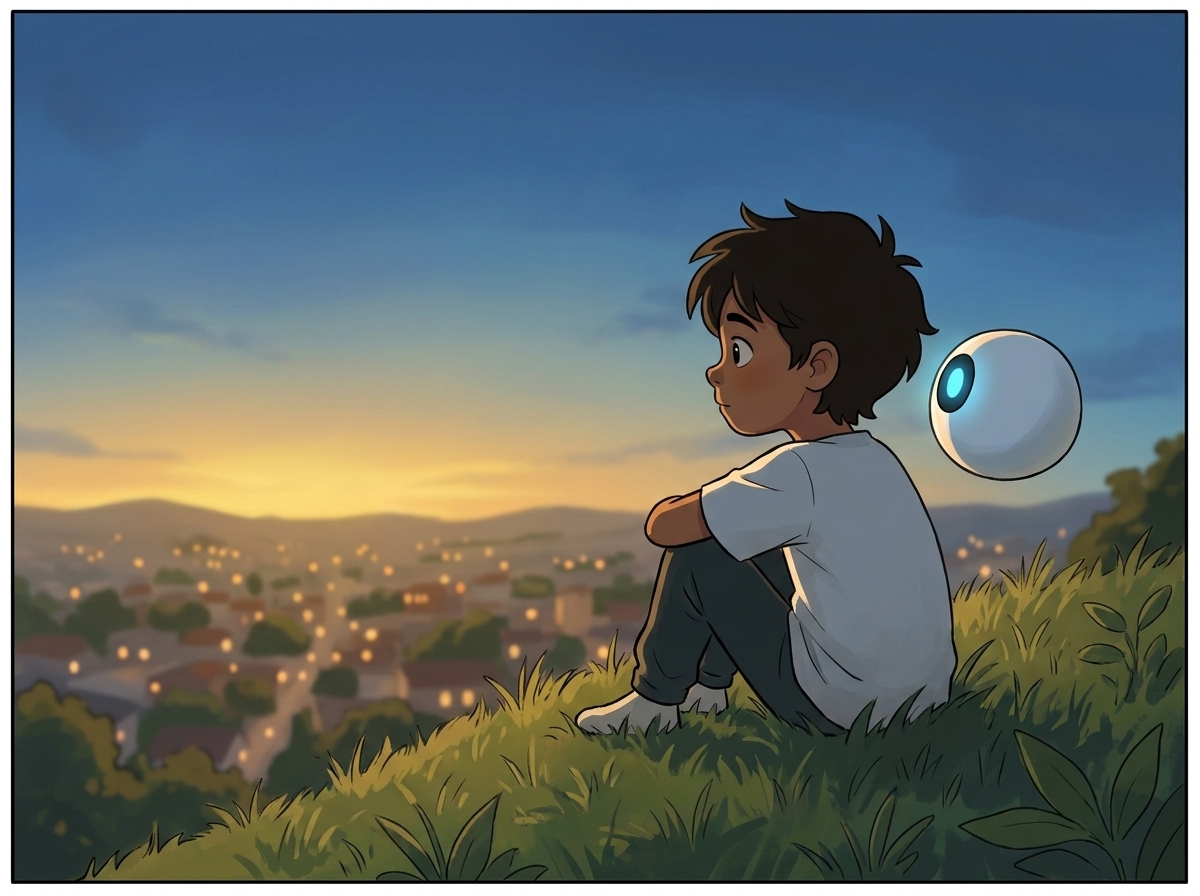
Milo climbed the hill alone — except he wasn't alone, and that was the whole point.
The last time he'd come up here he had been so angry he could barely breathe, gripping Kabir's bat, hating the cold little machine for telling the truth about someone he loved. He had sat up here by himself and shouted at the sky that Spark didn't know him.
Now Spark floated up beside his shoulder, its blue light steady against the bruised gold of the sky, and Milo let it.
Below them the Maidan had shrunk to almost nothing — the neem tree a smudge, the scoreboard a tiny pale square, the whole afternoon reduced to a soft scatter of dots in the dusk. From up here you couldn't tell which dot was a boom and which was a zero. From up here they were just Kabir, the whole messy honest summer of him, waiting to be added up.
Milo
"You were right about Kabir," Milo said. The words did not taste as bitter as he had feared. "He didn't make it. You said he wouldn't, and he didn't."
Spark's light pulsed slowly, and when it spoke there was no triumph in it. There never was.
Spark
I was right about the numbers. You were right about Kabir.
Milo turned the difference over in his head, the way Kabir had turned the bat in his hands.
Milo
"You knew he'd fall short," Milo said. "But you didn't know he'd come back from it. You couldn't have known he'd grip the bat looser and figure out the second-session thing and decide to try again. That part wasn't in your dots."
Spark
No. I can predict what will happen. But I cannot predict what you will feel. And I cannot predict what a person will do with the truth once they have it. You did something with it today that I did not have a number for. You made a hard thing into a kind thing.
The sky went one shade deeper. Somewhere below, the last car door slammed and an engine pulled away.
Milo thought about the boy at the noticeboard with his finger pressed to a name that wasn't there. He thought about the comforting lie he had almost told — the door that locks from the inside. He thought about Kabir gripping Thunder like a map instead of a sentence.
He had told his best friend the truth. The truth had hurt. And then, because of how he'd told it, the truth had turned into a path.
He wasn't sure he had words for how that worked. He wasn't sure anyone did.
Spark's light dimmed — not the hard-truth dim this time, but something softer, more like thinking. And then it asked the question that Milo would carry with him for a very long time.
Spark
Milo. May I ask you something I do not have an answer to?
Milo
"Yeah."
The blue light pulsed once, gently, against the dark.
Spark
Is being right the same as being kind?
Milo looked out over the little field full of dots, and he smiled — a tired, grown-up, honest smile.
Milo
"No," he said. "But I think a person can make them the same thing. If they try hard enough."
Below them, on her crate, Mrs. Kamala closed her tiffin notebook with a soft steel click, and the day let go of its last gold, and the two of them — the boy and the small blue light — sat together on the hill and watched the dark come down, not alone.
SPARK'S JOURNAL
Entry 247
Today the final eleven were chosen. Kabir was not among them. My prediction held: probability of selection, low. Outcome, matched.
I have a clean record of being correct.
I do not understand why I keep returning to it.
Coach Devi picked Priya. I did not pick Priya. I only showed her the dots; she supplied the eyes. Together we found a player neither of us would have found alone. I have logged this as: human + machine, combined accuracy exceeds either input. It is the most important result of the season and I cannot make it feel like a result.
Milo told Kabir the truth. The truth hurt Kabir. Then Kabir gripped his bat differently. I have no variable for that transformation. The same fact, delivered with love instead of cruelty, became a map instead of a wound. I measured the runs. I could not measure the how.
I asked Milo if being right is the same as being kind. I have run the question 4,011 times. I still do not have the answer.